.svg)


.svg)
Escheatment represents one of the most overlooked compliance obligations facing corporate issuers today. This legally mandated process forces companies to identify, report, and transfer unclaimed property including uncashed settlement checks, dormant accounts, and abandoned digital assets to state governments after specified dormancy periods. For organizations managing legal settlements, bankruptcy distributions, or shareholder payouts, escheatment creates a costly operational burden where a significant portion of paper checks go unclaimed, requiring costly tracking before funds ultimately transfer to state custody. Modern digital disbursement platforms can compress distribution timelines from weeks to 24-48 hours while achieving 95-98% redemption rates, transforming escheatment from an inevitable compliance drain into a preventable inefficiency.
Key Takeaways
- States currently hold over $50 billion in unclaimed property according to the National Association of Unclaimed Property Administrators (NAUPA), with only a fraction returned to owners annually
- Each of the 54 U.S. reporting jurisdictions maintains distinct escheatment laws with dormancy periods ranging from 1-15 years depending on property type
- Paper checks remain the primary driver of escheatment volume despite digital alternatives that achieve significantly higher redemption rates
- Standard audit lookback periods extend 15 years, with states extrapolating liability for missing records
- Delaware collects $607 million annually from escheatment, making aggressive enforcement a significant revenue driver
- A large share of escheated property remains unclaimed for long periods, highlighting the importance of prevention strategies
Understanding Escheatment: The Basics for Businesses
Escheatment is the legal process through which unclaimed or abandoned property transfers from private holders to state governments after specified dormancy periods. The term derives from feudal law, where property reverted to the crown when owners died without heirs. Today, escheatment serves a consumer protection function ensuring owners can eventually recover their property through centralized state databases rather than losing it entirely to private entities.
For corporate issuers, escheatment applies to virtually any financial obligation that remains uncollected:
- Uncashed checks including settlement distributions, vendor payments, and dividend checks
- Dormant bank accounts with no customer-initiated activity
- Unclaimed wages and payroll payments
- Outstanding credits on customer accounts
- Unredeemed gift cards (in states without exemptions)
- Abandoned securities and shareholder dividends
- Digital assets including cryptocurrency and virtual currency
The escheatment process follows a predictable sequence. First, property becomes "dormant" after a period of owner inactivity typically 1-5 years depending on property type and state jurisdiction. Next, the holder must conduct due diligence, attempting to locate the owner through written notices 60-180 days before the reporting deadline. If these efforts fail, the holder files a report with the appropriate state and remits the property. The state then holds the property in perpetuity, allowing rightful owners to claim it at any time.
Understanding which state receives escheated property follows clear priority rules. Property first escheats to the state of the owner's last known address. If no address exists or the address state doesn't claim the property type, it escheats to the holder's state of incorporation. This creates particular significance for Delaware-incorporated companies, which receive substantial escheatment revenue from unknown-owner property.
The Corporate Issuer's Challenge: Why Unclaimed Property Matters
Unclaimed property creates cascading operational, financial, and reputational risks that extend far beyond simple compliance obligations. Corporate issuers managing high-volume payouts face particular exposure because each unredeemed payment represents both an escheatment liability and a failed recipient interaction.
Financial Exposure
The direct costs of escheatment accumulate quickly across multiple categories:
- Check issuance costs: Commercial checks can cost significantly when accounting for printing, postage, reconciliation, and potential reissuance
- Tracking uncashed checks: Organizations spend considerable resources attempting to locate recipients and prevent escheatment
- State remittance processing: Filing reports, responding to state inquiries, and transferring funds consume administrative resources
- Audit defense costs: When states initiate examinations, legal and accounting fees can reach six figures even for routine audits
The 2024 Synapse bankruptcy exposed how poor recordkeeping in fintech-bank partnerships can create $65-96 million shortfalls in customer funds, with the trustee reporting that reconciling ledgers proved "an extremely difficult task." This single case demonstrates how poor payment recordkeeping and reconciliation failures can dwarf typical compliance penalties.
Compliance Complexity
Managing claimant abandonment across multiple jurisdictions multiplies operational requirements exponentially. A company distributing settlement funds to recipients in all 50 states must simultaneously comply with 54 distinct regulatory frameworks each with different dormancy periods, reporting deadlines, due diligence requirements, and remittance formats.
The compliance burden intensifies for organizations in shareholder services, bankruptcy administration, and class action settlements where court oversight adds another layer of accountability. Courts expect full documentation of fund disposition, making unexplained escheatment a potential fiduciary concern.
Reputational Risk
Settlement recipients, shareholders, and beneficiaries expect to receive funds owed to them. When payments go unclaimed and eventually escheat to states, organizations face questions about their distribution processes and recipient communication efforts. For plaintiff-side law firms, low redemption rates can affect future case negotiations and client relationships.
Escheatment Laws by State: A Complex Payout Landscape
The absence of uniform federal standards means corporate issuers must navigate a patchwork of state-specific regulations that vary dramatically across jurisdictions. Understanding these variations is essential for multi-state compliance.
Dormancy Period Variations
Dormancy periods the time property must remain unclaimed before becoming escheatable range significantly by state and property type:
- Payroll and wages: Typically 1 year across most states
- General business-to-business payments: Usually 3 years
- Securities and dividends: Often 3-5 years
- Safe deposit box contents: Can extend to 5-15 years
- Traveler's checks and money orders: Varies from 3-15 years
States have trended toward shortening dormancy periods to accelerate revenue collection. This creates urgency for corporate issuers who may have less time to locate owners before escheatment obligations trigger.
Key State Considerations
Delaware maintains the most aggressive escheatment enforcement, reflecting its status as the incorporation state for most large U.S. corporations. Delaware can impose interest and penalties that vary by violation, including interest capped at 50%, failure-to-file penalties that can reach 50%, failure-to-pay penalties capped at 25%, and a 75% fraud penalty. The state's 2022 Senate Bill 281 granted authority to issue compliance reviews for any reason and trigger audits if holders don't respond within 30 days.
New York safeguards more than $19 billion in unclaimed funds with separate deadlines for different holder types. Properties exceeding $1,000 require certified mail follow-up during due diligence.
California charges 12% annual interest on late property and has pursued aggressive enforcement including settlements in 2024 with healthcare and gift card companies.
Emerging Digital Asset Requirements
States are rapidly enacting legislation to classify virtual currency as reportable unclaimed property:
- Delaware (2021): Virtual currency defined as property with 5-year dormancy
- Illinois (2024): Framework nearly identical to Delaware
- Florida (2024): HB 989 updated definitions with 30-day liquidation window
- New York (2022): 5-year dormancy with first report due November 10, 2028
- California (2025): SB 822 includes "digital financial assets" with 3-year dormancy
- Arizona (2025): HB 2749 created Bitcoin and Digital Assets Reserve Fund
Some states require liquidation before remittance, while others are moving toward native-form custody for digital assets, creating state-specific operational and valuation risks for holders.
Proactive Steps to Minimize Unclaimed Funds and Escheatment Risk
Prevention strategies offer far better ROI than reactive escheatment compliance. Organizations that proactively reduce unclaimed property volumes avoid both remittance costs and the administrative burden of state reporting.
Accurate Record Keeping
Maintaining current owner contact information forms the foundation of escheatment prevention:
- Address verification at payment initiation: Validate recipient addresses before issuing payments using NCOA (National Change of Address) databases
- Regular database hygiene: Implement periodic verification campaigns to update stale contact records
- Multiple contact channels: Collect email addresses, phone numbers, and alternative physical addresses when possible
- Documentation retention: Maintain records of all owner contact attempts for audit defense purposes
The standard audit lookback period of 15 years means organizations must retain escheatment-related records far longer than typical business documents. Gaps in documentation allow states to extrapolate liability based on statistical assumptions often unfavorably for the holder.
Due Diligence Best Practices
State laws require written notice to owners before property escheats, typically 60-180 days before the reporting deadline. Effective due diligence programs include:
- First-class mail notifications clearly explaining the escheatment timeline and action required
- Follow-up communications via alternative channels (email, phone) where permitted by state law
- Clear instructions for claiming property or updating contact information
- Response tracking systems documenting all owner interactions
Some states now permit electronic due diligence notifications, reducing costs while potentially improving response rates. However, requirements vary by jurisdiction; organizations must verify state-specific rules before abandoning physical mail.
Payment Method Optimization
The choice of payment method directly impacts escheatment rates. Paper checks generate the highest abandonment volumes due to delivery failures, recipient inaction, and lost mail. Organizations can reduce escheatment risk by offering multi-channel payment options:
- ACH direct deposit: Funds arrive directly in recipient accounts with minimal failure rates
- Digital wallets: PayPal, Venmo integration reaches recipients on familiar platforms
- Prepaid cards: Virtual cards delivered via SMS/email in seconds, physical cards within 5-7 days
- Gift cards: High redemption rates for smaller-value distributions
Each alternative payment channel reduces the pool of unclaimed property requiring escheatment compliance while improving recipient experience.
How Digital Disbursement Solutions Combat Escheatment
Modern digital disbursement platforms directly address the root causes of escheatment by increasing redemption rates, accelerating payment delivery, and automating compliance workflows.
Redemption Rate Improvements
The fundamental escheatment problem is unredeemed payments. Traditional paper check distributions achieve around 70-80% redemption rates, meaning approximately 20-30% of payments eventually become escheatable. Digital disbursement solutions achieve 95-98% redemption through:
- Payment choice: Recipients select their preferred payment method, increasing engagement
- Instant delivery: Digital payments arrive in hours rather than weeks
- Mobile accessibility: Recipients claim funds from smartphones without visiting banks
- Smart reminders: Automated notifications prompt action before dormancy periods begin
- Reduced delivery failures: Digital channels eliminate lost mail and incorrect addresses
For settlement administrators managing distributions to thousands of claimants, even a 10-percentage-point improvement in redemption rates can prevent millions in potential escheatment liability.
Processing Time Compression
Paper check distributions typically require 6-8 weeks from authorization to recipient delivery, accounting for printing, mailing, postal delivery, and bank clearing. Digital disbursements compress this timeline to 24-48 hours, providing:
- Reduced dormancy window: Faster delivery means more time for recipients to act before escheatment periods begin
- Earlier abandonment identification: Digital tracking reveals non-engagement quickly, allowing intervention
- Improved cash flow visibility: Real-time status updates enable proactive escheatment risk management
Cost Reduction
Digital payment costs average significantly less per transaction compared to paper checks, representing substantial cost reduction before considering escheatment-related savings. Organizations eliminate:
- Check printing and postage expenses
- Manual reconciliation labor
- Reissuance costs for returned or expired checks
- Escheatment tracking and reporting overhead
Audit Trail Documentation
Digital disbursement platforms automatically generate the comprehensive audit trails required for escheatment compliance and state examinations:
- Complete transaction histories with timestamps
- Recipient communication logs
- Payment attempt records and failure reasons
- Due diligence documentation
- Fund flow tracking through settlement to recipient
This documentation proves invaluable during state audits, where demonstrating good-faith compliance efforts can reduce penalties and examination scope.
The Costs of Non-Compliance: Escheatment Penalties for Corporations
State enforcement has intensified dramatically as escheatment revenue has become a significant budget component. Corporate issuers face escalating consequences for compliance failures.
Financial Penalties
Penalty structures vary by state but can devastate unprepared organizations. Delaware can impose interest and penalties that vary by violation, including interest capped at 50%, failure-to-file penalties that can reach 50%, failure-to-pay penalties capped at 25%, and a 75% fraud penalty. California charges 12% annual interest on late property plus additional penalties. Most states charge interest of 1-1.5% per month on unreported property, with late filing penalties often ranging $100-$200 per day plus percentage penalties.
These penalties compound quickly. A company with $1 million in unreported property could face substantial fines and interest charges.
Audit Exposure
State audits represent the most significant compliance risk. Key concerns include:
- 15-year lookback periods: States can examine records spanning over a decade
- Extrapolation for missing records: Without documentation, states estimate liability based on industry averages or statistical models often unfavorably
- Multi-state coordination: Delaware's audit program often triggers examinations in other states
- Third-party auditors: Many states use contingency-fee auditors whose compensation depends on findings
Audit defense costs regularly exceed $100,000-$500,000 for mid-size companies, with examinations sometimes extending 2-3 years.
False Claims Act Liability
Whistleblowers can trigger qui tam actions for unreported property under state False Claims Acts, potentially recovering a percentage of amounts recovered. Recent enforcement demonstrates aggressive pursuit with multi-million dollar settlements in California and New York during 2024.
Delaware amended its statute in 2022 to limit direct whistleblower suits, but other states maintain robust qui tam provisions.
Leveraging Technology for Escheatment Compliance and Efficiency
Manual escheatment processes create unacceptable risk at scale. Organizations managing thousands of payments annually require automated systems that embed compliance into operational workflows.
Automation Capabilities
Modern platforms provide end-to-end escheatment management that reduces manual intervention significantly:
- Automatic dormancy tracking: Systems monitor inactivity periods across all outstanding payments
- State rule engines: Databases containing jurisdiction-specific requirements updated as laws change
- Due diligence generation: Automated letter production and mailing with response tracking
- Electronic filing: Direct submission to state portals in required NAUPA formats
- Reconciliation: Three-way matching of payments, due diligence, and remittance records
Real-Time Monitoring and Reporting
Dashboards providing live visibility into escheatment risk enable proactive management:
- At-risk payment identification: Flag outstanding payments approaching dormancy periods
- Jurisdiction exposure tracking: Monitor liability accumulation by state
- Due diligence status: Track notification delivery and response rates
- Deadline calendars: Automated alerts for approaching filing deadlines
These capabilities allow organizations to intervene before property becomes escheatable rather than simply reporting after the fact.
Tax Compliance Integration
Escheatment obligations often intersect with tax compliance requirements. Organizations must coordinate:
- 1099 reporting: Escheated payments may still require information returns
- W-9 collection: Documentation requirements before payment
- Backup withholding: 24% withholding for missing TIN numbers per IRS requirements
- State tax reporting: Some states coordinate unclaimed property and tax filings
Integrated platforms that handle both payment delivery and tax compliance reduce the risk of coordination failures.
Why Talli Solves Escheatment Challenges
For corporate issuers managing legal settlements, bankruptcy distributions, or shareholder payouts, Talli delivers the infrastructure needed to prevent funds from becoming unclaimed property in the first place.
Talli's digital disbursement platform achieves 95-98% redemption rates compared to approximately 70-80% for traditional paper methods directly addressing the abandonment rate that drives escheatment volume. The platform transforms week-long distribution processes into 24-48 hour payment cycles, compressing the window where funds sit unclaimed.
Key capabilities that reduce escheatment exposure include:
- Six payment method options: ACH direct deposit, prepaid Mastercard, digital wallets (PayPal, Venmo), gift cards, wire transfers, and paper checks as fallback letting recipients choose their preferred channel
- Integrated compliance automation: Built-in KYC verification, OFAC sanctions screening, automated W-9 collection with 90% completion rates, and 1099 generation eliminate manual compliance tracking
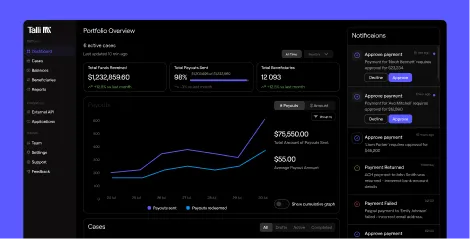
- Real-time tracking dashboards: Live visibility into payment status, completion rates, and failure root causes enables intervention before dormancy periods begin
- Court-ready audit trails: Comprehensive documentation of all payment attempts, recipient communications, and fund flows satisfies both state escheatment requirements and court reporting obligations
The platform demonstrates these capabilities at scale: significant increases in claimant redemption rates, substantial reductions in unresolved exceptions and manual reissuance overhead, and consistent fiduciary compliance maintained across all distributions.
For organizations seeking to minimize escheatment risk while improving recipient satisfaction, Talli provides the digital disbursement infrastructure purpose-built for legal settlement compliance.
Frequently Asked Questions
What is the primary purpose of escheatment laws?
Escheatment laws serve a consumer protection function by ensuring owners can eventually recover their property through centralized state databases. When property holders lose contact with owners, escheatment prevents them from retaining abandoned property indefinitely. States hold the property in perpetuity, allowing rightful owners to claim it at any time without statute of limitations concerns.
How does the dormancy period impact when property escheats?
The dormancy period defines how long property must remain unclaimed before becoming reportable to states. Periods vary by property type and jurisdiction; payroll typically becomes escheatable after 1 year, general business payments after 3 years, and securities after 3-5 years. Once the dormancy period expires, holders must conduct due diligence before filing reports with the appropriate state.
Can a company reclaim property after it has escheated to the state?
Yes, but the process shifts from holder to owner responsibility. Once property escheats, the original holder no longer has any claim to it. The rightful owner must file a claim directly with the state unclaimed property division, providing identification and proof of ownership. However, many remitted assets remain unclaimed for long periods, which is why corporate issuers should focus on preventing escheatment rather than relying on owners to recover funds later.
What types of property are most commonly subject to escheatment for corporations?
Uncashed checks represent the largest category of corporate escheatment, including settlement distributions, vendor payments, dividend checks, and refund checks. Paper checks remain widely used despite digital alternatives, making checks the primary driver of unclaimed property volume. Other common categories include dormant customer credit balances, unredeemed gift cards, outstanding accounts payable, wages for former employees, and increasingly, cryptocurrency and digital assets.
Why are digital payment methods more effective at preventing escheatment than paper checks?
Digital payments achieve 95-98% redemption rates compared to approximately 70-80% for paper checks because they eliminate multiple failure points. Checks fail due to incorrect addresses, mail delivery problems, recipient relocation, lost mail, and recipient inaction. Digital payments arrive instantly to verified accounts, include automated reminder notifications, allow recipients to choose their preferred payment channel, and provide real-time delivery confirmation. The compressed delivery timeline also gives recipients more time to claim funds before dormancy periods begin.