Settlement plans face a critical timeline challenge. With 60 days to distribute funds to 500,000 claimants across multiple jurisdictions, every payment must clear OFAC sanctions screening before disbursement. Based on an average of 10 minutes per claimant at $80/hour labor costs, manual verification could take over 18 months and cost $7 million in labor alone. Modern OFAC screening solutions compress that timeline to 8 weeks while maintaining full regulatory compliance.
Key Takeaways
- Automated KYC/OFAC screening processes 500,000 claimants in 8 weeks versus 18 months with manual verification
- AI-powered screening significantly reduces false positive rates, cutting analyst workload substantially
- Single OFAC violation fines can exceed $1.4 million, often more than entire compliance program costs
- Modern identity verification achieves rapid verification speeds of 6-8 seconds
- Immutable audit trails with 5-year retention satisfy OFAC documentation requirements and court-ready reporting
- Risk-based tiering enables 90% auto-approval for legitimate claimants while focusing manual review on actual risks
- Total automated cost of $409K-$877K versus $7M+ manual delivers 800-1,600% ROI
The Challenge of KYC Verification in High-Volume Legal Settlements
Traditional KYC processes were designed for ongoing customer relationships, verifying one individual at a time during account opening. Settlement distribution creates a fundamentally different challenge: the "thundering herd" problem where hundreds of thousands of verifications must occur within a compressed court-mandated timeframe.
Why Traditional KYC Fails at Scale
Manual verification averages 10 minutes per claimant when accounting for data entry, document review, and sanctions screening. For a 500,000 claimant settlement, that translates to:
- 83,333 hours of verification labor
- 48 full-time employees working for 18 months
- $6.67 million in labor costs alone at $80/hour
- 2-5% error rates creating 10,000-25,000 compliance issues requiring rework
Settlement administrators face additional complexity that generic KYC providers don't address. Unlike bank customers who maintain ongoing relationships, most claimants are "verify once, pay, done," requiring upfront verification without the benefit of behavioral monitoring or relationship history.
The Impact of Slow Verification on Beneficiaries
Delayed distributions directly harm claimants who are entitled to settlement funds. When class action settlements drag for months due to verification bottlenecks:
- Claimants lose trust in the settlement process
- Time value of money erodes recovery amounts
- Administrative costs consume funds meant for beneficiaries
- Courts face criticism for slow justice delivery
The regulatory environment adds pressure. OFAC requires documented sanctions screening with complete audit trails, and the strict liability standard means good faith isn't a defense. Every payment must be screened regardless of the compliance burden.
Automated KYC: Streamlining Identity Verification Online for Mass Payouts
Modern KYC platforms transform claimant verification from a bottleneck into an enabler of faster distributions. API-driven verification and automated sanctions screening help settlement administrators process large claimant populations efficiently while reducing manual verification workloads.
How Digital Identity Checks Accelerate Processes
Automated KYC platforms integrate multiple verification steps into unified workflows:
- Document Capture: Mobile SDKs enable claimants to photograph government IDs directly from smartphones, with OCR extracting name, date of birth, and address
- Biometric Matching: Face comparison and liveness detection confirm the person submitting documents matches the ID photo, improving fraud detection versus manual review
- Database Verification: Automated cross-referencing against identity databases validates provided information without administrator configuration
- Risk Scoring: AI models assess verification confidence, routing low-risk cases for instant approval and flagging high-risk cases for human review
Achieving High Completion Rates with Smart Reminders
Claimant onboarding often stalls when paper forms go unreturned or emails get ignored. Talli's compliance automation achieves 90% W-9 completion rates through digital forms with DocuSign integration and intelligent reminder sequences, compared to just 40% without automation.
The claimant experience drives completion rates. Modern platforms achieve strong first-attempt success through:
- Camera guidance that ensures proper document positioning
- Real-time feedback on image quality
- Mobile-optimized flows matching consumer expectations
- Support for 5,000+ ID document types globally
Navigating OFAC Sanctions Screening and AML Compliance for Global Reach
OFAC compliance isn't optional. It's a strict liability standard where single violations trigger fines exceeding $1.4 million. OFAC enforcement actions in early 2024 resulted in penalties of $48.8 million, demonstrating regulators' continued enforcement focus.
The Importance of Real-Time OFAC Checks
Every settlement payment must be screened against the Specially Designated Nationals (SDN) list, non-SDN lists, and additional sanctions programs before disbursement. Talli's Compliance Automation Suite includes automated OFAC screening against U.S. Treasury sanctions lists with documented timestamps, creating the audit trail regulators expect.
Effective sanctions screening requires more than simple name matching. Advanced platforms employ:
- Fuzzy Matching Algorithms: Catch aliases, misspellings, and transliterations that exact matching would miss
- Match Threshold Tuning: Adjustable sensitivity balances thoroughness against false positive volume
- Beneficial Ownership Screening: The OFAC 50% rule means entities 50%+ owned by sanctioned parties are themselves sanctioned, even if not listed by name
- Daily List Updates: Sanctions lists change frequently; stale data creates compliance gaps
Mitigating AML Risks in International Disbursements
Mass tort settlements increasingly include international claimants, requiring screening beyond U.S. sanctions to cover EU, UK, and UN watchlists. Cross-border compliance adds complexity through varying KYC requirements across jurisdictions, data residency rules, and currency regulations.
Global settlement distributions benefit from platforms supporting:
- 190+ countries with multi-currency capabilities
- GDPR-compliant data handling for European claimants
- Multi-language support for claimant communications
- PEP (Politically Exposed Persons) screening for enhanced due diligence
Ensuring Robust AML & KYC Compliance While Maintaining Distribution Speed
The fundamental tension in settlement compliance is speed versus security. Courts want rapid fund distribution to beneficiaries; regulators demand thorough verification. Resolving this tension requires risk-based approaches that apply appropriate scrutiny based on actual risk levels.
Balancing Speed and Security in Compliance
Not all claimants present equal risk. Effective compliance programs implement tiered verification:
- Low-Risk (70% of volume): U.S. individuals, small payments (<$1K), no adverse indicators for auto-approval with basic OFAC screening
- Medium-Risk (25% of volume): International claimants, moderate payments ($1K-$10K) requiring document verification with full KYC plus OFAC
- High-Risk (5% of volume): PEP matches, sanctioned jurisdiction connections, large payments (>$10K) needing enhanced due diligence with manual review
This approach processes the majority of claimants with minimal friction while focusing expensive human review on cases that actually warrant scrutiny.
The Role of AI in Enhancing AML/KYC Efficiency
AI-powered fraud detection complements AML/KYC by identifying suspicious patterns that rules-based systems miss. Talli's platform uses pattern recognition across device fingerprinting, behavioral analytics, and identity verification to achieve 40%+ reduction in fraudulent claims while identifying fraud 50% faster than manual review.
Machine learning models trained on settlement-specific data dramatically reduce false positives. Industry-standard rules-based screening generates high false positive rates, meaning most alerts are legitimate claimants incorrectly flagged. AI-powered platforms substantially reduce false positive rates, eliminating wasted analyst effort.
Beyond Checks: Diversifying Payment Methods with Integrated Verification
Paper check distribution compounds compliance challenges. Checks create 20-30% unclaimed rates, require $7-20 processing costs each, and generate reissuance overhead when addresses change or checks go stale. Digital payment methods with integrated verification solve multiple problems simultaneously.
Offering Secure, Verified Alternatives to Traditional Checks
Talli's Multi-Channel Payment Distribution maintains identity verification across all payment methods:
- ACH Direct Deposit: $0.25-$0.50 per transaction with 1-2 day delivery, requiring verified bank account ownership
- Prepaid Mastercard: Virtual cards delivered via SMS/email in 30 seconds with KYC baked into card issuance; physical cards within 5-7 days
- Digital Wallets: PayPal and Venmo integration leverages existing verified accounts, particularly popular with younger demographics
- Gift Cards: Via InComm for small-value settlements, achieving highest redemption rates for payments under $100
Serving the Unbanked with Compliant Digital Options
An estimated 5.6 million U.S. households lack bank accounts, a population often overrepresented in settlements affecting lower-income consumers. Prepaid cards issued by Patriot Bank, N.A., Member FDIC, provide FDIC-insured access to funds without requiring existing banking relationships, while maintaining full KYC compliance.
Real-Time Tracking and Reporting for Court-Ready Compliance
Settlement administrators must prove compliance to courts, trustees, and regulators. Manual record-keeping creates gaps, inconsistencies, and audit nightmares. Real-time dashboard capabilities transform compliance documentation from burden to competitive advantage.
Transparency in the Disbursement Lifecycle
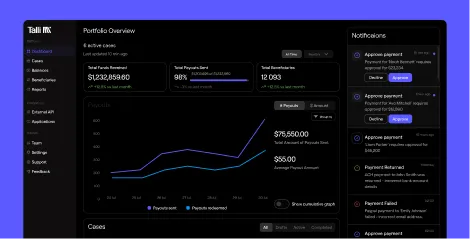
Talli's Real-Time Dashboard & Reporting provides live visibility into:
- Completion Rates: Percentage of successful payouts by verification status and payment method
- Fraud Flags: Cases requiring review with full documentation of screening results
- Fund Balances: Remaining undistributed amounts with projected disbursement timelines
- Failure Analysis: Root cause breakdown for rejected or returned payments
- Geographic Distribution: Regional concentration of claimants for compliance monitoring
Automating Court-Required Accounting and Audit Trails
Post-distribution accounting reports increasingly face judicial scrutiny. Courts now ask settlement administrators detailed questions about disbursement processes and verification procedures. Automated reporting generates court-required accounting without manual preparation, while stakeholder portals provide controlled access for courts, trustees, and legal teams.
The evidence store architecture maintains immutable records with 5-year retention, cryptographic hashing for tamper detection, and full-text search for regulatory examinations. When regulators ask "why did you approve this claimant?" the answer is retrievable with complete context, even years later.
The Impact of Efficient KYC/OFAC on Settlement Redemption Rates
Compliance friction directly impacts whether claimants receive their entitled funds. Cumbersome verification processes drive abandonment; streamlined verification drives redemption.
Increasing Claimant Access to Funds
Digital disbursement platforms achieve 95-98% redemption rates compared to 70-80% for traditional paper methods. The AB Data case study demonstrates concrete results:
- 30% increase in claimant redemption rates across check-issued populations
- 60% reduction in unresolved exceptions and manual reissuance overhead
- 100% fiduciary compliance record maintained across all distributions
Reducing Costs Associated with Uncashed Checks and Reissuance
Each uncashed check triggers $150 in tracking costs before eventual escheatment to state governments. Digital disbursements eliminate this leakage while compressing distribution timelines from 6-8 weeks to 24-48 hours. The cost differential is stark: $7-20 per paper check versus $0.25-$5 for digital payments, a 50-65% reduction in processing costs.
Scaling Compliance: Handling 500,000+ Claimants with Confidence
The architecture that works for 10,000 claimants often breaks at 500,000. Scalable compliance requires purpose-built infrastructure rather than stretched consumer tools.
Building Compliant Systems for Massive Distributions
Talli's Automated Disbursement Engine supports phased rollouts for settlements exceeding 50,000 claimants, enabling monitoring and adjustment before full release. The platform scales from 1,000 to 100,000+ recipients without performance degradation, backed by SOC 2 Type II and PCI DSS Level 1 compliance certifications.
Key architectural elements for scale include:
- Batch + Real-Time Hybrid: Batch screen full claimant lists overnight; real-time screen individual payments as they process
- Local Sanctions Cache: Maintain sub-daily updated local copies of sanctions lists for sub-second matching
- Webhook Architecture: Asynchronous processing handles volume spikes without blocking payment flows
- Horizontal Scaling: Infrastructure that grows with demand rather than hitting capacity walls
Real-World Applications in Large-Scale Settlements
Data breach settlements exemplify the scale challenge. The AT&T settlement involved $177 million for 73+ million affected customers with tiered payment structures based on exposure level. Processing such volumes requires:
- Automated validation against court-approved distribution plans
- Fraud detection for the 80 million fraudulent claims flagged industry-wide in 2023
- Multi-tier payment calculations (5x multipliers for SSN exposure)
- Court-ready reporting across all disbursement phases
Transforming Settlement Distribution with Talli
Talli's comprehensive compliance platform solves the fundamental challenge facing settlement administrators: distributing funds to hundreds of thousands of claimants within court-mandated deadlines while maintaining perfect regulatory compliance. By automating KYC verification, OFAC screening, and multi-channel disbursement, Talli compresses 18-month manual processes into 8-week automated workflows.
The platform's integrated approach delivers measurable results. Settlement administrators achieve 95-98% redemption rates while reducing processing costs by 50-65%. Real-time dashboards provide courts and trustees with complete transparency, while immutable audit trails satisfy regulatory requirements for 5-year record retention. Risk-based verification enables 90% auto-approval rates for legitimate claimants while focusing human review on the 5-10% of cases that warrant enhanced scrutiny.
With proven scale across billions in disbursed settlements, SOC 2 Type II certification, and bank-grade security infrastructure, Talli provides settlement administrators with the confidence to handle distributions of any size without sacrificing speed, compliance, or claimant experience. According to the U.S. Treasury, paper checks are 16 times more likely to encounter payment exceptions than electronic payments, highlighting the importance of reliable digital disbursements.
Frequently Asked Questions
What happens when a claimant fails KYC verification on the first attempt?
Failed first attempts typically result from poor document image quality, expired IDs, or data entry mismatches. Best practice involves immediate feedback explaining the failure reason, allowing claimants to retry with corrected submissions. For persistent failures, platforms should offer alternative verification paths such as knowledge-based authentication, notarized affidavits, or phone-based support. Escalation to manual review ensures legitimate claimants aren't permanently blocked while maintaining compliance standards.
How do settlement administrators handle OFAC false positives without delaying distributions?
Effective false positive management requires dedicated analyst queues with clear escalation paths. When screening flags a potential match, trained analysts compare additional identifying information (date of birth, address, country) against the SDN entry. Most false positives resolve within 24-48 hours through this secondary review. Whitelisting protocols for confirmed false positives prevent repeated flags on the same individual, while documented resolution records satisfy regulatory audit requirements.
What security measures protect claimant data during the verification process?
Enterprise-grade platforms implement multiple security layers: TLS 1.3 encryption for data in transit, AES-256 encryption for data at rest, role-based access controls limiting who can view sensitive information, multi-factor authentication for all compliance dashboard access, and SOC 2 Type II certification validating security control effectiveness. Talli's platform maintains bank-grade security through its partnership with Patriot Bank, N.A., Member FDIC, with dedicated FBO account structures preserving fund segregation throughout the verification and disbursement process.
Can settlement administrators use the same KYC/OFAC infrastructure for different settlement types?
Yes. Modern compliance platforms support configurable workflows that adapt to different settlement requirements. Class action settlements, mass tort distributions, and bankruptcy payouts each have distinct verification needs, but underlying infrastructure (document capture, sanctions screening, audit logging) remains consistent. Platforms like Talli allow administrators to create settlement-specific rulesets while maintaining centralized compliance controls, enabling operational efficiency across diverse case types without rebuilding verification infrastructure for each new matter.
How long must settlement administrators retain KYC and OFAC screening records?
OFAC requires maintaining records of sanctions screening for a minimum of 5 years from the date of the transaction. This includes the original screening results, any investigation documentation for flagged cases, analyst decisions, and supporting evidence. Settlement-specific retention requirements may extend beyond this baseline depending on court orders and state escheatment laws. Immutable evidence stores with cryptographic hashing ensure records remain tamper-evident throughout the retention period, supporting both regulatory examinations and potential litigation years after disbursement completion.