.svg)


.svg)
Maintaining an accurate shareholder register has become a board-level compliance priority as companies face stricter ownership transparency rules, tighter audit expectations, and growing pressure to modernize shareholder communications and distributions. In the UK, companies can no longer elect to keep their register of members centrally at Companies House as of January 26, 2026, and must instead maintain the register at their registered office or a single alternative inspection location under official register guidance. For companies managing dividends, shareholder settlements, bankruptcy distributions, or other high-volume ownership-linked payments, modern shareholder services infrastructure can connect register accuracy with compliant payment execution, audit trails, and real-time reconciliation.
Key Takeaways
- A shareholder register is the formal legal record of ownership, while a cap table is primarily an internal planning and modeling tool.
- UK companies can no longer keep the register of members centrally at Companies House as of January 26, 2026.
- Paper share certificates for in-scope UK traded companies are expected to be replaced by digitised share registers before the end of 2027.
- Digital register and payout workflows reduce manual handling, improve auditability, and shorten shareholder payment cycles.
- Audit-ready registers require source documents, board approvals, transaction records, reconciliations, and controlled change history.
- Payment infrastructure matters because inaccurate records can cause failed dividends, duplicate payments, unclaimed funds, and escheatment exposure.
Understanding the Fundamentals of Your Shareholder Register
A shareholder register is the official record showing who owns shares in a company. It supports voting rights, dividend entitlements, shareholder notices, inspection rights, ownership transfers, and corporate action eligibility. In the UK, the register of members remains a statutory requirement under the Companies Act 2006, and companies must keep it available at the registered office or a single alternative inspection location.
The register should not be confused with a capitalization table. A cap table helps founders, finance teams, and investors model ownership, dilution, option pools, funding rounds, and exit outcomes. The shareholder register is the legal record used to prove ownership. When the two conflict, investors, auditors, lawyers, and regulators will look to the statutory register and the documents supporting each entry.
This distinction matters during financing rounds, dividend declarations, shareholder votes, corporate restructurings, and disputes. A clean cap table is useful, but it is not enough if the formal register is incomplete, outdated, or unsupported by source documentation.
Key Data Points for Every Shareholder Record
An audit-ready register should contain enough information to prove who owns each share and how that ownership changed over time. Core data fields typically include:
- Full shareholder name and address
- Share class and number of shares held
- Amount paid or agreed to be treated as paid
- Dates of becoming and ceasing to be a member
- Joint holder details, where applicable
- Transfer, allotment, cancellation, or conversion references
- Supporting document links for each ownership change
Jurisdiction-specific fields may also apply. Indian company records may require additional identification and beneficial ownership details. Other jurisdictions may require share certificate numbers, transfer restrictions, nominee or beneficial ownership indicators, and historical retention of former shareholder information.
The best control is consistency. Each register entry should tie back to board approvals, subscription agreements, transfer forms, stock ledgers, payment records, and any required regulatory filings.
Choosing the Right Format for Your Register
The legal effect of the register depends on accuracy, not whether the record is kept in paper, spreadsheet, or software form. However, the format affects how easily accuracy can be maintained.
Paper registers are slow to update and difficult to reconcile across multiple teams. They also create physical security and version-control issues.
Spreadsheet registers are flexible but fragile. Formula errors, duplicate versions, unauthorized edits, and missing audit trails can create serious exposure during due diligence or audit review.
Digital register platforms improve control by logging edits, applying permissions, preserving historical versions, and connecting entries to documents. These systems can also support complete audit trails for ownership-linked distributions.
Blockchain-based registers may provide tamper-resistant transaction records in some use cases, but adoption depends on jurisdiction, governance structure, and integration with existing securities infrastructure.
For most companies, the priority is not the most complex technology. It is a system that keeps the legal register, transaction documents, payment records, and audit evidence aligned.
Leveraging Cap Table Management for Accuracy
Cap table software helps teams model financing scenarios, option exercises, dilution, vesting, and exit waterfalls. These tools can reduce calculation errors, but they should not replace statutory register controls.
A strong workflow keeps the cap table and shareholder register synchronized after each equity event. When new shares are issued, options are exercised, shares are transferred, or holders cease to be members, the legal register should be updated promptly and tied to the authorizing documents.
Automation can help with:
- Equity grant tracking
- Vesting schedule calculations
- Option exercise records
- Dilution modeling
- Waterfall analysis
- Pro forma ownership reports
The risk is assuming that planning data equals legal proof. Investors conducting due diligence will compare the cap table, register, board approvals, shareholder consents, transfer instruments, and filing history. Discrepancies can delay closings, create indemnity issues, or force costly remediation before a transaction can proceed.
Digital tools are most effective when paired with governance discipline. Companies should define who owns the register, who approves updates, how corrections are documented, and how the cap table is reconciled after each financing or equity event. Your reporting reconciliation process should also connect ownership records to downstream shareholder payments and audit reporting.
Ensuring Corporate Compliance With Shareholder Records
Corporate compliance extends beyond recording names and share counts. The register supports beneficial ownership checks, shareholder communications, dividend record dates, tax reporting, proxy materials, and statutory inspection rights.
In the UK, Companies House guidance confirms that companies must still maintain a register of members, even though the central register option has closed. The Economic Crime and Corporate Transparency Act 2023 also strengthens the wider corporate transparency framework, including identity verification and Companies House enforcement powers.
In the United States, public company reporting depends on accurate ownership and transfer data for SEC filings, Section 16 reporting, Schedule 13D and 13G monitoring, proxy administration, and dividend records. Corporate Transparency Act reporting should not be described as a universal U.S. company obligation because FinCEN removed BOI reporting requirements for U.S. companies and U.S. persons in 2025.
In the European Union, shareholder recordkeeping must also consider GDPR, data minimization, lawful basis, retention limits, and security controls. Beneficial ownership access rules may vary by member state and should be reviewed with counsel.
Companies with cross-border ownership should involve legal counsel before standardizing one register process globally. Local rules may differ on inspection rights, transfer documentation, beneficial owner disclosure, privacy, and retention. The goal is to build one operating model flexible enough to support multiple legal requirements without weakening the register’s evidentiary value.
Preparing for Audit Success
Audit readiness starts before the auditor requests evidence. The register should be maintained as a live control environment, not reconstructed at year-end. Stock ledger inaccuracies often surface during audits, financing rounds, dividend calculations, shareholder disputes, and corporate reorganizations, which makes preventive control far less expensive than remediation.
Auditors typically need:
- Share issuance, transfer, cancellation, and conversion records
- Board and shareholder approvals
- Subscription agreements and transfer instruments
- Stock option and warrant documentation
- Reconciliation between issued shares and register totals
- Evidence supporting dividend record dates
- Historical versions of the register
- Exception logs and correction approvals
Your audit trail documentation should show who changed the register, when the change occurred, why it was made, and what source document supports it. This creates a defensible chain of evidence for every ownership change.
A practical audit cadence includes quarterly reconciliations, annual legal review, access control testing, and exception reporting. The register should be reconciled against board minutes, securities ledgers, tax records, payment files, and shareholder communications.
Three-way reconciliation provides a strong control model. Register entries should match source documents, payment or consideration records, and external confirmations where available. Any mismatch should be logged, investigated, approved, and retained with the register history.
Corporate Governance and Register Management
Corporate governance depends on register accuracy. Directors rely on the register to confirm who can vote, who receives notices, who is entitled to dividends, and whether approval thresholds have been met.
Companies should document policies covering:
- Who can approve share issuances and transfers
- Who can edit register data
- How shareholder identity is verified
- How corrections are approved
- How former member records are retained
- How register access is logged
- How dividend record dates are validated
Segregation of duties is essential. The same person should not approve, enter, and reconcile material ownership changes without review. Dual approval is especially important for high-value transfers, changes to bank details, or corrections that affect voting control.
Poor register controls can create incorrect dividend payments, voting disputes, failed pre-emption processes, delayed corporate actions, and invalid approvals. Directors should treat the register as a core governance asset, not an administrative file. A reliable register protects shareholder rights while giving the board confidence that corporate actions are based on accurate ownership data.
Digital Solutions for Efficient Management
The move toward digital shareholder records is accelerating. The UK Digitisation Taskforce’s July 2025 final report recommends a staged transition that replaces paper share registers with digitised versions before the end of 2027, followed by broader improvements to the intermediated shareholding system through the Digitisation Taskforce report.
For in-scope traded companies, this shift creates pressure to prepare data, communicate with certificated shareholders, update processes, and coordinate with registrars and intermediaries.
Digital systems can improve:
- Transaction speed
- Error detection
- Version control
- Permission management
- Document linkage
- Reporting and reconciliation
- Shareholder communications
- Payment execution
The largest implementation challenge is usually data cleanup. Legacy records may contain outdated addresses, inconsistent names, missing certificate references, duplicate holders, incomplete transfer history, or unverified beneficial ownership data. Plan enough time to validate records before migration.
Digital platforms also improve operational continuity. When records are searchable, permissioned, backed up, and tied to documents, teams can respond faster to audits, shareholder inquiries, corporate actions, and payment exceptions. That structure is especially important when distributions depend on ownership data.
Addressing Fraud and Security
Shareholder register fraud can result in unauthorized transfers, diverted dividends, false address changes, or manipulated voting outcomes. Strong controls should protect against both external attacks and internal misuse.
Minimum safeguards include:
- Multi-factor authentication
- Role-based access controls
- Encryption in transit and at rest
- Complete access logs
- Dual approval for sensitive changes
- Independent verification for bank detail updates
- Regular vulnerability assessments
- Backup and disaster recovery procedures
Fraud controls are especially important when register data feeds dividend distributions or settlement payments. A fraudulent address or bank account change can redirect funds before anyone notices.
Digital systems can detect suspicious patterns across device fingerprints, behavioral activity, duplicate data, and identity mismatches. Talli’s fraud detection workflows help payment teams identify risk signals before funds move.
Internal fraud risk also deserves attention. Employees with system access may be able to alter payment details, suppress exceptions, or modify records unless duties are separated. Logs should be reviewed, not simply stored. Alerts should escalate unusual activity, such as repeated failed login attempts, bulk changes, or edits outside normal workflows.
Streamlining Shareholder Communications
Accurate registers support timely shareholder communications. AGM notices, proxy materials, dividend announcements, tax forms, corporate action notices, and regulatory updates all depend on current shareholder contact data.
A digital communication workflow should maintain:
- Verified email and mailing addresses
- Notice delivery history
- Returned mail tracking
- Consent records for electronic communications
- Language or accessibility preferences
- Escalation workflows for undeliverable notices
Poor contact data directly increases unclaimed funds. If shareholders do not receive notices or payment instructions, distributions fail, checks go uncashed, and dormant property exposure grows.
Modern multi-channel payouts help reduce that risk by allowing shareholders to choose payment methods they already use, including ACH, prepaid cards, digital wallets, and paper fallback where needed. Strong communication workflows also reduce inbound support volume because shareholders can track status, correct information, and complete required forms before payment deadlines.
Ensuring Timely Shareholder Payments
Dividend and shareholder distribution accuracy depends on the register as of the record date. Errors in ownership records can result in payments to the wrong holder, missed shareholders, duplicate distributions, incorrect withholding, or unresolved exceptions.
A payment-ready register should include:
- Verified shareholder identity
- Current contact details
- Valid tax documentation
- Payment method preference
- Sanctions screening status
- Record date ownership validation
- Exception and remediation history
For companies managing high-volume shareholder payments, real-time tracking can connect register data with tax collection, sanctions screening, payment routing, and audit-ready reporting. This reduces manual work while giving finance, legal, and operations teams visibility into completion rates and failed payments.
Tax documentation should be part of the same workflow. Missing or invalid tax forms can delay distributions, trigger backup withholding, or create reporting errors. Integrated tax compliance automation helps teams collect required documentation before funds move, reducing last-minute exceptions.
Why Talli Simplifies Shareholder Management
Register accuracy matters most when money, rights, or compliance obligations depend on it. Talli focuses on the distribution and compliance layer that connects shareholder records to payment execution.
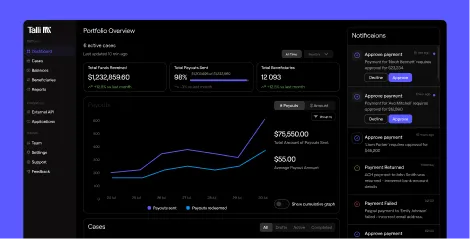
Talli supports shareholder services teams with multi-channel payment options, including ACH, prepaid Mastercard, PayPal, Venmo, Amazon gift cards, wire transfers, and paper checks as a fallback. The platform combines payment choice with KYC verification, OFAC screening, W-9 collection, 1099 support, fraud mitigation, audit logs, and real-time dashboards.
For shareholder distributions, bankruptcy payouts, class action settlements, and other legal disbursements, Talli helps administrators reduce check-issued populations, improve redemption, and document every step of the payout journey. Dedicated account structures support fund segregation, while dashboards show payment status, exceptions, completion rates, and remaining balances.
Talli’s customer case study shows how digital disbursement infrastructure can increase redemption, reduce unresolved exceptions, and maintain fiduciary compliance across high-volume distributions. That same operating model applies to shareholder services teams that need to move funds quickly without losing control over audit evidence, compliance checks, or recipient experience.
The result is a tighter link between ownership records and compliant disbursement. Instead of treating the register, payment file, tax workflow, and audit report as separate processes, Talli helps teams manage them through a coordinated distribution workflow built for regulated payouts.
Talli Conclusion
An audit-ready shareholder register is not just a statutory record. It is the foundation for governance, voting, dividend accuracy, shareholder communications, tax reporting, and unclaimed property control. Companies that rely on manual spreadsheets or fragmented payment processes risk errors at the exact moments when accuracy matters most.
Digital register management, strong documentation, and integrated payment infrastructure give teams better control over ownership data and shareholder distributions. Talli supports the payment and compliance side of that workflow by helping shareholder services teams launch, track, reconcile, and document disbursements with built-in controls.
For companies managing shareholder payments at scale, the goal is not simply to keep a cleaner register. It is to ensure the register can support fast, accurate, defensible distributions when shareholders, auditors, courts, or regulators need proof.
Frequently Asked Questions
What is a shareholder register?
A shareholder register is the formal legal record showing who owns shares in a company. It supports voting rights, dividend entitlements, notices, transfers, and ownership verification.
How is a shareholder register different from a cap table?
A cap table is an internal ownership and dilution model. A shareholder register is the statutory record used to prove legal ownership and shareholder rights.
What should an audit-ready register include?
It should include shareholder names, addresses, share classes, shares held, dates of membership, amounts paid or treated as paid, and source documents for every ownership change.
Are UK companies still required to keep a register of members?
Yes. UK companies must still keep a register of members at the registered office or a single alternative inspection location. The option to keep it centrally at Companies House ended on January 26, 2026.
How does Talli help with shareholder distributions?
Talli helps teams distribute shareholder payments through multiple payment methods while supporting KYC, OFAC screening, W-9 collection, fraud checks, audit logs, and real-time payment tracking.