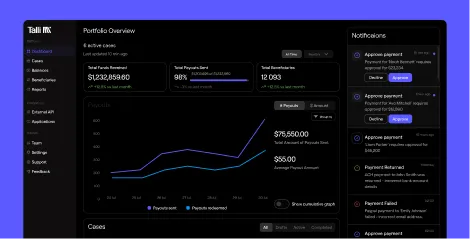
Exception backlogs represent the hidden tax on settlement administration. The time costs of failed payments can be significant. In the analogous field of accounts payable, each failed invoice payment can consume 15-20 minutes of investigation, according to research from eZintegrations. These delays affect funds that should already be in claimants' hands. With class action settlements totaling $159.4 billion from 2022-2024, the stakes have never been higher for claims administrators managing high-volume distributions. Modern disbursement platforms for claims now eliminate these bottlenecks through AI-powered verification, automated exception routing, and multi-channel payment options that achieve 98% success rates compared to approximately 70% for traditional paper checks.
Key Takeaways
- Exception rates of 20-30% are reducible to under 5% through AI-powered verification and systematic root cause elimination, fundamentally redesigning workflows to prevent failures rather than react to them
- Digital payment platforms achieve 98% success rates versus approximately 70% for paper checks, directly addressing judicial concerns about maximizing funds reaching victims
- In 2024, AI-powered fraud detection systems identified and prevented more than 800 million fraudulent claims, producing the first-ever recorded decline (40%) in fraudulent submissions through coordinated AI deployment
- Structured exception management frameworks reduce backlogs 50-65% in 90 days through categorization, clear ownership, automated routing, and quarterly calibration
- Complete fund segregation through dedicated QSF-compliant accounts protects law firms from commingling violations while enabling modern payment methods
- The 3M Combat Arms Earplugs settlement achieved 99.9% participation using digital methods, proving low claim rates aren't inevitable; they're a systems failure
Streamlining Global Payouts for Class Action Settlements
The scale of modern legal distributions demands industrial-strength infrastructure. Annual class action settlement volume now exceeds $42 billion, with mass tort, bankruptcy, data breach, and antitrust cases creating unprecedented distribution challenges across jurisdictions.
Overcoming Challenges in High-Volume Legal Distributions
Traditional paper-based systems collapse under settlement scale. A 50,000-claimant distribution at typical 30% uncashed rates generates 15,000 failed payments. Each requires tracking, reissuance attempts, and eventual escheatment processing. The administrative burden compounds through multiple channels.
The time costs of failed payments can be significant. The costs to track, reissue, and manage failed payments can be substantial, adding significant administrative overhead. Unclaimed funds eventually transfer to state treasuries, reducing actual victim compensation.
Modern platforms address these challenges through automated verification that catches errors before payment initiation, not after. Batch uploads validate claimant data against court-approved distribution plans, eliminating manual data entry errors that plague spreadsheet-based administration.
Ensuring Seamless Payments Across Borders
Global settlements require multi-jurisdictional payment capabilities. Cross-border distributions must navigate currency conversion, local banking requirements, and varying regulatory frameworks across 190+ countries.
Leading platforms now support 150+ currencies and 300+ payment rails while maintaining GDPR-compliant data handling for European claimants and multi-language support in 40+ languages.
Reducing Unclaimed Funds and Exception Backlogs in Legal Disbursements
The gap between digital and traditional payment performance now exceeds 28 percentage points, making digital adoption a competitive necessity rather than optional enhancement.
Boosting Claimant Redemption Rates with Digital Methods
Claimant preferences have shifted decisively. 91% of settlement recipients prefer digital payment options over paper checks. Yet many administrators still default to check-only distributions, artificially suppressing redemption rates.
The results speak clearly:
- Digital platforms: 98% payment success rate
- Paper checks: Approximately 70% redemption rate
- Email campaign claim rates: Only 3% participation without proper engagement
The 3M Combat Arms Earplugs settlement demonstrates what's possible with proper technology adoption, achieving 99.9% participation through digital-first methods, mobile-optimized claiming portals, SMS reminder campaigns, and multiple payment options.
Minimizing Manual Intervention and Reissuance Costs
Exception management represents the operational discipline separating professional settlement administration from reactive firefighting. Organizations implementing systematic frameworks reduce backlogs 50-65% within 90 days through structured approaches.
Effective exception management includes:
- Categorizing exception types: Data entry errors, tolerance mismatches, timing issues, duplicates
- Assigning clear ownership: Specific teams with defined SLAs for each exception category
- Implementing automated routing: Exceptions flow to appropriate resolution teams without manual triage
- Capturing resolution patterns: Root cause analysis prevents recurrence
- Quarterly calibration cycles: Continuous improvement based on exception trends
Modern Payment Processing Software for Claims Administrators
The payout phase is where settlements become real money in claimants' hands and where errors prove least forgivable. Monumental Legal Services notes: "An underpayment, an overpayment, a missed lien, or a delayed disbursement creates direct financial harm to a real person and significant liability exposure for the firm."
The Evolution of Claims Payout Technology
Manual exception processing requires 15-20 minutes per case, while AI-matched systems reduce this to 3-5 minutes through pre-populated evidence and recommended actions. Document extraction now achieves 95-99% accuracy, eliminating the data entry errors that create exceptions in the first place.
API-driven class action disbursement platforms integrate directly with case management systems, enabling streamlined operations.
Integrating Advanced Features for Enhanced Efficiency
Modern platforms deploy multi-layered verification before payments process:
- KYC identity verification cross-referencing provided information against identity databases
- OFAC screening achieving automated compliance checking against U.S. Treasury sanctions lists
- W-9 collection via digital forms with smart reminders achieving 90% completion rates
- Duplicate detection checking invoice number, amount, vendor, and PO quantities
- Velocity checks flagging unusually rapid claim sequences from single sources
These verification layers work together to prevent payment errors and fraud while maintaining processing speed.
Digital vs. Traditional: The Cost-Benefit of Modern Payment Processing
The economics favor digital adoption decisively. Processing costs drop from $7-20 per check to $0.25-$5 for digital payments, representing 50-65% cost reduction while compressing distribution timelines from 6-8 weeks to 24-48 hours.
Achieving Significant Cost Savings with Digital Disbursements
For a settlement with 1,000 claimants at 25% exception rate, traditional methods generate 62-83 hours of monthly exception handling. At staff costs of $50-$75 per hour, this represents $3,100-$6,225 monthly in exception processing alone before counting reissuance costs.
Digital platforms eliminate these hidden costs through multiple mechanisms.
Cost Reduction Strategies
Effective digital platforms reduce costs through:
- Upstream error prevention: Validation catches issues before payment initiation
- Automated routing: Exceptions flow to resolution without manual triage
- Self-service updates: Claimants correct addresses and payment preferences directly
- Smart reminders: Proactive outreach at 30, 14, and 3 days before deadlines
Accelerating Settlement Timelines for Faster Resolution
Implementation typically requires 2-6 weeks with vendor-assisted setup, achieving ROI within 4-7 months through reduced processing time and error rates. Platforms support phased rollouts for settlements exceeding 50,000 claimants, enabling monitoring and adjustment before full release.
Ensuring Fiduciary Compliance with Integrated Payment Processing
Fund segregation isn't just good practice. It's legally mandated for QSF compliance and ethically required under state bar rules governing client funds.
Automated Tools for Maintaining Fiduciary Compliance
Qualified Settlement Fund regulations require complete fund segregation to preserve tax structure throughout distribution lifecycles. Modern platforms support dedicated FBO (For Benefit Of) account structures for each settlement, maintaining FDIC insurance through banking partners while preventing commingling violations.
Under IRS segregation requirements, Qualified Settlement Funds must hold assets separately from those of the transferor and related parties, with a separate bank account serving as one way to satisfy this requirement.
Critical Compliance Capabilities
Essential compliance features include:
- IRC Section 468B preservation: Dedicated accounts maintain QSF tax treatment
- OFAC sanctions screening: Automated compliance checking with documented timestamps
- W-9 collection automation: Digital forms with DocuSign integration achieving 90% completion versus 40% without automation
- 1099-MISC/1099-NEC generation: Automated IRS e-filing integration
- 24% backup withholding: Automatic calculation for missing TIN numbers per IRS requirements
Talli maintains SOC 2 Type II and PCI DSS Level 1 compliance, with banking services provided by Patriot Bank, N.A., Member FDIC.
Multi-Channel Payment Distribution Options for All Claimants
Payment method directly determines whether settlement funds reach claimants or escheat to state treasuries. Multi-channel distribution addresses the dual failure mode of low initial participation plus high payment failure rates.
Catering to Diverse Claimant Needs with Flexible Payment Methods
Leading platforms offer six payment options to maximize claimant access:
- ACH Direct Deposit: Lowest cost at $0.25-$0.50 per transaction, 1-2 day delivery
- Prepaid Mastercard: Virtual cards delivered via SMS/email in 30 seconds, physical cards within 5-7 days, serving 5.9 million unbanked U.S. households
- Digital Wallets: PayPal and Venmo integration at $0.50-$1.00 per transaction, particularly popular with Millennials and Gen Z
- Gift Cards: Amazon and Target options for settlements under $100, highest redemption rates for small-value distributions
- Wire Transfers: Same-day option for high-value international payments at $10-$30 per transaction
- Paper Checks: Maintained as fallback despite $7-20 all-in costs
Optimizing Redemption Rates Through Choice and Accessibility
Claimant self-service portals allow payment method selection and address updates, reducing exceptions caused by outdated contact information. Real-time payment tracking shows claimants exactly where funds are in the process, reducing customer service inquiries and building trust.
Automated Reconciliation: Beyond Basic Payment Processing
Automated reconciliation reduces settlement reconciliation from weeks to hours through three-way matching with 90% auto-match rates, eliminating the month-end bottlenecks that plague traditional systems.
Achieving Faster Financial Closes with Automated Matching
Real-time dashboards provide live visibility into critical distribution metrics:
- Completion rates showing percentage of successful payouts
- Payment method distribution across ACH, cards, and wallets
- Geographic concentration by region
- Failure root cause analysis
- Fraud flags requiring review
- Remaining fund balances
Streamlined Reporting and Stakeholder Access
Automated reporting generates court-required accounting without manual preparation, while stakeholder portals provide controlled access for courts, trustees, and legal teams. CRM integration via webhooks syncs payment status updates automatically to case management systems.
Scaling Payouts for Large-Scale Settlements: Bulk Payments Made Simple
Purpose-built platforms scale from 1,000 to 100,000+ recipients without performance degradation, a critical capability as settlement sizes continue growing.
Handling High-Volume Distributions with Uncompromised Performance
Mass disbursement platforms handle complex multi-tier payment structures across thousands of claimants with varying award amounts based on claim severity. Automation benefits scale proportionally with volume: the larger the settlement, the greater the efficiency gains.
Key Scalability Features
Essential capabilities for large-scale distributions include:
- Batch uploads: Automated validation against court-approved distribution plans
- Phased rollouts: Monitoring and adjustment before full release
- Parallel processing: Thousands of simultaneous payments without queuing delays
- Stress testing: Platforms validated for catastrophe-level payment volumes
The Future of Legal Payouts: Digital-First Payment Processing
The shift from paper-based to digital-first disbursement represents the most significant transformation in settlement administration since electronic filing. Fraud detection provides a clear example: after a 19,000% surge in fraudulent claims between 2021 and 2023, coordinated AI deployment in 2024 produced the first-ever recorded decline, down more than 40% from peak levels.
Embracing Innovation for Faster, More Efficient Settlements
AI-powered fraud detection now analyzes submission patterns, detects duplicate claims, identifies synthetic identities, and flags suspicious documentation before payments process. The Dr. Dennis Gross Skincare settlement illustrates the threat level: only 127,000 valid claims out of 8.8 million filed, a 98.6% fraud rate.
Multi-Layered Verification
Modern fraud prevention deploys multiple verification layers:
- KYC authentication
- Document validation
- OFAC screening
- Duplicate detection
- Behavioral analysis
These systems work together to prevent billions in fraudulent distributions while maintaining processing speed for legitimate claims.
Talli's Platform Advantages
Talli's digital disbursement platform demonstrates the power of modern payment infrastructure for legal settlements. The platform combines AI-powered verification, automated exception management, and multi-channel payment options to achieve industry-leading results.
Talli supports settlements ranging from 1,000 to 100,000+ recipients, offering flexible implementation options and phased rollouts for large-scale distributions. The platform maintains SOC 2 Type II and PCI DSS Level 1 compliance while enabling the payment speed and choice that modern claimants expect.
With complete fund segregation through QSF-compliant accounts, automated tax reporting, and real-time payment tracking, Talli provides claims administrators with the infrastructure needed to maximize claimant participation while maintaining full fiduciary compliance. The platform's API-first architecture integrates seamlessly with existing case management systems, enabling automated workflows that reduce exception backlogs by 50-65% within 90 days.
Frequently Asked Questions
What causes the majority of payment exceptions in settlement distributions?
Payment exceptions typically stem from four root causes: data entry errors during claimant onboarding, address changes not captured between claim filing and payment, missing or invalid tax documentation (W-9/W-8BEN forms), and bank account verification failures for ACH payments. AI-powered platforms reduce exception rates from 20-30% to under 5% by validating data at submission rather than discovering errors at payment time.
How do claims administrators handle fraud without delaying legitimate payments?
Modern fraud detection operates in parallel with payment processing rather than creating sequential bottlenecks. AI systems analyze submission patterns, device fingerprints, and behavioral indicators to flag suspicious claims for review while automatically clearing legitimate submissions. This approach achieves 95% fraud detection accuracy while identifying fraud 50% faster than manual review, protecting settlement integrity without penalizing honest claimants.
What happens to unclaimed settlement funds after distribution deadlines pass?
Unclaimed funds follow a structured process: extended outreach attempts, due diligence letter campaigns, and ultimately escheatment to state unclaimed property divisions based on claimant last-known addresses. Each state maintains different dormancy periods and reporting requirements. Digital platforms reduce escheatment exposure by achieving 98% initial redemption rates versus 70% for paper checks, keeping more funds with intended recipients rather than state treasuries.
How do digital disbursement platforms integrate with existing case management systems?
API-driven platforms connect via webhooks that sync payment status updates automatically to case management systems. This integration enables real-time visibility without manual data entry, automated reporting that pulls directly from payment records, and bidirectional updates that keep claimant information current across all systems. Implementation typically requires 2-6 weeks with vendor-assisted setup.
What compliance certifications should claims administrators require from disbursement vendors?
Essential certifications include SOC 2 Type II (verifying security controls operate effectively over time), PCI DSS Level 1 (for card payment processing), and documented OFAC screening procedures with audit trails. Additionally, platforms handling QSF distributions must demonstrate fund segregation capabilities that preserve IRC Section 468B tax treatment through dedicated FBO accounts with banking partners providing FDIC insurance.