.svg)


.svg)
Medical liens are one of the highest-risk steps in personal injury and mass tort settlement disbursement, but many firms still treat them as back-office paperwork instead of a fiduciary control. A lien holder can claim part of a claimant’s recovery for injury-related medical payments, and premature distribution can expose counsel, administrators, and fiduciaries to avoidable disputes.
The risk is especially visible in mass torts. Empirical research on health care liens found that Medicare liens are frequent, Medicaid liens appear at meaningful rates, and private liens can exceed government liens on average depending on the compensation event. Complex pharmaceutical, medical device, and catastrophic injury matters can produce lien amounts that materially change each claimant’s net recovery.
That is why lien resolution must be built into the disbursement workflow before funds leave trust, QSF, or settlement accounts. Modern mass tort disbursement tools can help claims teams track lien status, coordinate payment sequencing, maintain audit trails, and reduce manual errors before claimant distributions are released.
Key Takeaways
- Medical lien work should begin at intake or early settlement planning, not after final approval
- Medicare conditional payment recovery must be resolved, paid, disputed, or adequately reserved before client disbursement
- California trust-account rules require prompt notification, written accounting, and distribution of undisputed funds
- Medicare, Medicaid, ERISA, hospital, and private insurance liens each require different validation steps
- Procurement cost reductions, allocation arguments, and documentation can improve claimant net recovery
- Digital platforms help administrators connect lien status, payment controls, reconciliation, and court-ready reporting
Understanding Medical Liens And Their Impact On Settlement Disbursement
A medical lien is a legal claim against settlement proceeds for injury-related treatment costs. The lien may come from a government payer, private health insurer, hospital, self-funded employer plan, or federal health program. The core issue is the same: money cannot be distributed cleanly until the responsible team knows who has a claim, how much is valid, and what must be paid or reserved.
Medical liens typically fall into these categories:
- Traditional Medicare: Federal conditional payment recovery under the Medicare Secondary Payer framework
- Medicare Advantage: Private Part C plans with plan-specific recovery processes
- Medicaid: State-administered recovery programs with state-specific rules
- ERISA Plans: Employer-sponsored plans with contractual subrogation or reimbursement rights
- Hospital Liens: Statutory liens that may require filing, notice, and technical compliance
- Private Insurance: Contractual subrogation claims under health insurance policies
- VA, TRICARE, And CHAMPVA: Federal health programs with separate recovery rights
The operational burden grows quickly in high-volume settlements. A single claimant may have Medicare, Medicaid eligibility history, a hospital lien, and a private plan assertion. In a settlement with thousands of claimants, lien resolution becomes a workflow, data, documentation, and payment-control problem.
For firms managing mass tort settlements, the goal is not just to reduce liens. The goal is to prevent premature disbursement, prove each step, and make sure the claimant receives the correct net amount after valid obligations are resolved.
Identifying And Verifying Liens Early
Lien identification should start as soon as the firm has enough claimant data to run reliable checks. Waiting until settlement approval creates pressure, especially when the settlement agreement, court order, or state trust-account rule requires prompt distribution of undisputed funds.
A reliable lien search protocol should include:
Medicare Verification
- Query the Medicare recovery portal using the claimant’s identifying information
- Confirm whether the claimant is a Medicare beneficiary
- Request conditional payment information when Medicare has made injury-related payments
- Check for Medicare Advantage or Part D coverage separately because those plans may not be fully captured through the traditional Medicare process
- Track every query, response, authorization, and update with dates
Medicaid Verification
- Contact the relevant state Medicaid recovery unit
- Request eligibility history, not only current enrollment status
- Compare eligibility dates against injury-related treatment dates
- Confirm whether the state requires notice, consent, allocation review, or agency approval before disbursement
Private Insurance And ERISA Review
- Review medical records, intake forms, explanation of benefits, and provider billing records
- Request plan documents when ERISA reimbursement rights are asserted
- Identify whether the plan is insured or self-funded
- Review plan language before assuming the asserted amount is fully payable
Hospital Lien Review
- Check applicable state and county filing requirements
- Confirm whether the hospital complied with notice, filing, timing, and content requirements
- Compare liened charges against treatment dates and settlement-related injuries
These checks should feed into a single lien status tracker. For compliance purposes, an audit trail should show when each lien was searched, who responded, what amount was asserted, what was disputed, and how the final amount was resolved.
Negotiating And Reducing Medical Liens
Lien negotiation is not just a courtesy to the claimant. It is part of maximizing net recovery while protecting the settlement team from paying invalid, inflated, or unrelated claims.
For Medicare, recovery may be reduced for procurement costs, including attorney fees and case expenses, under the Medicare recovery formula. If a claimant paid a contingency fee and litigation costs to obtain the settlement, Medicare’s recovery should generally reflect its proportionate share of those costs.
Common Medicare review steps include:
- Dispute unrelated charges in the conditional payment summary
- Challenge treatment that does not match the injury dates or alleged harm
- Request itemized backup for questionable payments
- Confirm the final demand amount before payment
- Keep proof of payment and acknowledgment in the file
Medicaid negotiations are more state-specific. The key question is often what portion of the settlement represents past medical expenses. Allocation arguments, hardship requests, and state approval processes can materially affect the final amount. Counsel should avoid applying one state’s Medicaid rule to another jurisdiction.
ERISA and private insurance liens require plan-level analysis. Some plans have strong reimbursement language. Others may be limited by plan terms, state law, common fund principles, made-whole arguments, or settlement allocation. Private lien resolution programs can also create standardized reduction pathways in large settlement inventories.
Compliance Checklist Before Disbursement
Use this checklist before settlement funds are released to claimants.
Pre-Settlement Lien Identification
- Collect claimant SSN or other required identifiers, date of birth, legal name, and coverage history
- Run Medicare beneficiary checks as early as possible
- Request Medicaid eligibility history from every relevant state
- Review medical records and provider bills for insurance indicators
- Identify Medicare Advantage, Part D, ERISA, hospital, and private insurance claims
- Record all queries, submission dates, and responses
Lien Verification And Validation
- Obtain conditional payment information for Medicare beneficiaries
- Compare asserted charges against injury dates and treatment records
- Request itemized statements for disputed or unclear charges
- Confirm Medicaid eligibility dates and covered treatment periods
- Review ERISA plan documents before accepting reimbursement demands
- Check hospital lien filing and notice compliance
Negotiation And Reduction
- Calculate procurement cost reductions where available
- Prepare Medicaid allocation arguments when appropriate
- Review plan language for ERISA and private insurance claims
- Submit disputes with supporting records
- Document every offer, counteroffer, reduction, and approval
Payment Controls
- Confirm Medicare has been resolved, paid, or adequately reserved before client disbursement
- Hold disputed funds separately until entitlement is fixed
- Pay valid government and private liens according to applicable law, agreement terms, and court instructions
- Release only undisputed claimant funds
- Obtain client approval of the final settlement statement
Documentation And Audit Trail
- Store lien releases, satisfaction letters, and payment confirmations
- Preserve Medicare final demand and acknowledgment records
- Keep written settlement statements and client authorizations
- Maintain matter-level ledgers, bank records, and reconciliation files
- Retain records for the period required by applicable ethics rules, court orders, and firm policy
A checklist only works if it is connected to the payment workflow. Claims teams need a process that blocks premature payments, flags unresolved liens, and creates records that can be shown to courts, auditors, clients, and regulators.
Tax And Reporting Considerations
Personal injury tax treatment depends on what the settlement compensates. Under IRC Section 104(a)(2), damages received on account of personal physical injuries or physical sickness are generally excluded from gross income, except punitive damages. Interest, punitive damages, and non-physical injury components may be taxable.
Lien reductions do not automatically make the entire recovery taxable, but they can create reporting questions when the claimant previously deducted medical expenses or when the settlement includes taxable components. Large settlements should involve tax counsel, especially when allocations involve wages, punitive damages, interest, emotional distress, or mixed claims.
Qualified Settlement Funds can help administrators manage timing, reporting, and fund segregation when properly structured. Talli’s payment infrastructure supports tax compliance workflows, including W-9 collection, backup withholding workflows, and reporting support for settlement distributions that require tax documentation.
Common Lien Management Mistakes
The most common lien failures are process failures, not legal mysteries.
Starting Too Late: Medicare, Medicaid, and private lien holders may take weeks or months to finalize amounts. Early identification gives the team time to dispute unrelated charges and avoid holding up claimant funds.
Relying Only On Claimant Memory: Claimants may not know whether Medicare, Medicaid, a Medicare Advantage plan, or an ERISA plan paid for treatment. Intake answers should be verified against records and payer systems.
Treating Every Asserted Lien As Valid: Some charges are unrelated. Some hospital liens have filing defects. Some private plans lack strong reimbursement language. Validation protects claimant recovery.
Confusing Notice Rules: California trust-account notice duties, Medicare portal steps, court distribution orders, and settlement administrator reporting obligations are not the same rule. Each should be tracked separately.
Distributing Before The Lien File Is Closed: Paying the claimant before resolving or reserving for known lien obligations can create personal liability, bar complaints, client disputes, and malpractice exposure.
Missing Reconciliation: A lien payment must match the approved settlement statement, the ledger, and the bank record. Strong settlement reconciliation prevents unexplained balances, duplicate payments, and unresolved exceptions.
How Claims Administrators Support Lien Resolution At Scale
In single-event cases, a firm may manage lien work internally. In mass torts, class settlements with injury claims, or multi-claimant personal injury programs, the process often requires claims administrator support.
Claims administrators help by:
- Standardizing claimant intake and payer identification
- Running batch Medicare and Medicaid checks
- Maintaining lien status across large claimant inventories
- Coordinating lien holder communications
- Tracking unresolved exceptions
- Producing court-ready reports
- Linking net claimant amounts to payment instructions
Specialized settlement administration workflows reduce the risk that one unresolved lien is lost in a spreadsheet or email inbox. They also help firms respond quickly when a court, trustee, or client asks why a distribution was delayed.
For mid-sized matters, hybrid models often work best. The firm or lien specialist handles negotiation, while a digital platform controls disbursement readiness, payment sequencing, reconciliation, and audit records.
Using Digital Disbursement To Reduce Lien-Related Risk
Lien resolution and payment disbursement should not operate as separate silos. If lien data lives in one spreadsheet and payment approvals live in another, the risk of premature disbursement increases.
Digital disbursement platforms help by creating controlled workflows around:
- Claimant identity verification
- Payment preference collection
- Lien status tracking
- Holdback and reserve management
- Payment sequencing
- Failed payment resolution
- Court reporting
- Reconciliation and exception management
Talli supports multi-channel payouts, including ACH, prepaid cards, digital wallets, gift cards, and check fallback where needed. That flexibility helps administrators release approved funds quickly once lien obligations are resolved or reserved.
For legal teams, the main advantage is control. A claimant should not receive a final net distribution while a known lien is unresolved unless the disputed amount is reserved and documented. Built-in controls help convert that rule from a manual reminder into a system requirement.
Why Talli For Lien-Involved Disbursements
Talli is purpose-built for legal settlement payments where timing, compliance, and claimant experience all matter. The platform helps claims teams launch, fund, track, and reconcile distributions while maintaining fund segregation and real-time visibility.
For lien-involved matters, Talli helps administrators connect the pieces that often break down in manual workflows:
- Dedicated settlement accounts to support fund segregation
- Status tracking for claimant payments and unresolved exceptions
- KYC, OFAC screening, W-9 collection, fraud mitigation, and audit logs
- Payment method flexibility for banked and unbanked claimants
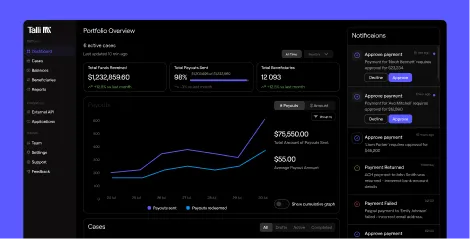
- Dashboards for completion rates, remaining balances, and failed payments
- Reporting for courts, administrators, auditors, and legal teams
Talli’s reporting tools support a clear record of what happened to settlement funds, who was paid, what remains outstanding, and which payments require follow-up. Its reconciliation workflows help administrators match payment records, account balances, and claimant-level ledgers without relying on manual spreadsheet checks.
Conclusion: Resolve Liens Before Disbursement With Talli
Medical lien resolution is not separate from settlement disbursement. It is one of the controls that determines whether a distribution is compliant, defensible, and complete. When lien searches, reductions, reserves, payment sequencing, and reconciliation are handled manually, even sophisticated teams can miss a deadline, pay the wrong party, or release funds too early.
Talli helps legal teams reduce that risk by bringing disbursement controls, audit trails, claimant payment options, and real-time reporting into one platform. For firms and administrators managing high-volume settlements, that infrastructure makes lien-aware distribution faster, more transparent, and easier to defend.
If funds remain unclaimed after compliant outreach and distribution attempts, administrators should also maintain an escheatment process so unresolved balances do not become a separate regulatory problem.
Frequently Asked Questions
What Happens If A Claimant Is Paid Before A Medicare Lien Is Resolved?
Premature payment can expose the responsible parties to Medicare recovery demands, double-damage risk, client disputes, and ethics issues. The safer process is to resolve, pay, dispute, or reserve the Medicare amount before releasing claimant funds.
When Should Lien Resolution Start?
Start at intake or early settlement planning. Medicare, Medicaid, ERISA, hospital, and private insurance checks take time, and early verification gives the team room to dispute unrelated charges before distribution deadlines arrive.
Are Medical Liens Always Negotiable?
Many are negotiable or reducible, but not all for the same reason. Medicare may allow procurement cost reductions, Medicaid depends on state rules and allocation, and private or ERISA claims depend heavily on plan language.
Can Undisputed Funds Be Distributed While Liens Are Pending?
Often yes, if the disputed lien amount is properly held back, documented, and consistent with applicable law, court orders, ethics rules, and client instructions. The key is separating undisputed funds from unresolved obligations.
How Does Talli Help With Lien-Related Disbursement Risk?
Talli helps administrators track payment readiness, maintain fund segregation, support audit trails, reconcile distributions, and send approved funds through multiple payment methods once lien obligations are resolved or reserved.