.svg)


.svg)
The traditional legal settlement distribution process leaves large volumes of funds delayed, reissued, redistributed, or unclaimed. Paper checks achieve only 55-77% cash rates while costing $7-$20 per transaction when printing, postage, reconciliation, and reissuance are included. Modern settlement platforms address this gap by delivering funds directly to claimants through digital channels, achieving up to 98% payment success rates while reducing per-payment costs to $0.25-$5, depending on the payment method. With fraudulent claim submissions increasing sharply across class action and mass tort programs, claims administrators need automated solutions that improve redemption without exposing settlement funds to improper claims.
Key Takeaways
- Paper checks achieve only 55-77% cash rates, leaving 23-45% of check-issued payments uncashed, delayed, reissued, redistributed, or eventually subject to unclaimed property handling
- Digital disbursement platforms can reduce payment costs from $7-$20 per check to $0.25-$5 per digital payment, depending on the payment method
- Claimants strongly prefer digital payment options when offered a choice, and flexible payment selection can improve redemption and satisfaction
- Industry reporting found that real-time screening and verification tools identified and prevented more than 723 million fraudulent class action and mass tort claims in 2024 alone
- Settlement closure timelines can compress from 180+ days to approximately 90 days with digital payment infrastructure
- Real-time payment rails can enable near-instant fund availability, but end-user pricing varies by bank, provider, and implementation
Understanding the Traditional Settlement Payment Process and Its Pitfalls
The conventional settlement payment workflow creates friction at every stage, from claimant notification through final fund delivery. Paper checks remain a common disbursement method despite decades of digital banking adoption, forcing claimants into a slow process that can increase operational cost, manual follow-up, and unclaimed fund exposure.
A settlement administrator may issue thousands or hundreds of thousands of checks, then spend months tracking returned mail, uncashed payments, reissue requests, stale-dated checks, and claimant support tickets. Every unresolved payment creates more work for the administrator and more uncertainty for the court, counsel, and claimants.
The settlement-to-claimant gap is not only a delivery problem. It is also a compliance, fraud, reconciliation, and reporting problem. If funds are not delivered, administrators still need to show what happened, why the payment failed, what remediation steps were taken, and how remaining funds were handled under the governing settlement agreement.
The High Cost of Unclaimed Paper Checks
Settlement administrators face compounding costs when checks go uncashed:
- Printing and postage: Physical production, mailing, and handling costs add up quickly across large claimant populations
- Tracking and reissuance: Uncashed or returned checks require follow-up, claimant support, validation, and replacement workflows
- Unclaimed property handling: Funds may eventually require dormancy tracking, reporting, or other treatment depending on the settlement order and applicable law
- Manual reconciliation: Staff must match issued checks against cleared payments, stop-payment requests, reissues, and remaining fund balances
- Fraud investigation: Physical checks create risks around theft, alteration, duplicate presentment, and suspicious activity
The math is difficult to ignore. A 500,000-claimant settlement using paper checks can create millions of dollars in administrative cost before every claimant has a realistic chance to receive funds. When a meaningful percentage of checks go uncashed, the waste compounds through reissuance, manual review, reporting, and support.
Why Traditional Processes Lead to Low Redemption Rates
Multiple factors suppress check redemption:
- Address accuracy decay: Recipients move, creating undeliverable mail and returned envelopes
- Check theft and fraud: Physical mail can be intercepted, altered, or misused
- Banking access barriers: Millions of U.S. households remain unbanked or underbanked, making check deposit difficult or costly
- Expiration confusion: Stale-dated checks require reissuance and additional claimant support
- Lost or destroyed checks: Physical documents are easy to misplace, discard, or ignore
Courts increasingly scrutinize low redemption rates because the purpose of settlement distribution is not merely issuing payments. It is getting approved funds to eligible claimants. When administrators can show only that checks were mailed, but not that funds were actually received, the payment process may fall short of the settlement’s compensatory purpose.
Redefining Legal Settlement Payouts: The Digital Disbursement Advantage
Digital payment platforms eliminate much of the settlement-to-claimant gap by meeting claimants where they already manage money. Instead of forcing recipients to wait for mail, visit a bank, or request a replacement check, modern digital disbursement systems deliver funds through secure, trackable channels.
The best digital programs do not replace every payment method with a single electronic option. They give claimants practical choices: ACH, prepaid card, PayPal, Venmo, gift card, wire where appropriate, and paper check fallback when required. That flexibility improves redemption because different claimant populations have different levels of banking access, technology comfort, and payment preference.
Accelerating Fund Delivery with Digital Platforms
Speed improves claimant experience and reduces administrative backlog. Common settlement payment channels include:
- ACH direct deposit: One to two business day delivery for banked claimants, usually at the lowest per-payment cost
- Real-time payments: Near-instant availability where supported by participating financial institutions
- Digital wallets: Fast delivery through PayPal and Venmo for claimants with existing accounts
- Prepaid cards: Virtual or physical card options for claimants who do not want to provide bank account information
- Gift cards: Practical for small-dollar distributions where immediate utility matters
- Paper checks: A fallback option for claimants who request or require a physical payment
Settlement timelines can compress dramatically. What traditionally required six to eight weeks for check distribution can move much faster for digital-first programs, especially when claimant communication, payment selection, identity checks, and status tracking are managed in one workflow.
Cost Savings Through Automated Payment Processing
The financial case for digital disbursements is strongest in high-volume settlements. Paper checks may cost $7-$20 per transaction after printing, postage, reconciliation, reissuance, and support are included. ACH transfers can cost $0.25-$0.50, while digital wallets, prepaid cards, and other methods vary based on provider, delivery model, and program design.
For large settlements, these differences can translate into major cost reductions while also improving claimant outcomes. A program that reduces paper reliance can lower postage, returned-mail handling, reissue activity, support volume, reconciliation time, and stale-check exposure. Administrators also gain better visibility because every payment status can be tracked in real time.
Automated payment processing also reduces the operational risk of spreadsheet-driven settlement administration. Manual files, batch uploads, and disconnected banking records create room for errors. A purpose-built platform can centralize claimant records, payment preferences, approval status, delivery attempts, fraud flags, and reconciliation data.
Optimizing Payouts: Best Practices for Claimants and Administrators
Providing Flexible Options for Diverse Claimant Needs
No single payment method serves all claimants effectively. Settlement administrators should offer multiple channels to maximize redemption and reduce support burden.
ACH Direct Deposit: The lowest-cost option for banked claimants. ACH works well for claimants comfortable entering routing and account information through a secure portal. It is often a strong default for higher-value payments where cost efficiency and traceability matter.
Digital Wallets: PayPal and Venmo can reduce friction for claimants already using peer-to-peer payment platforms. These options are especially useful for recipients who prefer not to wait for mail or provide traditional bank account details.
Prepaid Mastercard: Prepaid cards are important for unbanked claimants, underbanked claimants, and recipients who prefer not to connect a bank account. Virtual cards can arrive quickly by email or SMS, while physical cards remain useful for claimants who need a tangible payment instrument.
Gift Cards: Gift cards can work well for smaller distributions where immediate redemption matters more than bank transfer functionality. They can be especially useful when the settlement amount is modest and claimant convenience is a priority.
Paper Checks: Checks should remain available when required by the settlement plan or requested by claimants, but they should not be the only path. When digital options are presented clearly, many claimants will choose faster and easier methods.
Ensuring Rapid and Secure Fund Delivery
Security and speed must work together. Digital disbursement programs should include protective measures across the full payment lifecycle:
- Payment tokenization protects sensitive payment credentials by replacing account details with secure tokens
- Real-time fraud screening validates payment requests against known fraud patterns before release
- Webhook notifications provide instant status updates when payments clear, fail, or require review
- Idempotency controls help prevent duplicate payments when systems retry failed requests
- Role-based access limits who can approve, modify, or release settlement funds
- Audit logging creates a record of claimant actions, administrator decisions, and payment events
The goal is not only faster payment. The goal is controlled payment, with each step documented and defensible.
Ensuring Compliance and Reducing Risk in Claimant Payments
Automating Regulatory Adherence for Legal Settlements
Legal settlement payments can trigger multiple compliance requirements that manual processes struggle to apply consistently. These workflows should be built into the disbursement process rather than handled after the fact.
KYC Verification: Identity confirmation helps validate that the claimant receiving funds is the eligible person or entity. Automated checks can compare claimant information against trusted data sources and flag discrepancies for review.
OFAC Sanctions Screening: Sanctions screening should run before payment release and create a documented record showing when screening occurred. When a possible match appears, administrators need a controlled hold process, documented legal review, and a clear decision trail.
Tax Form Collection: Digital W-9 collection can improve completion rates through secure forms and automated reminders. For reportable payments, systems should support 1099 generation and year-end reporting workflows.
Backup Withholding: When required taxpayer information is missing or incorrect, systems should apply backup withholding at the required rate and maintain a clear record of the calculation.
Protecting Against Fraud and Non-Compliance
Fund segregation and payment controls are essential. Administrators need structures that prevent commingling, preserve auditability, and support court reporting.
- Dedicated FBO accounts for each settlement support fund segregation and QSF administration when the settlement fund otherwise meets QSF requirements
- Matter-level tracking provides audit-ready documentation showing fund separation and payment activity
- Court reporting automation helps generate required accounting without manual preparation
- Banking partner safeguards can include FDIC-insured deposit accounts where eligible, alongside operational controls, audit trails, and fraud screening
It is important to be precise: an FBO account alone does not create QSF tax treatment. QSF status depends on the fund meeting the applicable requirements, including the required governmental or court approval and separate fund structure. A dedicated account can support proper administration, but it does not replace the legal requirements.
Similarly, FDIC insurance applies to eligible deposits under standard coverage rules. It is not a substitute for fraud prevention, access controls, reconciliation, audit logging, or legal compliance.
Driving Efficiency: The Role of AI and Automation in Claims Management
Leveraging AI for Proactive Fraud Prevention
Fraud attempts have increased sharply across mass claims programs. Claims administrators have reported dramatic growth in fraudulent submissions, and manual review cannot scale to meet that threat across large claimant populations.
AI-powered fraud detection can identify suspicious patterns across:
- Device fingerprinting: Detecting multiple claims from the same device or environment
- Behavioral analytics: Flagging unusual submission patterns, timing, or form behavior
- Identity verification: Cross-referencing claimant information against authoritative data sources
- Velocity checks: Catching high-volume submissions from a single source or related cluster
- IP analysis: Identifying suspicious geographic or network patterns
- Duplicate detection: Spotting repeated claims with slight variations in name, address, email, or payment details
Industry reporting found that real-time screening and verification tools identified and prevented more than 723 million fraudulent class action and mass tort claims in 2024 alone, helping protect settlement funds from dilution and improper payment.
Streamlining Operations with Automated Reporting and Analytics
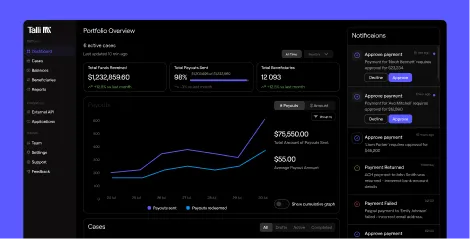
Real-time dashboards transform administrative oversight by giving claims teams a current view of distribution progress. Instead of waiting for bank statements, spreadsheet updates, and manual reconciliation, administrators can monitor payment status as it changes.
Useful reporting views include:
- Redemption tracking by payment method and claimant segment
- Failure analysis showing rejected ACH transfers, expired cards, returned mail, and claimant drop-off points
- Fraud review queues showing claims requiring manual review before payment release
- Geographic concentration reports identifying regional delivery or verification issues
- Fund balance monitoring showing remaining settlement funds, payments in flight, and unresolved exceptions
Automated settlement reconciliation can dramatically reduce monthly close time by matching claimant records, bank activity, and fund balances in one workflow. That matters because settlement administration is not finished when payments are issued. It is finished when payments are delivered, exceptions are resolved, funds are accounted for, and the court receives a defensible record.
Minimizing Payout Risks: Common Disqualification Factors and How to Avoid Them
Common Reasons for Claim Disqualification
Several factors can disqualify otherwise legitimate-looking claims:
- Duplicate submissions: The same claimant files multiple times, often with slight name, address, or email variations
- Identity verification failures: Provided information does not match authoritative records
- Eligibility violations: Claimants fall outside the settlement class definition
- Documentation gaps: Required supporting materials are missing, incomplete, or inconsistent
- Sanctions matches: OFAC screening identifies a prohibited party or unresolved potential match
- Payment detail inconsistencies: Bank account or wallet details do not align with claimant information
- Late submissions: Claims arrive after the deadline set by the court-approved process
Mitigating Risks Through Advanced Verification Processes
Robust verification prevents improper payments while reducing friction for legitimate claimants.
Pre-payment validation confirms payment amounts and eligibility before funds are released. Systems should verify claim details against the court-approved distribution plan automatically.
Multi-factor authentication for claimant portal access helps prevent account takeover. SMS verification, email confirmation, or similar controls add security without creating unnecessary friction.
Document verification can use automation to identify incomplete forms, altered documents, or inconsistent evidence. AI-assisted review does not replace human judgment, but it can prioritize suspicious items and reduce manual workload.
Continuous monitoring flags status changes between claim submission and payment. Address changes, bank account updates, repeated failed deliveries, and suspicious login activity can trigger additional review before funds move.
Case Study: Achieving Higher Redemption Rates and Cost Reductions
AB Data, one of the largest U.S. claims administrators managing settlements worth hundreds of millions of dollars, transformed its disbursement operations through digital payment infrastructure.
Results achieved:
- 30% increase in claimant redemption rates across check-issued populations
- 60% reduction in unresolved exceptions and manual reissuance overhead within 12 months
- 100% fiduciary compliance record maintained across all distribution cycles
- Faster time to funds for claimants while lowering distribution costs
As Thomas R. Glenn, President and CEO of AB Data, stated: "We don't think of digital disbursement as a feature, we think of it as infrastructure. Talli gave us the regulated payout rails we needed to move faster, reduce unclaimed funds, and give courts full confidence in how settlement money is being distributed."
The transformation demonstrates practical benefits for high-volume programs:
- Time saved: Manual payment processing and exception handling can fall sharply when payment selection, reminders, fraud review, and reconciliation are automated
- Higher success: Digital channels can improve payment success compared with mailed checks
- Cost savings: Administrators can reduce postage, printing, reissue, and support costs
- Settlement velocity: Digital-first workflows can shorten the path from final approval to claimant redemption
For administrators, the lesson is clear. Redemption rates improve when payment choice, claimant communication, fraud controls, and reconciliation operate from the same system.
The Future of Claimant Payments: Global Reach and Scalability
Modern settlements increasingly involve international claimants, mobile-first claimants, and claimant populations with uneven banking access. Digital platforms can support multi-jurisdictional programs through global payment methods, multi-currency capabilities, localized communications, and privacy controls.
International distributions require more than a payment rail. Administrators must account for currency conversion, sanctions screening, data privacy, claimant support, tax documentation, local banking requirements, and reporting obligations. A strong global payout workflow should combine payment execution with compliance and auditability.
Scalable architecture matters because large settlements rarely move in a straight line. Administrators may need phased rollouts, test batches, claimant reminders, payment retries, fraud holds, manual review queues, and final court accounting. A system that performs well for 1,000 claimants should also be able to support 100,000+ claimants without losing visibility.
Implementation timelines vary by case complexity, payment methods, fund structure, claimant data quality, and court requirements. Many digital disbursement programs can be configured in weeks, especially when the platform already supports bulk upload, claimant communication, payment preference collection, fraud screening, and reporting.
Why Talli Closes the Settlement-to-Claimant Gap
Talli delivers purpose-built infrastructure for legal settlement compliance rather than generic payment processing. The platform addresses the core problems that create the settlement-to-claimant gap: slow delivery, low redemption, manual follow-up, fraud exposure, fund segregation, and incomplete reporting.
Comprehensive Payment Options: Talli supports multiple claimant payment methods, including ACH, prepaid Mastercard via Patriot Bank, N.A., PayPal, Venmo, gift cards through InComm, and paper check fallback. This flexibility helps every claimant choose a practical way to receive funds, regardless of banking status or technology comfort level. When claimants have real payment choice, redemption can improve and support tickets can fall.
AI-Powered Fraud Protection: Talli applies fraud mitigation across device, behavioral, identity, and payment signals. For high-volume settlements, automated screening helps administrators identify suspicious patterns before funds leave the account. That is critical in an environment where fraudulent submissions can arrive at a massive scale.
Built-In Compliance Automation: KYC verification, OFAC screening, W-9 collection, 1099 workflows, audit logs, and matter-level reporting operate inside the platform. Administrators do not need to stitch together disconnected tools for verification, communication, payment release, and reconciliation.
Fund Segregation and Auditability: Dedicated accounts help maintain separation between settlement funds and operating funds. Complete payment records, claimant status updates, and reconciliation data support court reporting and fiduciary oversight. Talli’s audit trail functionality helps claims teams show what happened at every stage of the distribution process.
Proven Performance at Scale: Unlike generic payment processors that require customization for settlement workflows, Talli is designed for class action, mass tort, bankruptcy, and shareholder services distributions. The platform supports bulk claimant populations, phased rollouts, real-time dashboards, and final reconciliation.
With banking services provided by Patriot Bank, N.A., Member FDIC, Talli gives claims administrators regulated payout rails, built-in compliance, and real-time visibility. The AB Data case study demonstrates the operational impact: 30% higher claimant redemption rates, 60% fewer unresolved exceptions, and 100% fiduciary compliance maintained across all distributions.
For claims teams under court deadlines, the priority is not simply sending payments faster. It is sending the right payments, to the right claimants, through the right channels, with a record that stands up to scrutiny. Talli helps administrators close that gap from settlement approval to claimant redemption.
Frequently Asked Questions
What is the primary challenge with traditional settlement payments?
Traditional paper check disbursements often produce low cash rates, high administrative cost, and long exception cycles. Checks can be lost, returned, stolen, ignored, or left uncashed until they require reissue or additional handling. For administrators, the challenge is not only sending the payment. It is proving that funds reached eligible claimants or were handled properly when they did not.
How do digital platforms improve redemption rates?
Digital platforms improve redemption by giving claimants faster, easier ways to receive funds. ACH, PayPal, Venmo, prepaid cards, gift cards, and other options reduce reliance on mail and bank branch access. Automated reminders also help claimants complete payment selection before deadlines pass.
What compliance features are essential for settlement payments?
Essential compliance features include KYC identity verification, OFAC sanctions screening, W-9 collection, 1099 support, backup withholding logic, fund segregation, audit logs, and court-ready reporting. The strongest platforms connect these workflows directly to payment release and reconciliation.
Can digital platforms handle large-scale settlements?
Yes. Modern settlement platforms can support programs ranging from thousands to hundreds of thousands of claimants. The key is having bulk upload, automated validation, phased rollout, fraud review queues, payment tracking, claimant communication, and reconciliation in one system.
How do digital platforms prevent fraudulent claims?
Digital platforms use device fingerprinting, behavioral analytics, duplicate detection, identity verification, velocity checks, and payment-detail validation. These tools flag suspicious claims before funds move, while still allowing legitimate claimants to complete the payment process with minimal friction.
Do FBO accounts automatically create QSF tax treatment?
No. Dedicated FBO accounts support fund segregation and proper settlement administration, but QSF tax treatment depends on the fund satisfying IRC Section 468B requirements. Administrators should work with counsel, tax advisors, and qualified fiduciary partners to structure funds correctly.
Should paper checks disappear completely?
Not necessarily. Paper checks should remain available when required by the settlement plan or when a claimant specifically needs one. The better approach is digital-first distribution with paper check fallback, so claimants have practical choices and administrators reduce avoidable check-related costs.
Why use Talli instead of a generic payment processor?
Talli is purpose-built for legal settlement distributions. It combines payment choice, KYC, OFAC screening, W-9 collection, fraud mitigation, fund segregation, audit trails, real-time dashboards, and reconciliation in one workflow. Generic payment processors may move money, but they often do not include the settlement-specific compliance and reporting infrastructure claims administrators need.