.svg)


.svg)
Settlement administrators managing class action, mass tort, and bankruptcy distributions face a silent threat: by the time funds are ready to disburse, the bank account numbers, addresses, and contact details collected during claim submission have quietly become outdated. Because settlement distributions can extend well beyond initial claim submission, previously accurate bank accounts, mailing addresses, email addresses, and phone numbers may change before funds are ready to disburse. Administrators that rely on claimant data collected months or years earlier therefore face a meaningful risk of payment failures and unreachable recipients. Digital disbursement platforms with integrated verification workflows address this structural challenge by refreshing payee data systematically rather than reactively.
Key Takeaways
- Claimant contact and banking details can become outdated during long settlement timelines, making pre-disbursement verification important before funds are released
- Organizations managing payments across 10+ banks carry 15-25% inaccurate payee records at any given time due to fragmented portal systems
- Traditional paper-based distributions achieve approximately 70-80% redemption rates, while digital methods can reach 95-98%
- In Talli's AB Data case study, digital disbursement contributed to a 30% increase in claimant redemption rates while reducing unresolved exceptions and reissuance work
- Verification of Payee (VoP) requirements took effect for euro-area payment service providers on October 9, 2025 for SEPA credit transfers and instant credit transfers, reinforcing the shift toward payment-time account-name verification
- Automated identity verification achieves 92% match rates using minimal data (phone + partial SSN), enabling verification at scale
- Poor data quality can create substantial operational costs across organizations, while inaccurate payee records specifically drive failed payments, manual remediation, and additional claimant outreach
Understanding the Challenge: Why Payee Data Decays in Recovered Funds
Data decay isn't administrator negligence. It's a structural consequence of settlement timelines colliding with natural information degradation. Four distinct mechanisms drive this decay:
- Natural aging: Gradual staleness as time passes without updates
- Logical decay: Records that remain technically valid but functionally wrong (e.g., closed bank accounts still on file)
- Mechanical decay: System errors corrupting previously accurate data
- External/structural decay: Single events like bank mergers invalidating entire record segments simultaneously
Individual-level fields (phone numbers, email addresses, bank account details, physical addresses) decay significantly faster than institutional data. Business contact databases are commonly estimated to decay by roughly 2% per month, but settlement administrators should not assume the same rate applies directly to claimant banking and personal contact information.
The Cost of Outdated Information in Legal Disbursements
The financial impact extends beyond failed payments. Top 15 U.S. banks collectively spend $3 billion annually handling and processing payment disputes. Failed or returned payments create additional reconciliation, claimant outreach, and reissuance work for settlement administrators, especially when banking information has changed since claim submission. For settlement administrators, each payment failure triggers manual research, cure notices, check reissuance, and eventually escheatment processes for unclaimed funds.
Factors Contributing to Payee Data Inaccuracy
Settlement distributions follow predictable but prolonged timelines:
- 2-6 months: Claim filing window after preliminary approval
- 6-18 months: Claim review and cure notices
- 3-12 months: Tier placement and allocation
- 3-12 months: Lien resolution (often concurrent)
- 12-24+ months: Payment waves begin
The typical claimant receives payment 1-2 years after preliminary settlement approval, with complex distributions taking 3+ years. During this window, claimants change banks, move addresses, abandon email accounts, and have phone numbers reassigned, all while the settlement fund works through its mandatory administrative process.
Combatting Unclaimed Funds: The Impact of Address Verification
Address accuracy directly determines whether claimants receive their entitled funds or those funds eventually escheat to state governments. When physical mail returns undeliverable, administrators face costly manual tracking processes and extended fund maintenance obligations.
Strategies for Proactive Address Verification
Effective address verification requires systematic approaches rather than reactive remediation:
- USPS address standardization during claim intake to catch formatting errors before they cause delivery failures
- NCOA (National Change of Address) database matching to identify forwarding addresses for claimants who moved after filing
- Real-time validation through online verification tools that confirm deliverability before mailing
- Multi-channel contact strategies combining physical mail with email and SMS notifications
Returned mail management becomes operationally significant when distributions scale to tens of thousands of claimants. Each returned piece requires investigation, skip tracing, and potential reissuance, adding months to distribution timelines.
Minimizing Escheatment Risks with Accurate Addresses
State unclaimed property laws impose specific dormancy periods (typically 1-5 years) before funds escheat. Administrators must demonstrate due diligence efforts to locate claimants before reporting funds as unclaimed. Proactive address verification reduces the volume of funds entering dormancy cycles and the associated compliance burden.
Streamlining Financial Payouts: The Role of Bank Account Verification
Bank account details present unique verification challenges. Unlike addresses that can be updated through mail forwarding, ACH transactions to closed or changed accounts simply fail, triggering return codes, exception handling, and claimant frustration.
Real-Time Bank Verification for Efficient Disbursements
Modern verification approaches validate bank details before payment release:
- Account number and routing number format validation catches data entry errors
- Account status verification confirms accounts remain open and can receive deposits
- Name-matching verification ensures the account holder matches the intended payee
The EU's Instant Payments Regulation requires euro-area payment service providers to offer Verification of Payee for SEPA credit transfers beginning October 9, 2025. Unlike the UK's existing Confirmation of Payee (CoP) system, VoP requires name-matching verification for every payment, not just new payees. This regulatory shift signals growing expectations for payment-time verification even in markets without explicit mandates.
Reducing Payment Exceptions Through Automated Checks
Digital disbursement platforms integrate verification directly into the payment workflow, catching errors before funds leave the settlement account. This approach transforms verification from a remediation activity into preventive infrastructure, identifying decayed data during payment preparation rather than after payment failure.
Integrated Data Cleansing for Optimal Client Contact Management
Effective payee data management requires treating data cleansing as continuous infrastructure rather than periodic cleanup projects. Settlement administrators need comprehensive reporting and reconciliation capabilities that surface data quality issues proactively.
Best Practices for Ongoing Data Maintenance
Data cleansing for settlement distributions should address:
- Duplicate detection to prevent multiple payments to the same claimant
- Format standardization ensuring consistent data structures across claim records
- Validation against external sources (identity databases, banking networks, postal services)
- Change tracking with audit trails documenting when and how data was updated
CRM synchronization via webhooks enables real-time status updates to case management systems, ensuring all stakeholders work from current data rather than stale exports.
Leveraging Technology for Comprehensive Data Cleansing
Organizations managing payments across multiple banks face a fundamental problem: payee records exist in separate, unsynchronized portals that drift independently. When a claimant updates banking information, that change propagates to whichever system the administrator updates first, but other portals retain outdated details until manually corrected one by one.
Payment infrastructure analysis found organizations managing 10+ bank relationships carry 15-25% inaccurate or outdated payee records at any given time. Vendor banking changes take 2-4 weeks to propagate across all portals because teams process them sequentially alongside daily operations.
AI-Powered Solutions for Proactive Payee Data Management
Artificial intelligence transforms payee data management from reactive remediation to predictive maintenance. Machine learning models trained on payment patterns can identify records likely to fail before payment attempts occur.
Predicting Data Decay with Artificial Intelligence
AI-powered verification achieves 92% match rates using minimal data inputs (phone number + partial SSN), enabling administrators to verify and refresh payee information at scale. These systems auto-complete 70%+ of profiles while flagging high-risk exceptions for human review.
Pattern recognition across device fingerprinting, behavioral analytics, and identity verification can help reduce fraudulent claims while identifying legitimate data decay requiring refresh rather than rejection.
Securing Disbursements with Advanced Data Checks
Fraud detection systems must distinguish between malicious manipulation and organic data decay. A claimant whose bank account changed legitimately presents differently than a fraudster attempting to redirect payments. One claims administrator reported receiving 80 million fraudulent claims in 2023, a 19,000% increase from the number it reported in 2021, highlighting the scale automated fraud attempts can reach and underscoring the need for sophisticated verification that catches fraud without blocking legitimate updates.
The Digital Advantage: Fast, Flexible, and Compliant Payment Processing
Digital disbursement platforms purpose-built for legal settlements deliver structural advantages over traditional check-based methods. These platforms compress distribution timelines from 6-8 weeks to 24-48 hours while achieving higher redemption rates compared to paper methods.
Transforming Settlement Payments with Digital Solutions
Multi-channel payment distribution lets claimants choose their preferred payment method:
- ACH direct deposit: Lowest cost at $0.25-$0.50 per transaction, 1-2 day delivery
- Prepaid Mastercard: Virtual cards delivered via SMS/email in 30 seconds, serving unbanked claimants
- Digital wallets: PayPal and Venmo integration for instant access
- Gift cards: Highest redemption rates for small-value distributions
- Paper checks: Maintained as fallback despite higher costs
Payment choice directly impacts take-up rates. Offering multiple channels increases the likelihood claimants can receive funds even when their primary banking details have changed.
Achieving High Redemption Rates Through Digital Channels
The AB Data case study demonstrates measurable outcomes: 30% increase in claimant redemption rates across check-issued populations and 60% reduction in unresolved exceptions within 12 months. As AB Data's President & CEO Thomas R. Glenn noted, "We don't think of digital disbursement as a feature. We think of it as infrastructure."
Ensuring Fiduciary Compliance with Segregated Funds and Automated W-9s
Fiduciary obligations require demonstrable processes for maintaining fund integrity and tax compliance throughout the distribution lifecycle. QSF trustees must preserve Qualified Settlement Fund tax treatment under IRC Section 468B while ensuring proper documentation of all disbursements.
Maintaining Audit-Ready Documentation for Settlement Funds
Dedicated FBO (For Benefit Of) account structures help keep settlement assets segregated from operating funds. For Qualified Settlement Funds, asset segregation is one of the requirements under Treasury Regulation Section 1.468B, while matter-level tracking also simplifies court reporting and maintains audit-ready documentation throughout the disbursement lifecycle.
Simplified Tax Compliance for Legal Payouts
Automated W-9 collection via digital forms with DocuSign integration achieves 90% completion rates through smart reminders versus 40% for manual processes. Integrated 1099-MISC/1099-NEC generation with IRS e-filing reduces compliance burden while automated 24% backup withholding calculation handles missing TIN numbers per IRS requirements.
Real-Time Visibility: Monitoring Payment Status and Data Accuracy
Live dashboards transform payment administration from periodic batch reporting to continuous monitoring. Administrators need real-time visibility into completion rates, failure root causes, and remaining fund balances to identify and address data decay before it cascades into operational crisis.
Proactive Identification of Data-Related Payment Issues
Real-time tracking enables immediate response when payments fail. Rather than discovering failed ACH transactions in next-day reports, administrators can see failures as they occur and initiate remediation within hours rather than days.
Key monitoring capabilities include:
- Completion rate tracking showing percentage of successful payouts
- Payment method distribution across ACH, cards, and wallets
- Failure root cause analysis distinguishing data decay from other issues
- Fraud flags requiring human review before payment release
Empowering Administrators with Actionable Insights
Automated reporting generates court-required accounting without manual preparation. Stakeholder portals provide controlled access for courts, trustees, and legal teams while maintaining complete audit trails documenting every payment attempt, verification result, and status change.
From Paper to Digital: Reducing Costs and Increasing Redemption
The economic case for digital disbursement becomes compelling when examined against the full cost of paper-based distribution. Processing costs can drop from approximately $7-20 per check to substantially lower per-payment costs for digital methods, depending on the payment rail and distribution requirements.
The Economic Benefits of Digital Disbursement
Beyond per-transaction savings, digital methods eliminate:
- Returned mail handling: Skip tracing, address research, remailing
- Check reissuance: Stale-dated checks requiring reprinting and redistribution
- Escheatment processing: Compliance overhead for unclaimed funds
- Extended fund maintenance: Holding costs while tracking unredeemed checks
Traditional paper-based methods achieve approximately 70-80% redemption rates, leaving a meaningful share of payments unredeemed and requiring additional follow-up. Each unclaimed payment creates ongoing liability and eventually requires escheatment filing.
Boosting Claimant Satisfaction with Faster, More Reliable Payouts
Digital platforms with integrated verification address the root cause of unclaimed funds: data decay combined with inflexible payment methods. When claimants can update their information through secure portals and choose how to receive payments, redemption rates rise dramatically while administrative overhead falls.
Mass tort distributions involving hundreds of thousands of claimants make this efficiency essential. Meaningful improvements in redemption rates across large settlements translate to substantial additional funds reaching entitled claimants rather than escheating to state governments.
Talli: Purpose-Built Infrastructure for Settlement Data Management
Talli's digital disbursement platform addresses payee data decay through integrated verification workflows that systematically refresh contact and banking information before payment release. Purpose-built for class action and mass tort settlements, Talli combines AI-powered identity verification, multi-channel payment distribution, and real-time monitoring to improve redemption rates while reducing manual remediation work.
Verification and Payment Infrastructure
The platform supports settlement administrators with:
- 92% match rates using minimal data inputs, auto-completing profiles at scale while flagging exceptions for review.
- Integrated fraud detection that distinguishes legitimate data changes from malicious attempts without blocking valid updates.
- Multi-channel payments through ACH, prepaid cards, digital wallets, and checks, helping claimants receive funds when primary banking details change.
Compliance and Visibility
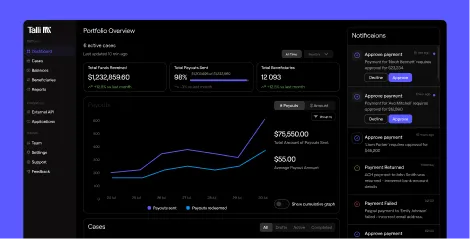
Dedicated FBO account structures maintain proper fund segregation for QSF compliance, while automated W-9 collection and 1099 generation simplify tax reporting. Real-time dashboards provide visibility into payment status, completion rates, and failure root causes, enabling proactive intervention before data decay creates larger operational problems.
By treating verification as preventive infrastructure rather than reactive remediation, Talli helps settlement administrators deliver entitled funds efficiently while maintaining fiduciary standards and audit-ready documentation throughout the distribution lifecycle.
Frequently Asked Questions
How long does payee data remain accurate after initial collection?
For settlement distributions with 1-3 year timelines from claim filing to payment, administrators should assume a meaningful portion of initially accurate contact and banking information will require refresh by the time payments are ready to release. Business contact databases commonly decay by roughly 2% monthly, though individual-level banking and contact fields may degrade differently.
What triggers escheatment obligations for unclaimed settlement funds?
State unclaimed property laws impose dormancy periods (typically 1-5 years) before funds must be reported to state governments. Before escheatment, administrators must conduct due diligence efforts to locate claimants, typically certified mail with specific timing requirements. Proactive data refresh and multi-channel payment options reduce funds entering dormancy cycles.
How does Verification of Payee (VoP) differ from traditional bank account validation?
Traditional validation confirms account and routing numbers are properly formatted and the account exists. VoP matches the payee name provided against the name registered to the recipient's bank account. Euro-area payment providers must offer VoP for SEPA transfers as of October 2025, requiring real-time name-matching for every transaction.
What compliance penalties exist for inadequate payee verification?
U.S. regulators issued $4.3 billion in AML/KYC/compliance penalties in 2024. Settlement administrators subject to U.S. sanctions requirements must avoid prohibited transactions with blocked or sanctioned parties. Risk-based sanctions screening before payment release is an important control for identifying potential OFAC exposure and documenting compliance.
What happens when AI verification flags a legitimate claimant as potentially fraudulent?
Sophisticated systems distinguish between fraud indicators and organic data changes. A claimant whose bank account changed legitimately presents different patterns than attempted payment redirection. Flagged transactions receive human review before rejection, with claimants offered secure channels to verify identity and update information, preventing both fraudulent payments and legitimate claimant frustration.