.svg)


.svg)
Settlement administrators face a critical challenge that batch processing systems simply cannot solve: maintaining accurate, court-defensible fund balances from the moment a Qualified Settlement Fund receives its initial deposit through the final claimant payment. The gap between when transactions occur and when ledgers update creates reconciliation nightmares, audit vulnerabilities, and payment errors that undermine fiduciary obligations. Purpose-built QSF digital disbursement platforms address this running balance problem by recording every transaction atomically as it happens, eliminating the drift that plagued systems like RushCard and resulted in $10 million in restitution.
Key Takeaways
- Real-time ledger systems eliminate the gap between "what happened" and "what the system shows," preventing the balance drift that causes reconciliation failures
- Batch processing can increase reconciliation gaps because transaction activity may occur before account balances and reporting systems are fully updated
- Purpose-built QSF platforms deploy in 1-4 weeks versus 6-18 months for generic ledger solutions or 18-36 months for custom builds
- QSF assets must remain segregated from the transferor and related parties under IRC § 468B, while dedicated settlement accounts can strengthen fund controls, reporting, and potential FDIC coverage arrangements
- Digital disbursements achieve 30% higher redemption rates compared to traditional check-only distributions
- Automated compliance workflows can complete many OFAC and identity checks in seconds or minutes, with exceptions requiring additional review
- Court-ready reporting generated in minutes replaces days of waiting for vendor-prepared reconciliation documents
Understanding Qualified Settlement Funds and Their Purpose
A Qualified Settlement Fund (QSF) under IRC Section 468B serves as a court-supervised holding entity for settlement proceeds, providing specific tax advantages and liability protections when properly established. A QSF generally cannot qualify retroactively to a date before the required governmental order or approval, so administrators should establish the fund before transferring settlement proceeds intended to receive QSF treatment.
Defining a QSF: Legal and Tax Implications
QSFs operate as separate legal entities that allow defendants to claim tax deductions immediately upon funding while claimants defer tax liability until actual distribution. This structure requires:
- Court establishment order obtained prior to any fund transfers
- Dedicated FDIC-insured accounts titled to indicate fiduciary capacity
- Complete fund segregation preventing commingling with operating capital or other settlements
- Detailed transaction records supporting Form 1120-SF annual filing requirements
The tax treatment preserves significant value for all parties, but only when administrators maintain precise ledger records demonstrating proper fund management throughout the distribution lifecycle.
Why QSFs Are Essential in Legal Settlements
Beyond tax advantages, QSFs provide critical operational benefits for class action settlements involving thousands of claimants:
- Liability protection for settling defendants once funds transfer to the QSF
- Flexible distribution timing allowing administrators to resolve liens and complete verification before disbursement
- Interest accrual that benefits claimants rather than defendants during extended administration periods
- Simplified court reporting with clear fund segregation supporting audit requirements
The Challenge of Real-Time Trust Accounting for Settlement Administrators
Traditional batch processing systems create a fundamental problem: the gap between when financial events occur and when ledgers reflect those changes. This delay generates the "running balance problem" where administrators cannot definitively answer basic questions like "What is the current fund balance?" or "How much remains available for distribution?"
Why Traditional Accounting Fails in Dynamic Settlements
Batch systems process transactions in scheduled cycles, typically nightly, meaning balances shown during business hours may not reflect pending transactions. For settlement administration, this creates specific failures:
- Balance conflation between ledger balance, available balance, and pending balance
- Intraday uncertainty during active distribution periods when courts or counsel need immediate answers
- Reconciliation gaps requiring manual investigation after each processing cycle
- Audit vulnerabilities when transaction timing cannot be precisely demonstrated
The RushCard incident illustrates the consequences of unreliable ledger and payment-processing infrastructure. Failures during a major processor conversion led to delayed and incorrectly posted transactions, inaccurate balances, and widespread loss of access to funds, ultimately resulting in regulatory action and significant restitution requirements.
The High Cost of Manual Reconciliation and Error Correction
Administrators using spreadsheet-based tracking or batch systems spend significant time on manual data entry and reconciliation tasks. Beyond time costs, manual processes introduce:
- Error rates requiring costly correction cycles
- Delayed identification of failed payments
- Incomplete audit trails for disputed transactions
- Extended distribution timelines frustrating claimants and courts
Key Components of Effective Settlement Fund Management
Proper QSF ledger management requires tracking multiple interconnected elements from initial deposit through final payment and escheatment reporting.
From Initial Deposit to Final Disbursement: A Workflow Overview
Effective fund management tracks every transaction type:
- Inflows: Settlement funding, interest income, returned payment reversals
- Outflows: Claimant distributions, fee deductions, lien payments, tax withholding
- Reserves: Amounts held pending lien resolution or disputed claims
- Expenses: Administrator fees, banking costs, compliance services
Each transaction must post as an atomic double-entry event where debits always equal credits, maintaining balance integrity across all accounts.
Tracking Every Transaction: The Foundation of Trust
Audit trail requirements demand that every fund movement includes:
- Timestamp showing exact transaction moment
- User identification for accountability
- Before and after balance states
- Supporting documentation references
- Compliance screening results
This granular tracking enables point-in-time balance reconstruction, answering auditor questions like "What was the reserve balance on March 14 at 3:42 PM?"
Digital Solutions for Real-Time Fund Tracking and Compliance
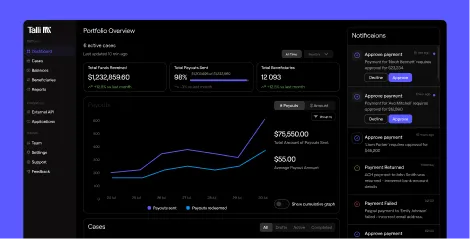
Real-time ledger systems solve the running balance problem by recording transactions atomically as they occur, eliminating the gap between event occurrence and ledger update.
Leveraging Technology for Unprecedented Accuracy
Modern digital disbursement platforms improve payment tracking, reconciliation accuracy, and financial reporting compared to manual processes through:
- Atomic double-entry posting ensuring every transaction maintains balanced books
- Running balance materialization with pre-computed balances updated alongside each write operation
- Per-settlement account segregation maintaining separate ledgers for each QSF automatically
- Immutable audit trails recording every change with complete before/after documentation
Beyond Spreadsheets: The Future of Settlement Accounting
Purpose-built QSF platforms integrate compliance directly into ledger operations rather than treating it as a separate workflow:
- OFAC screening executes automatically before every payment release
- KYC verification can automate identity checks in real time or near real time, with exceptions routed for additional review
- W-9 collection achieves 90% completion rates through automated smart reminders
- 1099 generation connects directly to actual payment records, eliminating year-end reconciliation
Ensuring Fiduciary Compliance and Mitigating Risk in Fund Management
Settlement administrators bear strict fiduciary obligations requiring accurate fund accounting and transparent reporting. Real-time ledgers directly support these requirements.
Avoiding Penalties: The Cost of Non-Compliance
Compliance failures carry significant consequences:
- Bar association violations for fund commingling
- IRC § 468B disqualification if fund segregation requirements fail
- FDIC insurance loss when pass-through requirements aren't met
- Court sanctions for inadequate distribution accounting
Platforms with embedded compliance automation reduce these risks by ensuring screening occurs on every transaction without administrator intervention.
Building an Impenetrable Audit Trail for Every Dollar
Court reporting requirements increasingly demand real-time access to fund status. Self-service dashboards allow administrators and counsel to:
- Generate current balance reports instantly
- Review transaction history with full documentation
- Track payment completion rates by distribution method
- Identify exceptions requiring manual review
- Export court-ready accounting without vendor delays
The Role of Escrow Accounts in Securing Settlement Funds
While QSFs and escrow accounts both hold funds on behalf of others, they serve distinct purposes in settlement administration.
How Escrow Differs from QSFs: A Critical Distinction
Escrow accounts provide neutral third-party holding pending specific conditions, while QSFs offer tax-advantaged structures specifically for legal settlements. Key differences include:
QSF characteristics:
- IRC § 468B tax benefits for defendants and claimants
- Court order required for establishment
- Primary purpose is settlement distribution
- IRS and court supervision framework
Escrow account characteristics:
- No special tax treatment
- Contract-based establishment
- Conditional holding purpose
- State escrow regulations apply
Leveraging Escrow for Enhanced Fund Security
Some settlement structures use escrow accounts within the broader QSF framework for specific purposes:
- Holding disputed amounts pending resolution
- Securing lien payments awaiting final calculations
- Managing attorney fee holdbacks
- Protecting reserves for future distribution rounds
FDIC-compliant payout structures require proper titling and beneficiary documentation regardless of whether funds sit in QSF accounts or related escrow arrangements.
Optimizing Disbursement for Speed and Redemption Rates
The ultimate test of QSF management is getting funds to claimants efficiently while maintaining complete accountability.
From Funding to Claimant: Accelerating the Payment Journey
Digital disbursement platforms compress timelines dramatically. Traditional check-based distributions require 6-8 weeks from funding to completion, while purpose-built platforms achieve:
- 24-48 hour payment cycles for digital methods
- Virtual card delivery in about 30 seconds via SMS/email
- 1-2 day ACH transfers at approximately $0.25-$0.50 per transaction
- Same-day wire options for high-value international payments
Minimizing Unclaimed Funds Through Modern Payment Channels
Unclaimed settlement funds represent failed administration. Traditional paper methods can leave 20-30% of payments unredeemed, creating additional reissuance, reconciliation, and residual-fund work. The ultimate treatment of those funds depends on the settlement agreement, court order, and applicable unclaimed-property requirements. Multi-channel digital options address this directly:
- ACH direct deposit: Preferred by banked claimants, lowest cost
- Prepaid Mastercard: Provides an alternative for claimants without traditional bank accounts, including the approximately 5.6 million U.S. households the FDIC identified as unbanked in 2023
- Digital wallets: PayPal and Venmo for immediate access
- Gift cards: Highest redemption for small-value distributions under $100
Case Studies: Real-World Impact of Digital Disbursement Platforms
Documented results demonstrate the measurable benefits of purpose-built QSF platforms over traditional methods.
Transforming Settlement Administration: Before and After
AB Data, a leading U.S. claims administrator managing settlements worth hundreds of millions of dollars, implemented digital disbursement infrastructure with documented results:
- 30% increase in claimant redemption rates
- Faster time to funds for claimants
- Lower distribution and reissuance costs
- Greater transparency across payment outcomes
Thomas R. Glenn, President & CEO of AB Data, characterized the transformation by emphasizing that digital disbursement should be treated as essential infrastructure rather than an optional feature.
Quantifiable Benefits: Reducing Costs and Increasing Payouts
Platform costs vary significantly based on settlement size, payment methods, compliance requirements, integrations, and service scope. Administrators evaluating solutions should compare total costs across implementation, transaction processing, reconciliation, compliance, support, and ongoing administration to determine the most cost-effective approach.
The three-way reconciliation capabilities of purpose-built platforms help reduce monthly closing time by automating transaction matching, identifying discrepancies, and minimizing the manual intervention required by batch systems.
Future-Proofing Your Settlement Fund Ledger: Trends and Innovations
Settlement administration technology continues advancing, with AI and machine learning driving significant improvements in fraud detection and process automation.
The Evolving Landscape of Legal Finance
Emerging capabilities reshaping QSF management include:
- AI-powered fraud detection achieving 95% accuracy while identifying fraud 50% faster than manual review
- Predictive analytics for redemption rate optimization
- Blockchain-enabled audit trails for enhanced transparency
- Cross-border payment innovation supporting international claimant populations
Staying Ahead: Adopting Next-Generation Fund Management Tools
Administrators evaluating platforms should prioritize:
- Real-time balance accuracy eliminating batch processing gaps
- Embedded compliance automation reducing manual verification burden
- Self-service reporting enabling instant court-ready documentation
- Multi-method payout options maximizing claimant redemption
- Scalability handling settlements from 1,000 to 100,000+ recipients
Why Purpose-Built QSF Platforms Matter
The running balance problem is fundamentally an architecture issue. Batch-processing platforms cannot resolve it through configuration changes or workflow adjustments. Only real-time ledger systems that record transactions atomically can deliver the balance accuracy, audit transparency, and court-defensible reporting required for modern settlement administration.
Purpose-built platforms like Talli address these challenges by combining:
- Real-time ledger technology for accurate balances and transparent reporting
- Embedded compliance automation to streamline regulatory requirements
- Multi-channel disbursement capabilities to improve payment delivery
- Operational efficiency through faster distributions, higher redemption rates, and lower costs
- Fiduciary transparency throughout the settlement lifecycle
For administrators managing court-supervised funds, the choice is clear: invest in QSF-specific infrastructure that supports accurate reporting and efficient distributions, or continue facing the reconciliation gaps, audit vulnerabilities, and payment delays common in legacy systems.
Frequently Asked Questions
What happens if a QSF is established after settlement funds have already been received?
Retroactive QSF designation typically fails to qualify for IRC § 468B tax benefits. If funds were received before the court order establishing the QSF, tax counsel must evaluate remediation options, which may include refunding and re-establishing the fund properly. This is why obtaining the court establishment order BEFORE receiving any settlement proceeds is critical. It's not a paperwork formality but a foundational requirement for valid QSF treatment.
How does FDIC pass-through insurance work for QSF accounts, and what documentation is required?
Standard FDIC coverage provides $250,000 per depositor per institution. Some fiduciary settlement-account structures may qualify for FDIC pass-through coverage when the underlying parties are the actual owners of the deposited funds and FDIC recordkeeping and disclosure requirements are satisfied. Coverage depends on the legal ownership structure, account records, identifiable ownership interests, and each owner's other deposits in the same ownership category at the same insured bank. Administrators should not assume that every QSF automatically receives $250,000 of coverage per claimant. Proper account titling indicating fiduciary capacity and maintained beneficiary records are essential, but do not guarantee pass-through treatment.
What is the difference between "ledger balance," "available balance," and "pending balance" in QSF accounting?
Balance conflation causes many production bugs in settlement systems. Ledger balance reflects all posted transactions, money that has definitively moved. Available balance shows funds actually accessible for new disbursements, excluding holds and pending items. Pending balance represents transactions initiated but not yet finalized, such as ACH transfers in process or cards issued but not activated. Real-time ledger systems track all three explicitly, while batch systems often conflate them, creating the "where's my money?" confusion that plagues traditional administration.
How should administrators handle settlements requiring multi-year fund holding while liens are resolved?
Extended administration periods require ledger systems that automate interest posting, track fee accruals per court-approved schedules, and support point-in-time balance queries for quarterly court reports. Purpose-built platforms handle this automatically: interest posts monthly to designated income accounts, fees deduct per schedule, reserves adjust as liens resolve, and period-end reports generate without manual journal entries. The alternative, maintaining parallel spreadsheets for 18-24 months, introduces compounding error risk and audit vulnerability.
What compliance certifications should settlement administrators require from disbursement platform vendors?
SOC 2 Type II certification verifies security, availability, and processing integrity controls through independent audit. This is table stakes for financial platforms. PCI DSS compliance matters if the platform processes payment card data directly. Beyond certifications, administrators should verify embedded OFAC screening (not manual), documented KYC workflows, automated W-9 collection with TIN validation, and 1099 generation capabilities. Platforms lacking these features push compliance burden back onto administrators, creating both risk and operational overhead.