.svg)


.svg)
A bankruptcy trustee should choose a disbursement vendor by confirming whether the workflow can improve redemption, preserve fiduciary controls, and produce defensible records for creditor data, reserves, tax handling, payment exceptions, and final-report evidence.
This guide gives Chapter 7, Chapter 11, and Chapter 13 trustees a practical checklist for reviewing modern claims disbursement vendors, including KYC verification, OFAC screening, multiple payout methods, real-time dashboards, audit transparency, and stale-check closeout evidence.
If you are evaluating a bankruptcy disbursement vendor in 2026, you are probably trying to avoid a familiar problem: the payment process looks manageable until exceptions start stacking up. Stale checks, disputed-claim reserves, tax-form gaps, claimant callbacks, and final-report cleanup usually do not show up in the first demo. They show up later, when the trustee office is already accountable for every break in the record and needs a compliance-critical workflow that can stand up in court.
This review starts with one practical rule: digital claims disbursement that increases redemption rates while preserving fiduciary compliance is not a nice-to-have. A vendor becomes part of your control environment for receipts, disbursements, claimant communications, tax forms, exception handling, and the final report you may have to defend later. If the vendor cannot support segregated client-account handling, FDIC-insured banking through Patriot Bank, N.A., and exportable audit evidence, the problem is not operational inconvenience. It is trustee risk.
This guide breaks down what trustees should verify before moving a live distribution, including chapter-specific workflow fit, ledger exportability, stale-check controls, claimant support, tax readiness, and the evidence quality needed for court and U.S. Trustee scrutiny.
Key Takeaways
- Trustee vendor review should map directly to 11 U.S.C. § 704, including accountability for property received, receipts and disbursements reporting, and final-report support.
- The U.S. Trustee Program says it oversees about 1,100 private trustees, which makes standardized reporting and comparable controls more important, not less.
- Chapter 7 and Chapter 13 stale-check handling is a real diligence issue because 11 U.S.C. § 347 requires trustees to stop payment on checks that remain unpaid 90 days after final distribution and pay remaining estate property into court.
- Chapter 11 disbursement tooling has to support ongoing reporting because the U.S. Trustee Program requires reporting tied to receipts, disbursements, and case status.
- Current Chapter 13 benchmark reporting is active: the U.S. Trustee Program page shows a March 3, 2026 update with FY-2025 audited annual reports.
- A modern digital disbursement infrastructure should reduce manual follow-up, preserve audit transparency, and give creditors or claimants payout choice within a clearly defined support model.
Trustee Requirements for a Disbursement Vendor
A bankruptcy trustee needs a disbursement vendor that can prove control over creditor data, funds, reserves, tax handling, exceptions, and reporting before any live distribution begins. In practice, that means the platform must support trustee-ready ledgers, chapter-specific workflows, and closeout evidence instead of just sending payments quickly.
That standard is higher than “can this platform send money?” A trustee may need to reconcile claim classes, maintain reserve logic for disputed claims, support recurring plan disbursements, and document tax handling. Ranking pages in this space often describe disbursements as a service line, yet they rarely translate those duties into a vendor scorecard the office can actually use. That gap matters because the wrong vendor does not merely create more support tickets. It can slow final reporting, increase reissue work, weaken audit support, and force the trustee office to recreate records the vendor should have produced natively.
In practice, trustees should evaluate vendors the same way they evaluate any other compliance-critical workflow: by control area, by chapter fit, and by evidence quality. An exportable receipts-and-disbursements ledger is the primary evidence a trustee needs when scrutiny arrives.
Why Do Teams Switch Disbursement Vendors?
Trustees revisit disbursement vendors when reserve tracking, exception handling, reporting, and tax workflows still live outside the system and create avoidable cleanup risk.
Trustee-facing service pages surface the same pressure points. Those include reserve handling that lives in side spreadsheets, weak reporting workflows, slow exception handling after failed payouts, and tax-form workflows bolted on late instead of built into the operating process.
The pain is not just administrative. In Chapter 7, stale-payment handling can turn into unclaimed-funds work after final distribution. In Chapter 11, disputed-claim reserves and tax reporting can stay open long after the first payment batch leaves the estate. In Chapter 13, recurring plan distributions expose every weak handoff over time. That is why more trustee teams are shifting from a “can this vendor send money?” mindset to a vendor review standard built around whether the workflow can hold up under scrutiny.
Bankruptcy Trustee Duties That Shape Vendor Selection
Bankruptcy trustee vendor selection is shaped by statutory and reporting duties, not by feature marketing or consumer payout convenience.
Under 11 U.S.C. § 704, trustees must collect and reduce estate property to money, remain accountable for property received, provide estate information to parties in interest, and make a final report and final account. If the debtor’s business is operating, the same section also requires periodic reports that include a statement of receipts and disbursements. Those are not abstract obligations. They define what a disbursement vendor has to support inside the workflow and what evidence the trustee may need later.
Chapter 7 controls and stale-check risk
Chapter 7 vendor selection is driven by liquidation accuracy, final-report support, and cleanup after the last distribution leaves the estate.
The U.S. Trustee Program says it oversees about 1,100 private trustees administering Chapter 7 asset and no-asset cases, and those trustees file final reports that account for asset disposition and distributions. That makes ledger cleanliness and exportability table stakes. It also makes stale-check workflow a first-order diligence topic. Section 347 of the Bankruptcy Code requires a trustee to stop payment on any check remaining unpaid 90 days after final distribution in Chapter 7 or Chapter 13 and pay remaining estate property into court. A vendor that cannot track stop-payment timing and unclaimed-funds escalation creates avoidable cleanup risk after the distribution appears to be complete.
Chapter 11 reserves, tax forms, and classes
Chapter 11 vendor selection should prioritize reserve management, tax readiness, and reporting that holds up across longer and more exception-heavy cases.
The U.S. Trustee Program’s Chapter 11 guidance makes two points that matter for vendor review. First, debtors-in-possession and Chapter 11 trustees must account for the receipt, administration, and disposition of all property and file periodic reports that include receipts and disbursements. Second, quarterly fees continue until the case is closed, dismissed, or converted, and the U.S. Trustee Program now lists a fee schedule effective April 1, 2026 through December 31, 2030, including a 0.9% fee for quarterly disbursements of $1 million or more, capped at $250,000. That means the vendor should support class-based distribution logic, disputed-claim reserves, tax-form collection, and audit-ready reporting across an extended timeline. Reserve management is the most important Chapter 11 capability after basic ledger accuracy. A platform optimized for one-time vendor payments is usually a weak fit for this pattern.
Chapter 13 recurring payments and reporting
Chapter 13 vendor selection should emphasize recurring accuracy, creditor-level visibility, and repeatable reporting over one-time launch theater.
Chapter 13 disbursement operations are different from a one-off liquidation event. Trustees need dependable payment files, routine reconciliations, and reliable creditor records over time. The U.S. Trustee Program’s Chapter 13 statistics page was updated on March 3, 2026 with FY-2025 audited annual reports, which is a useful reminder that standing-trustee reporting is current and measurable. For vendor diligence, that means recurring plan distributions, posting logic, and exception handling should be reviewed with the same seriousness as payout speed. A trustee does not need novelty here. The trustee needs consistency, proof, and fast correction when a payment or creditor record is wrong.
9 Disbursement Vendor Control Areas
Trustees should score disbursement vendors across nine control areas because a polished payout demo rarely shows the operational work that surfaces after go-live.
- Creditor data integrity: confirm the vendor can preserve claim-file accuracy and track changes after cutover.
- Reserve management: confirm disputed-claim reserves can be created, adjusted, and released inside the system.
- Tax readiness: confirm W-9 collection, TIN validation, withholding logic, and year-end exports are built in.
- Ledger exportability: confirm receipts-and-disbursements records export cleanly without manual reconstruction.
- Payment flexibility: confirm electronic payouts and paper fallback stay visible in one workflow.
- Exception handling: confirm failed payouts, verification issues, and claimant support are logged and owned.
- Fund controls: confirm segregated funds, role-based approvals, and timestamped audit trails exist.
- Cutover execution: confirm the vendor has a documented launch plan, dry runs, and named owners.
- Closeout workflow: confirm stale checks, replacements, and unclaimed-funds escalation are not ad hoc tasks.
1. Creditor data integrity and claim-file controls
Good bankruptcy disbursement starts with file integrity, not payment rails. Ask how the vendor ingests claims data, validates creditor records, preserves class logic, and logs changes after cutover. What good looks like is version-controlled imports, role-based approvals for file changes, and a ledger that ties each payment event back to a source record. Red flag: the vendor relies on email attachments and manual spreadsheet edits during live distributions. Demo question: “Show the claims workflow for one changed creditor record from import through payment release.”
2. Disputed-claim reserve management
Reserve handling is a Chapter 11 and complex Chapter 7 issue that generic payout tools often miss. A strong vendor can hold reserve categories separately, document release triggers, and show how reserve adjustments affect downstream reporting. What good looks like is reserve-aware distribution logic with clear reporting by class, claim status, and release date. Red flag: reserves are handled “outside the system” and reconciled later. Demo question: “Show how a disputed claim reserve is established, partially released, and reflected in the final ledger.”
3. Tax forms, withholding, and reporting readiness
Trustees should not have to bolt tax compliance onto the payout workflow after distributions are already in motion. Good platforms support W-9 collection, TIN validation, backup withholding workflows where required, and export-ready reporting for year-end tax forms. That expectation is consistent with the tax workflows trustees increasingly need in legal distributions. Red flag: tax forms are collected through a separate claimant portal or manually by the estate team. Demo question: “Show where W-9 collection happens, what happens to an invalid TIN, and what data exports are available for year-end reporting.”
4. Receipts and disbursements ledger exportability
A vendor’s internal dashboard is not enough if the trustee cannot export records into a usable receipts-and-disbursements package. Good looks like timestamped exports by matter, claimant or creditor, distribution batch, payment method, return reason, and reissue status, especially because final reporting must account for asset disposition and settlement payout activity. The export should be understandable without the vendor’s customer-success manager interpreting it line by line, and it should support court reporting without manual cleanup. Red flag: the only available output is a summary report or a custom export that takes days to generate. Demo question: “Export receipts and disbursements ledger for a closed matter and show how it supports final-report preparation.”
5. Electronic payments with paper fallback
Trustees often prefer vendors that support electronic payments while retaining paper-check fallback for creditors or claimants who cannot receive digital payments. That setup can give the estate more flexibility while keeping payout choice and delivery status in one place. Red flag: the vendor offers only one or two rails and handles alternatives through external partners the trustee cannot see. Demo question: “Show how a recipient changes payout method after an initial payment fails.”
6. Claimant support and exception handling
Many vendor reviews underweight support even though support loops are where trustee offices lose time and credibility. Trustees should look closely at how the vendor handles verification failures, bank-account mismatches, returned payments, and claimant communication status. Good looks like service levels, clear escalation paths, and support notes logged inside the matter record. Red flag: there is no clear handoff model for edge-case communication between the vendor, the trustee office, and outside counsel. Demo question: “Walk through a failed payout, the claimant notification sequence, and the eligibility workflow rules between your team and ours.”
7. Segregated funds, audit trails, and access controls
This control area is where operational fit meets fiduciary defensibility. Trustees should confirm how funds are segregated, who has access to release workflows, and whether every action is timestamped and attributable. Good looks like segregated client-account logic, granular permissions, and audit trails that can be exported, not just viewed. Red flag: one admin role can change payment status, upload a new file, and release funds without a second control. Demo question: “Show the permission model and the complete event log for one payment from funding through final completion.”
8. Scale, timelines, and cutover execution
Trustees should ask whether the vendor can move from signed contract to live matter without turning implementation into a parallel project the estate team has to manage alone. Good looks like documented onboarding timelines, dry-run procedures, cutover signoffs, and a defined owner for implementation. Talli’s bankruptcy page says campaigns can move from setup to live bankruptcy matters in days, not months, which is the kind of operational compression trustees should test in every demo. Red flag: no written cutover plan or no evidence from similar matters. Demo question: “Show the implementation checklist you use for a live bankruptcy distribution and the signoffs required before launch.”
9. Stale payments and unclaimed funds
Cleanup controls matter because distributions are judged by how they close, not just how they start. Section 347 of the Bankruptcy Code makes stale-check handling and unclaimed-funds escalation part of the closeout picture, so trustees should verify how the vendor tracks stale payments, stop-payment actions, and unclaimed-funds escalation. Good looks like a documented workflow and clear evidence for the trustee’s final file. Red flag: the vendor treats stale payments or unclaimed funds as ad hoc back-office tasks. Demo question: “Show how your system handles a stale payment from first notice through replacement or unclaimed-funds disposition.” For trustees, this is not an edge case. It is part of the job description.
Trustee Scorecard
Use a weighted scorecard so that the highest-risk control areas decide the outcome instead of the strongest sales presentation.
Treat those percentages as a sample trustee weighting rubric, then score each area on a 1-5 basis and require written evidence for any score of 4 or 5. A vendor that cannot demonstrate evidence should be rescored down, even if the narrative answer sounds strong. This keeps the process grounded in control maturity rather than presentation quality.
Disbursement Vendor Red Flags for Trustees
The biggest red flags are the ones that force trustees to recreate core evidence outside the platform after money has already moved.
- The vendor cannot show a clean receipts-and-disbursements export tied to batch, recipient, payment method, and exception status.
- Reserve logic lives in a side spreadsheet rather than in the system of record.
- Tax-form collection is deferred until after distribution planning is already complete.
- There is no clear support model for claimant or creditor issues during payout failures.
- The fund-control model is vague, especially around user permissions and release authority.
- Stale-payment handling is treated as manual cleanup.
- The implementation plan depends on custom reporting being built after contract signature or skips insurance review.
None of those problems are theoretical. Each one shifts work back to the trustee office at the exact point when the trustee most needs defensible records and fewer moving parts.
What Should Trustees Ask in a Disbursement Vendor Demo?
Trustees should use demos to force evidence, require live workflow proof, and leave the estate with artifacts it can review after the meeting. Strong vendor criteria turn each demo into evidence the estate can keep.
Ask questions that require the vendor to show a workflow live:
- Show one changed creditor or claimant record from import through payment release.
- Show how a disputed-claim reserve is created, adjusted, and reported.
- Show the W-9 or tax-form collection workflow and an invalid-record exception.
- Export a receipts-and-disbursements ledger for a closed matter.
- Show a failed payment, the support notes around it, and the reissue workflow.
- Show the permissions for releasing funds and editing payment data.
- Show the stale-check or unclaimed-funds workflow for a closed distribution.
- Show the implementation checklist and the launch timeline for a comparable matter.
If the vendor cannot show those workflows without hand-waving, the trustee has learned something useful. The right demo leaves behind proof artifacts the estate team can review later, not just confidence in the presenter’s polish.
How Does Talli Fit Bankruptcy Workflows?
A trustee can view Talli as digital claims disbursement infrastructure that keeps payout choice, claimant support, compliance checks, and audit visibility in one workflow.
Positioning: Digital claims disbursement infrastructure for compliance-critical bankruptcy workflows
Compliance: KYC verification, OFAC screening, segregated client accounts, audit-ready reporting
Pricing: Custom demo-based pricing
Talli fits bankruptcy disbursement work when the trustee wants modern claims disbursements with payout choice, compliance-critical controls, and full audit transparency inside one operating workflow. The bankruptcy page frames the platform around faster payouts, claimant communication handling, a claimant portal, payout-choice selection, dashboard visibility, and compliance support around KYC, OFAC, and audit requirements.
For trustee offices, the practical value is that payment execution, claimant support, delivery status, and audit evidence stay closer together. Talli states that funds move into a segregated client account designed to support compliant fund handling, recipients can select payout methods, and delivery, completion, and engagement status update in real time. That shortens the operational distance between issuing a distribution and proving what happened after issuance.
Talli is also explicit about regulated payout rails and banking infrastructure. Its site states that banking services are provided by Patriot Bank, N.A., Member FDIC, and that related prepaid-card services are issued by Patriot Bank, N.A. The Talli platform also highlights digital payout infrastructure for legal claims teams, while the bankruptcy workflow page emphasizes launch timelines measured in days, not months. For a trustee, those proof points matter because they connect payout speed to control visibility instead of treating speed as the only success metric. In practice, that means less chasing, more redemptions without giving up fiduciary discipline.
Key Features
- Multiple payout methods, including ACH, prepaid Mastercard, PayPal, Venmo, and gift cards, so trustees can compare payout methods without splitting visibility across separate vendors.
- Claimant communication and support handling that keeps failed-delivery or verification issues from defaulting entirely back to the trustee office.
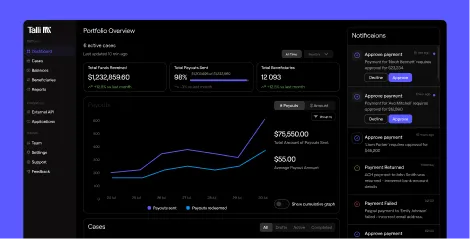
- Real-time dashboard visibility for delivery, completion, and engagement status, which helps trustees monitor live distributions and respond faster to exceptions.
- KYC verification and OFAC screening controls built into the workflow, which matters for compliance-critical legal distributions.
- Segregated client-account structure, FDIC-insured banking through Patriot Bank, N.A., and audit-ready reporting for court-facing diligence.
Why It Fits Trustee Workflows
Talli is purpose-built for legal claims and bankruptcy-adjacent disbursements rather than generic vendor-payments workflows. It combines payout choice, claimant support, compliance checks, and audit transparency in one workflow instead of scattering them across separate systems.
That fit matters when a trustee needs to monitor payment delivery and engagement in real time rather than waiting for end-of-cycle reconciliation. It also matters when the distribution timeline is constrained by court or case milestones and the office needs an implementation path that does not create another manual project.
Trustee Checks Before Go-Live
Before go-live, trustees should confirm how Talli maps reserve logic, claim classes, and ledger exports to the chapter-specific reporting process. They should also verify who owns exception handling when payout details change after approval or when a recipient fails verification. Finally, the estate team should review the exact export package it will use for final reporting, closeout evidence, and downstream system integration.
Talli Conclusion
Trustee diligence should not stop at payment speed. A bankruptcy disbursement vendor has to preserve the record, protect funds, support tax and reserve workflows, and make exceptions visible before they become final-report problems.
Talli is strongest for trustee offices and legal teams that want to replace manual, check-heavy workflows with digital disbursement infrastructure that still feels defensible under fiduciary review. Its value is not only that claimants can choose more flexible payment methods. The stronger fit is that payout choice, claimant support, KYC and OFAC workflows, segregated account handling, and dashboard visibility stay in one operating environment.
For simple one-time payment runs, trustees should still demand reserve logic, exception support, and trustee-ready ledger evidence. For recurring or exception-heavy matters, the same controls become even more important. If the primary need is modern claims disbursements with audit transparency and compliance-critical controls, Request a Demo.
Frequently Asked Questions
What should trustees check first in a vendor?
A bankruptcy trustee should look first for exportable receipts-and-disbursements records, reserve controls, tax readiness, exception handling, and documented stale-check workflow. The right vendor should be able to prove those controls live in the platform before the trustee relies on it for a real distribution.
How are trustee payments sent to creditors?
Trustee payments are sent according to the case chapter, approved distribution rules, creditor records, and the estate’s documented payment process. The vendor should turn approved data into payment batches, track delivery status, handle failures, and preserve ledger evidence behind every creditor payment.
What records must a trustee maintain?
A trustee must maintain records showing receipts, disbursements, payment status, reissues, and final-account support for each estate matter and reporting cycle. In practice, that means the vendor should export records by matter, batch, recipient, payment method, return reason, and reissue status without forcing the trustee office to rebuild the ledger later.
What happens to uncashed checks after distribution?
Checks left uncashed after final distribution should be stopped after 90 days, and remaining estate property should be paid into court as unclaimed funds. That is why stale-payment workflow should be treated as a core diligence item, not a back-office edge case.
How should trustees review reserves and tax handling?
Trustees should ask vendors to demonstrate reserve creation, reserve release, W-9 collection, TIN validation, and year-end tax exports in one demo. If either workflow happens outside the platform, the trustee should expect more reconciliation work and weaker evidence later.
Which controls reduce trustee risk?
Reserve-aware ledgers, role-based approvals, segregated funds, exception tracking, and routine exports give trustees stronger protection during complex distributions. Those controls matter even more in Chapter 11 and Chapter 13 because distributions may recur over time, change by class, or stay open while exceptions are still being resolved.
How long should implementation take?
Implementation should include a written cutover plan, test files, signoff steps, and a named owner before any live bankruptcy distribution launches. If the timeline is vague or depends on building key reports after contract signature, the estate should assume more project risk than the demo suggests.
What if a creditor changes payout details?
The system should pause the payment, log the change request, preserve audit history, and route the exception through a defined approval path. If the only answer is “email us and we’ll handle it,” the trustee should treat that as a control gap.