.svg)


.svg)
The difference between who someone says they are and who they can prove they are represents one of the most important control points in settlement disbursement fraud prevention. High-volume digital claims can expose settlement funds to fabricated identities, duplicate submissions, account takeovers, and coordinated fraud attempts. For settlement administrators managing court-supervised distributions, the gap between claimed and verified identity can determine whether funds reach legitimate claimants or are redirected through fraudulent submissions.
This distinction becomes increasingly important as administrators replace manual review and paper checks with digital workflows. A secure settlement disbursement platform must do more than collect a name, address, and payment preference. It must support appropriate identity checks, sanctions screening, tax-document collection, payment controls, and auditable records without creating unnecessary barriers for legitimate claimants.
Key Takeaways
- Claimed identity is the information a claimant submits, while verified identity is supported by evidence and validation appropriate to the payment’s risk.
- Identity proofing commonly includes identity resolution, evidence validation, confirmation that the identity exists, and verification that the presenter is associated with that identity.
- AI and machine learning can identify patterns that static rules may miss, but detection performance varies by platform, fraud type, data quality, and review thresholds.
- The U.S. Treasury prevented or recovered more than $4 billion in fraud and improper payments during fiscal year 2024 through several data-driven initiatives.
- KYC, OFAC screening, tax-document collection, fraud controls, and payment records serve different purposes and should operate as coordinated parts of a distribution workflow.
- Settlement tax reporting does not depend on one universal dollar threshold. Requirements vary based on the payment type, tax characterization, recipient, and applicable information-return rules.
- Risk-based verification can protect settlement funds while allowing most legitimate claimants to complete the payment process without unnecessary manual review.
Why Identity Verification Is a First Line of Defense
Identity verification in settlement disbursements begins with a simple distinction. A claimed identity is what appears on a submission form, such as a name, date of birth, address, taxpayer identification number, email address, phone number, or bank account. A verified identity is supported by evidence and checks that provide reasonable confidence that the claimant is who they say they are.
According to federal identity-proofing guidance, the process may involve several related outcomes:
- Resolution: Determining which specific person the submitted information represents
- Validation: Confirming that identity evidence is genuine, accurate, and not altered
- Evidence of existence: Establishing that the identity corresponds to a real person
- Verification: Connecting the individual presenting the evidence to the resolved identity
These outcomes are related but not interchangeable. A valid-looking document may belong to someone other than the person submitting the claim. A real Social Security number may be combined with a false name or synthetic profile. An accurate address may have been obtained through a data breach.
For that reason, administrators should evaluate identity as a combination of signals rather than treating any single data point as conclusive.
The Scale of the Fraud Problem
Fraud is not limited to settlement administration, but broader consumer-loss data illustrates the financial stakes. The Federal Trade Commission reported that consumers lost more than $10 billion to fraud in 2023.
Settlement programs can become attractive targets because they combine public notice, large claimant populations, fixed fund amounts, and defined submission periods. Fraudsters may use stolen personal data, automated form submissions, disposable email addresses, manipulated documents, or multiple payment accounts to submit claims at scale.
Manual review alone may be difficult to maintain when a settlement receives tens or hundreds of thousands of claims. A purpose-built fraud prevention workflow can help administrators compare submissions, identify duplicate or inconsistent records, monitor device and account patterns, and route suspicious claims for additional review.
The objective is not to reject every unusual claim. It is to distinguish ordinary data inconsistencies from patterns that indicate material risk.
KYC Verification and Settlement Disbursements
Know Your Customer, or KYC, refers to identity-related controls commonly used by regulated financial institutions and payment providers. Anti-Money Laundering, or AML, is a broader framework that can include customer due diligence, transaction monitoring, sanctions controls, recordkeeping, and suspicious activity reporting.
Settlement administrators are not automatically classified as banks or financial institutions simply because they distribute settlement funds. Customer Identification Program requirements generally apply to covered financial institutions when customers open accounts.
However, the banks, card issuers, payment processors, and other regulated partners involved in a settlement distribution may have their own legal and compliance obligations. Administrators must therefore coordinate with those partners to determine what claimant information, identity checks, sanctions controls, and records are required.
Core Identity Information
Depending on the distribution structure, payment method, and risk profile, identity checks may use:
- Legal name
- Date of birth
- Current or prior address
- Taxpayer identification information
- Government-issued identification
- Phone and email records
- Bank account ownership information
- Device and network information
- Claim-specific eligibility evidence
Not every claimant should automatically be required to complete the most intrusive verification process. A low-value distribution to a previously validated claimant may require fewer checks than a high-value payment involving changed contact information, multiple failed payment attempts, or inconsistent identity records.
Risk-tiered verification allows administrators to apply additional scrutiny where it is justified rather than forcing every claimant through the same process.
OFAC Screening
U.S. persons generally may not conduct prohibited transactions with blocked persons or interests covered by U.S. sanctions. Settlement administrators should therefore incorporate OFAC screening controls into the distribution process.
A reasonable workflow may include screening before payment and refreshing the result when sanctions data, claimant information, ownership details, or payment instructions change. A potential match should not automatically be treated as a confirmed sanctions hit. The record should be reviewed using available identifiers and handled according to applicable legal and banking guidance.
The administrator should also preserve records showing:
- When screening occurred
- Which claimant information was screened
- Which sanctions data source was used
- Whether the result produced a potential match
- How the potential match was reviewed
- Whether the payment was cleared, held, rejected, or escalated
These records help demonstrate that sanctions controls were consistently applied.
How Verified Identity Protects Settlement Payments
Paper checks do not eliminate identity risk. Checks can be intercepted, altered, delivered to outdated addresses, deposited into unauthorized accounts, or remain uncashed until they become stale.
Digital payments can reduce some of these problems, but they introduce other risks. Fraudsters may replace legitimate bank details, redirect digital wallet payments, create synthetic claimant profiles, or take over email and phone accounts.
Verified identity helps connect three essential elements:
- The claimant is eligible under the approved settlement criteria.
- The individual requesting payment is associated with that claimant record.
- The payment destination is authorized for the intended claimant.
A secure payment eligibility process should examine these elements together. Confirming eligibility without confirming the presenter can allow account takeover. Confirming identity without confirming eligibility can allow a real person to submit an invalid claim. Confirming both without validating the payment destination can still result in misdirected funds.
Verification Without Excessive Friction
Strong verification should not create unnecessary claimant abandonment. Instead, the workflow should allow ordinary claims to move through automated checks while escalating only the cases that require additional evidence.
A risk-based process may consider:
- Claim value
- Duplicate submission indicators
- Recent changes to contact details
- Repeated use of the same device or payment account
- Identity-data inconsistencies
- Failed authentication attempts
- Document manipulation indicators
- Geographic or network anomalies
- Links to previously rejected claims
Administrators should avoid treating one weak signal as proof of fraud. A claimant may have moved, changed phone numbers, used a shared device, or lacked conventional banking access. Multiple signals and documented review are more reliable than one rigid rule.
Redemption Rates and Unclaimed Funds
Identity controls affect more than fraud prevention. They can also influence whether legitimate claimants successfully receive their money.
Manual processes may require claimants to submit documents by mail, respond to repeated notices, or wait for an employee to review minor inconsistencies. Each added delay increases the risk that a claimant abandons the process.
Digital verification can reduce that burden by:
- Validating information during submission
- Identifying missing fields immediately
- Allowing secure mobile document upload
- Sending automated email or SMS reminders
- Offering several approved payment methods
- Recording the status of every payment attempt
- Routing only material exceptions to manual review
Talli’s customer case study reports a 30% redemption increase across check-issued populations and a 60% reduction in unresolved exceptions and manual reissuance overhead. Those results reflect a specific implementation and should not be treated as guaranteed outcomes for every settlement.
The broader lesson is that fraud controls and claimant experience should be designed together. A process that is secure but nearly impossible to complete may increase unclaimed funds. A process that is convenient but poorly controlled may expose the settlement to improper payments.
IRS Reporting and Claimant Identity
Tax reporting creates another reason to maintain accurate claimant identity information. However, the statement that every settlement payment above one dollar threshold automatically requires Form 1099 reporting is incorrect.
The reporting treatment depends on factors such as:
- The nature of the underlying claim
- Whether the payment represents taxable damages
- Whether attorney fees are separately reportable
- Whether interest is included
- The recipient’s tax classification
- The applicable information-return form
- Any exclusion or reporting exception
For tax years beginning after 2025, the IRS increased the base threshold for certain payments reported on Forms 1099-MISC and 1099-NEC from $600 to $2,000 for applicable payments. That does not mean every settlement payment below $2,000 is exempt from all reporting, or that every payment above $2,000 must be reported. Administrators should obtain tax advice for the particular settlement and distribution plan.
W-9 Collection and Backup Withholding
A Form W-9 helps collect a U.S. claimant’s legal name, federal tax classification, taxpayer identification number, and certification. It supports information reporting but should not be confused with complete identity verification.
A missing W-9 does not automatically require backup withholding in every settlement. Backup withholding generally depends on whether the payment is reportable and whether a statutory condition applies, such as failure to provide a correct taxpayer identification number.
Where backup withholding applies, the federal rate is generally 24%.
Talli’s digital tax workflow helps centralize taxpayer-information collection, reminders, and compliance records within the disbursement process. Administrators should still confirm the appropriate tax treatment with qualified counsel or tax professionals.
Identity Accuracy Reduces Reporting Problems
Accurate claimant information can help prevent:
- Name and taxpayer identification number mismatches
- IRS notices related to incorrect information returns
- Improper application of backup withholding
- Duplicate tax forms
- Forms delivered to outdated addresses
- Disputes over the named payment recipient
- Incomplete documentation during an audit
Identity verification does not determine whether damages are taxable, but it supports accurate reporting once the correct tax treatment has been established.
Online Identity Verification Methods
Government identity services may provide useful authentication or identity-proofing capabilities, but settlement programs often require a workflow tailored to the claimant population and approved distribution plan.
Verification methods may include:
- Phone verification: Evaluating whether a phone number is active and associated with the claimant
- Address validation: Comparing submitted addresses with reliable records
- Email analysis: Checking account history, domain characteristics, and prior use
- Device intelligence: Identifying repeated devices, automation, or unusual submission patterns
- Document validation: Examining identity documents for alteration or inconsistency
- Biometric comparison: Comparing a live image with an identity-document photograph
- Liveness detection: Assessing whether the presenter is physically present rather than using a static or manipulated image
No method is conclusive by itself. A reliable workflow combines evidence based on the risk of the payment.
The Deepfake Challenge
FinCEN reported increased suspicious activity involving deepfake media used to circumvent identity-verification and authentication controls. Its deepfake fraud alert describes typologies and red flags involving manipulated identity documents, images, video, and audio.
Liveness detection can strengthen remote verification, but it should not be described as universally equivalent to in-person review. Its adequacy depends on the technology, implementation, claimant risk, settlement order, and supporting evidence.
Administrators using biometric or liveness tools must also evaluate privacy requirements, consent, data retention, vendor security, and state biometric-information laws.
Building a Defensible Verification Workflow
A defensible workflow should be proportionate, documented, consistently applied, and connected to the complete payment process.
Speed and Escalation
The platform should automate routine checks without promising that every legitimate claimant will receive immediate approval. Administrators should define:
- Which claims qualify for automated processing
- Which signals require additional evidence
- Which cases require human review
- Who may approve or release a flagged payment
- How claimants can correct inaccurate information
- How long unresolved cases remain pending
Integration and Records
Identity verification should connect with:
- Claim submission
- Eligibility review
- Duplicate-claim detection
- OFAC screening
- W-9 collection
- Payment preference capture
- Payment authorization
- Failed-payment handling
- Reconciliation
- Court reporting
A disconnected verification vendor may confirm identity but leave the administrator responsible for manually connecting the result to the claimant ledger. Integrated audit trail reporting reduces that gap.
Audit Transparency
A complete record may include:
- Submitted identity information
- Verification methods applied
- Date and time of each check
- Decision status
- Reasons for escalation
- Documents received
- Reviewer actions
- Payment destination changes
- Sanctions-screening results
- Final payment status
Courts do not apply one universal identity-verification checklist to every settlement. The required showing depends on the order, claims process, fraud risk, and administrator’s responsibilities. Still, consistent documentation helps demonstrate that the approved procedures were followed.
How Talli Supports Verified Settlement Disbursements
Talli is a purpose-built digital payment platform for legal settlement disbursements, class action payouts, mass tort distributions, bankruptcy matters, and other high-volume legal payments.
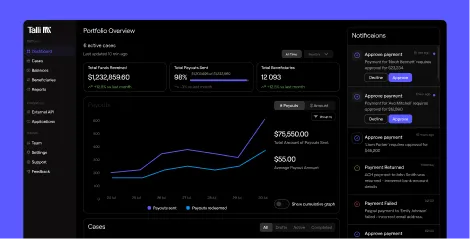
The platform supports built-in KYC, OFAC screening, W-9 collection, fraud mitigation, and audit logging. Claims teams can upload claimant data, create distribution campaigns, monitor completion, and track payments through a centralized dashboard.
Talli also supports multiple claimant payment options, including ACH, prepaid Mastercard, PayPal, Venmo, and eligible digital gift cards. This flexibility can help administrators serve both banked and unbanked claimants without relying exclusively on paper checks.
Dedicated settlement accounts preserve fund separation and matter-level records. Banking services are provided through regulated financial partners, including Patriot Bank, N.A., Member FDIC, where applicable.
Talli’s real-time reporting tools give administrators visibility into payment status, exceptions, claimant engagement, remaining balances, and reconciliation data. These controls help claims teams respond to court deadlines while maintaining documentation of how funds were distributed.
Why Verified Identity Must Remain Part of the Entire Workflow
Identity verification should not be treated as a one-time checkbox. Claimant risk can change after an initial submission when contact information, payment instructions, documents, or account access changes.
A defensible process connects identity, eligibility, compliance, and payment authorization from claim submission through final reconciliation. That connection helps administrators reduce duplicate claims, detect account takeover, maintain tax records, document sanctions screening, and show where settlement funds were delivered.
Talli supports this approach by combining claimant communication, payment selection, compliance controls, fund segregation, fraud mitigation, and real-time reporting in one settlement-focused platform. Rather than forcing legal teams to connect generic tools manually, Talli provides infrastructure designed around court-supervised distributions.
For claims administrators, the central question is not whether a claimant entered enough information to complete a form. It is whether the available evidence provides reasonable confidence that the approved claimant controls the approved payment destination. That is the practical difference between claimed and verified identity, and it is a distinction that can protect both the settlement fund and the integrity of the final distribution report.
Frequently Asked Questions
What Is the Difference Between Identity Authentication and Verification?
Identity verification establishes who a person is by comparing a claimed identity with supporting evidence, databases, documents, or biometric information. Authentication checks whether someone attempting to access an account or complete an action is the previously verified individual. A settlement may use verification during onboarding and authentication before later account changes or payments.
How Does Risk-Tiered Verification Work?
Risk-tiered verification applies controls based on factors such as claim value, data consistency, payment method, duplicate indicators, device history, and changes to claimant information. Lower-risk claims may pass automated checks, while higher-risk claims may require documents, liveness testing, database review, or manual approval. Costs and performance vary by provider and claimant population.
Can Identity Credentials Be Reused Across Settlements?
Reusable credentials may reduce repetitive verification in related matters, but they should not be described as permanently valid. Administrators must consider consent, data retention, security, biometric-privacy requirements, changes to claimant information, and whether the original verification remains appropriate for the new distribution.
How Can Administrators Avoid Excluding Claimants Without Current ID?
Administrators can offer multiple verification pathways, including address history, phone and email records, payment-account validation, claim-specific documents, database checks, and human review. Alternative methods should be documented and applied consistently so that claimants without current government-issued identification are not automatically rejected.
What Identity Records May Be Needed for Court Reporting?
Requirements vary by settlement order, but useful records may include verification steps, decision timestamps, exception handling, sanctions-screening results, payment-destination changes, failed-payment records, reviewer actions, and aggregate distribution outcomes. A complete audit trail helps demonstrate that the administrator followed the approved process and handled exceptions consistently.