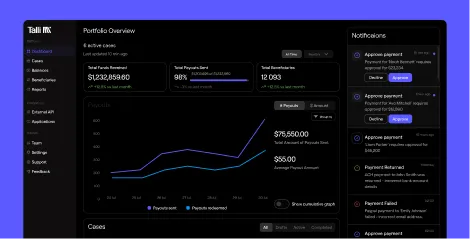
Settlement administrators face a persistent challenge: getting money into claimants' hands. When 20-30% of paper settlement checks go unclaimed, the problem isn't the settlement itself; it's how administrators communicate with recipients. Effective claimant communication transforms take-up rates from industry-standard 70-80% to 95-98% through strategic timing, clear messaging, and diversified channel selection. Talli's digital disbursement platform addresses these communication gaps by automating outreach sequences, enabling multi-channel delivery, and providing real-time tracking that keeps claimants engaged throughout the payment lifecycle.
Key Takeaways
- Digital communication strategies achieve 95-98% redemption rates compared to 70-80% for traditional paper-based methods
- Strategic reminder sequences with smart automation improve W-9 completion from 40% to 90%
- Multi-channel approaches combining email, SMS, and portal access reduce claimant abandonment significantly
- AB Data achieved a 30% increase in redemption rates by implementing digital-first communication workflows
- Timing matters: initial notifications within 24-48 hours of settlement approval capture peak claimant attention
- Language localization across 40+ languages ensures accessibility for diverse claimant populations
- Virtual payment notifications delivered via SMS reach claimants in 30 seconds, creating immediate engagement
What is Claimant Communication in Legal Settlements and Why It Matters for Take-Up Rates
Claimant communication encompasses every touchpoint between settlement administrators and beneficiaries, from initial eligibility notifications through final payment confirmation. Unlike general customer communication, legal settlement outreach operates under strict fiduciary obligations, court oversight, and compliance requirements that demand precision and documentation.
Take-up rate, the percentage of eligible claimants who actually receive and access their settlement funds, serves as the primary measure of communication effectiveness. When administrators rely solely on mailed notices and paper checks, they accept industry-standard redemption rates of 70-80%. The remaining 20-30% represents real money that never reaches intended recipients.
The Cost of Unclaimed Funds
Unredeemed settlement payments create cascading problems beyond disappointed claimants:
- Escheatment exposure: Unclaimed funds eventually transfer to state governments under escheatment laws, removing them permanently from the settlement pool
- Tracking costs: Each uncashed check requires approximately $7-$20 in initial costs, with follow-up expenses potentially escalating as high as $150 for reissuance, address verification, and administrative overhead
- Court scrutiny: Judges increasingly question low redemption rates during final accounting reviews
- Cy pres complications: When funds cannot reach claimants, courts must redirect them to charitable recipients, potentially undermining the settlement's original purpose
Digital communication strategies address these failures systematically. Platforms achieving 95-98% redemption rates do so through automated reminder sequences, multiple contact channels, and real-time delivery confirmation, capabilities impossible with paper-based workflows.
Ensuring Fiduciary Compliance
Settlement administrators operate as fiduciaries, legally obligated to act in claimants' best interests. Effective communication directly supports this duty by:
- Providing clear, accurate information about payment options and timelines
- Maintaining documented proof of every outreach attempt
- Enabling claimants to select preferred payment methods
- Ensuring accessibility across languages and literacy levels
- Creating audit trails that demonstrate good-faith distribution efforts
Courts now regularly review communication strategies during settlement approval hearings. Administrators using comprehensive tracking systems can demonstrate exactly when, how, and whether each claimant received notifications, documentation that satisfies judicial oversight requirements.
Mastering Communication Management for Optimal Settlement Outcomes
Effective claimant communication management requires treating outreach as an integrated system rather than isolated touchpoints. The goal is guiding each claimant from initial notification through successful fund receipt with minimal friction and maximum clarity.
Streamlining Complex Settlement Processes
Large settlements involving thousands or hundreds of thousands of claimants demand automated communication workflows. Manual processes break down at scale:
- Individual email sends become impossible to track
- Mailed notices generate inconsistent delivery timing
- Phone follow-ups lack documentation
- Reminder schedules slip without automation
Modern disbursement platforms process communications end-to-end, from initial batch uploads through final payment reconciliation. Automated validation ensures claimant data accuracy before outreach begins, eliminating bounced emails and returned mail from preventable data entry errors.
For settlements exceeding 50,000 claimants, phased communication rollouts enable monitoring and adjustment before full release. Administrators can test messaging variations, identify delivery issues, and optimize timing based on early cohort response rates.
Data-Driven Communication Strategies
Real-time dashboards transform communication management from reactive to proactive. Key metrics to monitor include:
- Notification delivery rates: Percentage of messages reaching intended recipients
- Open rates: Email engagement indicating message visibility
- Click-through rates: Action taken on payment links or portal access
- Completion rates: Claimants who finish required steps (W-9 submission, payment selection)
- Redemption rates: Final fund access across payment methods
- Failure root causes: Specific reasons for non-completion at each stage
CRM synchronization via webhooks enables automatic status updates, ensuring case management systems reflect current communication states. This visibility allows administrators to identify struggling claimants early and intervene with targeted follow-up.
The AB Data case study demonstrates data-driven communication impact: 30% increase in redemption rates and 60% reduction in unresolved exceptions within 12 months of implementing digital-first workflows.
Designing Effective Enrollment Periods for Legal Claimants
The enrollment period (when claimants select payment preferences and complete required documentation) represents the highest-friction stage of settlement participation. Poor enrollment design directly causes abandonment and reduced take-up rates.
Structured Rollouts for Large Settlements
Settlement timing affects enrollment success more than most administrators realize. Key timing considerations include:
- Initial notification timing: Messages sent within 24-48 hours of court approval capture peak claimant attention while the settlement remains newsworthy
- Enrollment window duration: Periods too short create unnecessary urgency; periods too long allow claimants to forget
- Reminder cadence: Automated sequences at 7, 14, and 21 days maintain engagement without overwhelming recipients
- Deadline messaging: Clear, prominent expiration dates drive action
For mass tort distributions with complex multi-tier payment structures, enrollment periods must accommodate varying documentation requirements based on claim severity. Claimants receiving higher awards often require additional verification, extending their enrollment timeline beyond standard participants.
Clarity in Claimant Selection and Payout Tiers
Enrollment communications must clearly explain:
- Eligibility confirmation: Why this specific claimant qualifies for payment
- Award amount: The exact or estimated sum available to them
- Payment options: Available methods with clear pros and cons
- Documentation requirements: What forms must be completed and why
- Timeline expectations: When they can expect to receive funds
- Support resources: How to get help if needed
Digital enrollment portals simplify this process by presenting information progressively. Rather than overwhelming claimants with a dense notice letter, portal-based enrollment guides users through each step with contextual help and immediate validation.
W-9 collection illustrates the enrollment impact: digital forms with smart reminders achieve 90% completion rates versus 40% for paper forms without automated follow-up. This 50-percentage-point improvement directly affects take-up by ensuring claimants complete required tax documentation.
Lessons from Insurance Claims for Legal Settlement Communications
Insurance claim payment processes offer valuable parallels for settlement administrators. Both involve distributing funds to verified recipients under regulatory constraints, and insurance industry innovations in communication efficiency translate directly to legal settlement contexts.
Automating Verification Steps
Insurance carriers have largely automated claimant verification, reducing manual review while maintaining fraud prevention. Settlement administrators can apply similar approaches:
- Identity verification: Cross-referencing provided information against identity databases without requiring in-person appearance
- Documentation validation: Automated checks for completeness and consistency before human review
- OFAC screening: Automated compliance checking against sanctions lists with documented timestamps
- Duplicate detection: Pattern recognition identifying potentially fraudulent duplicate claims
These verification steps, when integrated into communication workflows, allow administrators to request specific corrections rather than rejecting incomplete submissions outright. A targeted message saying "Please upload a clearer photo of your ID" converts more claimants than a generic rejection notice.
Reducing Reissuance Costs through Digital Efficiency
Insurance industry data demonstrates that digital payment methods dramatically reduce reissuance overhead. The same principles apply to settlements:
- Paper checks require physical reissuance for address errors, stale-dating, or loss
- Digital payments can be re-sent instantly to corrected email addresses or phone numbers
- Virtual cards remain accessible regardless of physical mail delivery
- ACH transfers confirm completion definitively, eliminating uncertainty
Automated three-way reconciliation reduces monthly closing time by 70%, freeing administrative resources for claimant follow-up rather than paperwork.
Payment Method Impact on Communication Effectiveness
How claimants receive payments directly affects whether they receive them at all. Payment method selection influences communication strategy, timing, and channel selection throughout the disbursement process.
Diversifying Payment Options for Wider Reach
Multi-channel payment distribution ensures every claimant can access their funds through a familiar method:
- ACH direct deposit: Lowest cost at $0.25-$0.50 per transaction, 1-2 day delivery, ideal for banked claimants
- Prepaid cards: Virtual delivery via SMS/email in 30 seconds, physical cards within 5-7 days, serving the estimated 4.5% of unbanked U.S. households
- Digital wallets: PayPal and Venmo integration providing instant access for users already on these platforms
- Gift cards: Amazon and Target options showing highest redemption for small-value distributions under $100
- Wire transfers: Same-day option for high-value international payments
- Paper checks: Maintained as fallback despite higher costs
Each payment method requires tailored communication. SMS notification works well for virtual cards delivered digitally; email excels for ACH requiring account verification; mailed notices may still be necessary for claimants without digital access.
Cost-Benefit Analysis of Payment Channels
Communication investment should align with payment method economics:
ACH Direct Deposit
- Per-transaction cost: $0.25-$0.50
- Communication focus: Account verification, timing expectations
Prepaid Cards
- Per-transaction cost: Varies by provider
- Communication focus: Activation instructions, usage guidance
Digital Wallets
- Per-transaction cost: $0.50-$1.00
- Communication focus: App access confirmation, link authentication
Gift Cards
- Per-transaction cost: Platform-dependent
- Communication focus: Redemption instructions, balance checking
Wire Transfers
- Per-transaction cost: $10-$30
- Communication focus: International compliance, timing confirmation
Paper Checks
- Per-transaction cost: $7-$20
- Communication focus: Deposit reminders, stale-date warnings
Digital disbursements reduce costs by 50-65% compared to paper checks when accounting for printing, postage, reconciliation, and reissuance. These savings can fund enhanced communication efforts that further improve take-up rates.
Improving Claimant Satisfaction and Trust Through Communication
Claimant satisfaction directly correlates with take-up rates. Recipients who feel informed, respected, and supported complete enrollment steps and access their funds. Those who feel confused, ignored, or frustrated abandon the process.
Communication Speed and Expectation Management
Speed matters enormously in claimant communication. Traditional settlement processes taking 6-8 weeks create extended periods of uncertainty where claimants question whether they'll ever receive payment. 24-48 hour digital payment cycles compress this anxiety into a manageable window.
Communication must set accurate expectations:
- Acknowledge claim receipt immediately
- Provide realistic timelines without overpromising
- Send proactive updates even when status hasn't changed
- Confirm completion definitively when funds arrive
Building Claimant Confidence
Each communication touchpoint reinforces trust when messages arrive on time and match reality. Broken promises (such as "You'll receive payment within two weeks") followed by delays destroy claimant confidence and reduce engagement with future messages.
Providing Multi-Language Support for Global Claimants
Claimant support in 40+ languages ensures accessibility for diverse settlement populations. Language barriers cause abandonment when claimants cannot understand instructions, verify eligibility requirements, or complete documentation forms.
Effective multilingual communication requires more than translation:
- Cultural adaptation of tone and formality levels
- Localized date, currency, and number formats
- Region-appropriate payment method emphasis
- Native-speaking support staff for questions
Settlements involving international claimants across 190+ countries face additional complexity. Multi-jurisdictional support with 150+ currencies and 300+ payment rails requires communication systems that adapt messaging to recipient location automatically.
Optimizing Email Communications for Claimant Outreach
Email remains the primary digital communication channel for settlement notifications, but effectiveness varies dramatically based on execution. Subject lines, sender reputation, and content design all influence whether messages reach claimants and prompt action.
Subject Line Best Practices
Settlement emails compete with dozens of other messages in cluttered inboxes. Subject lines must:
- Clearly identify the settlement by name
- Convey urgency without sounding spammy
- Indicate personal relevance ("Your [Settlement Name] Payment")
- Include dollar amounts when possible ("Your $XXX Payment is Ready")
- Avoid trigger words that activate spam filters
Testing subject line variations across initial cohorts identifies what resonates with specific claimant populations. A class action involving consumers may respond differently than a mass tort involving injury victims.
Leveraging Personalization for Engagement
Generic settlement notices underperform personalized communications:
- Address claimants by name
- Reference their specific award amount
- Acknowledge their claim category (for tiered settlements)
- Include their claim ID for easy reference
- Provide direct links to their specific portal account
Digital forms with smart reminders enable automated personalization at scale. Rather than sending identical messages to all claimants, systems can segment recipients based on completion status and tailor follow-up accordingly.
Claimants who opened but didn't click receive different messaging than those who never opened. Claimants who started enrollment but abandoned mid-process need specific encouragement to return. This segmentation requires real-time tracking capabilities that paper-based workflows cannot provide.
Maximizing Engagement Through Strategic Multichannel Communication
Single-channel communication strategies accept unnecessary claimant loss. Recipients who don't check email, have outdated postal addresses, or ignore unfamiliar phone numbers simply won't receive single-channel outreach. Multichannel approaches ensure multiple opportunities for contact.
Synergizing Email and SMS for Higher Engagement
Email and SMS serve complementary roles:
- Email: Detailed information, documentation links, portal access, formal notices
- SMS: Urgent notifications, time-sensitive reminders, payment arrival alerts
Combining channels creates redundancy that improves reach:
- Send initial notification via email with complete settlement details
- Follow with SMS reminder if no email engagement within 48 hours
- Use SMS for time-critical deadline warnings regardless of email status
- Deliver payment notifications via both channels simultaneously
Virtual prepaid cards delivered via SMS/email in 30 seconds exemplify effective dual-channel delivery. Claimants receive immediate notification through whichever channel they access first, with backup notification on the other.
Designing Intuitive Digital Experiences
Communication effectiveness extends beyond message delivery to the experiences those messages create. Poorly designed enrollment portals, confusing payment selection interfaces, and broken mobile experiences all reduce take-up regardless of communication quality.
Key design principles for claimant-facing systems:
- Mobile-first design (most recipients access via smartphone)
- Minimal required fields with clear explanations
- Progress indicators showing completion status
- Save-and-return functionality for interrupted sessions
- Accessible design complying with ADA requirements
Recipient-friendly flows reduce friction at every step. Each additional click, each confusing label, each unexpected requirement causes marginal claimant loss that compounds across large populations.
Leveraging Multichannel Marketing for Enhanced Take-Up
True multichannel communication treats all channels as an integrated system rather than parallel efforts. Messages reinforce each other, timing coordinates across touchpoints, and claimant preferences guide channel selection.
Designing a Seamless Claimant Journey
The ideal claimant experience flows naturally:
- Awareness: Initial notification reaches claimant through their preferred channel
- Understanding: Clear messaging explains what's happening and why they qualify
- Enrollment: Simple process collects necessary information and preferences
- Confirmation: Immediate acknowledgment that enrollment succeeded
- Anticipation: Accurate timeline sets realistic expectations
- Delivery: Payment arrives through selected method with notification
- Access: Claimant can use funds immediately without barriers
Each stage requires appropriate channel selection. Formal legal notifications may require mailed notices for compliance; payment delivery notifications work best via instant digital channels.
The Power of Redundant Communication Channels
Redundancy isn't waste; it's insurance against delivery failure. Settlement administrators should assume:
- Some email addresses are outdated or incorrect
- Some physical addresses have changed
- Some phone numbers are no longer active
- Some claimants don't regularly check certain channels
Building redundancy means attempting contact through multiple channels before assuming non-response. A claimant who doesn't respond to three emails might respond immediately to a text message. Someone who ignores digital notifications might open a mailed postcard.
Multi-channel payment distribution applies this same principle to fund delivery. Offering ACH, prepaid cards, digital wallets, gift cards, and paper checks as fallback ensures claimants receive payments through their most accessible channel.
Implementation Best Practices
Communication Timing Strategy
Optimal timing varies by message type:
- Initial notification: Within 24-48 hours of settlement approval
- Enrollment reminder #1: 7 days after initial notification
- Enrollment reminder #2: 14 days after initial notification
- Deadline warning: 5-7 days before enrollment closes
- Final notice: 24-48 hours before deadline
- Payment confirmation: Immediately upon fund transfer
- Access instructions: Concurrent with payment confirmation
Message Content Requirements
Every settlement communication should include:
- Clear sender identification (settlement name, administrator name)
- Specific action required from the claimant
- Deadline for action (if applicable)
- Contact information for questions
- Privacy/security reassurances (legitimate settlement, not fraud)
- Reference number for tracking
Channel Selection Best Practices
Initial Notification
- Primary channel: Email
- Backup channel: Mail
- Timing: Day 1
Enrollment Reminders
- Primary channel: SMS
- Backup channel: Email
- Timing: Days 7, 14
Deadline Warnings
- Primary channel: SMS + Email
- Backup channel: Phone
- Timing: Day 23-25
Payment Confirmation
- Primary channel: SMS
- Backup channel: Email
- Timing: Immediate
Support Inquiries
- Primary channel: Portal/Phone
- Backup channel: Email
- Timing: On-demand
How Talli Powers Effective Claimant Communications
Talli's digital disbursement platform addresses the communication challenges that reduce settlement take-up rates. The platform's integrated approach connects automated outreach, multi-channel payment options, and real-time tracking to maximize claimant redemption.
Key communication capabilities include:
- Automated notification sequences: Smart reminder systems that adapt timing and messaging based on claimant engagement
- Multi-channel delivery: Email, SMS, and portal notifications coordinated through a single platform
- Real-time dashboards: Live visibility into notification delivery, open rates, and completion status
- Language support: Claimant communications in 40+ languages for diverse settlement populations
- Compliance documentation: Complete audit trails demonstrating every outreach attempt
The AB Data case study demonstrates these capabilities in practice: 30% increase in claimant redemption rates, 60% reduction in unresolved exceptions, and 100% fiduciary compliance maintained across all distribution cycles.
Thomas R Glenn, President & CEO of AB Data, summarized the impact: "Digital disbursement isn't just a feature; it's infrastructure. Talli gave settlement administrators the regulated payout rails needed to move faster, reduce unclaimed funds, and give courts full confidence in how settlement money is being distributed."
Frequently Asked Questions
What is the optimal number of reminder messages before claimants disengage?
Research across settlement programs suggests three to four reminder touchpoints before diminishing returns. The most effective sequence includes an initial notification followed by reminders at 7-day intervals, culminating in deadline-focused final notices. Beyond four reminders, response rates flatten while irritation complaints increase. However, switching channels (email to SMS, digital to phone) can extend the effective reminder window by reaching claimants through channels they actually monitor.
How should settlement administrators communicate with deceased claimants' estates?
Distributing settlements to estates requires modified communication workflows. Initial contact should address the estate representative or executor rather than the deceased. Documentation requirements expand to include death certificates and letters testamentary. Payment methods may need adjustment, as estate bank accounts differ from individual accounts. Timeline expectations should account for probate delays common in estate processing.
What communication approaches work best for unbanked claimant populations?
Unbanked claimants require payment methods that don't assume bank account access. Prepaid cards, digital wallets, and gift cards serve this population effectively. Communication should emphasize these options prominently rather than defaulting to ACH language. SMS outreach often performs better than email for unbanked populations, as mobile phone access frequently exceeds regular email use in these demographics. Clear instructions for payment access without bank accounts reduce confusion and abandonment.
How do communication requirements differ for minor beneficiaries?
Minor beneficiary settlements direct communications to parents or legal guardians rather than the minor directly. Messaging must clearly explain that funds belong to the minor while payment processes involve adult representatives. Many jurisdictions require structured settlement arrangements or blocked accounts for minors, necessitating additional communication about these requirements. Age-of-majority timing affects when direct claimant communication can begin.
What metrics indicate that communication strategies need adjustment?
Key warning signs requiring communication strategy revision include: email open rates below 20% suggesting deliverability or subject line issues, click-through rates below 5% indicating unclear calls-to-action, enrollment abandonment exceeding 40% pointing to portal friction, and final redemption rates below 85% for digital-first settlements. Real-time dashboards enable early identification of these issues, allowing mid-campaign adjustments rather than post-mortem analysis.