.svg)


.svg)
Legal settlements award billions annually to claimants who never collect their money. The Federal Trade Commission's study of 149 consumer class actions found a 9% median claim rate, showing that the median claims rate remained in the single digits across cases requiring claims submission. This gap between award and payment creates massive compliance burdens for administrators, triggers costly escheatment processes, and leaves rightful owners without compensation. Modern digital disbursement platforms address these systemic failures by eliminating the friction points where funds stall.
Key Takeaways
- Federal Trade Commission research found a 9% median claim rate across consumer class actions requiring a claims process
- U.S. states collectively hold approximately $70 billion in unclaimed property from settlements, dividends, and other sources
- Paper checks cost an estimated $7.78 on average to issue, with all-in costs reaching $20 per check including reissuance
- Email settlement notices produce only 3% claim rates compared to 10% for mailed packets with claim forms
- Media-only notice settlements (newspaper ads, website banners) achieve median claim rates of 0.023% according to claims administrator analysis
- State false claims litigation has produced settlements with over $43 million in allegedly unreturned deposits and $31.25 million in damages and penalties
- New York State returns over $2 million daily to owners who locate their unclaimed funds
Understanding the Scale of Unclaimed Settlement Funds
The volume of unclaimed property in state treasuries reveals the systemic failure of traditional settlement disbursement methods. Vermont alone holds over $175 million in unclaimed property from more than one million properties. New York returned a record $633 million in fiscal year 2024-25, yet new property becomes unclaimed faster than old property gets claimed.
The problem compounds across every settlement category:
- Class action settlements: $42 billion cumulative value across top settlements in each major class-action category
- Data breach cases: 1,488 filings in 2024, representing a 1,265% increase over six years
- Consumer protection settlements: Consistently achieve single-digit claim rates
- Securities litigation: Complex documentation requirements suppress redemption
California holds more than $15 billion in unclaimed property, demonstrating both the scale of the problem and the ongoing challenge of reconnecting funds with their intended recipients. The hidden cost of uncashed checks extends beyond the unclaimed amounts themselves to include tracking, reissuance, and eventual escheatment compliance.
Why Traditional Methods Create Unclaimed Property
Paper check disbursements face structural failure points that systematically generate unclaimed property:
- Delivery failures: Recipients move, checks get lost, or mail is discarded as junk
- Cashing barriers: 5.6 million unbanked U.S. households cannot easily deposit paper checks
- Detection delays: Identifying uncashed checks requires 90+ days versus real-time feedback for digital payments
- Reissuance costs: Canceling, reprinting, and remailing multiplies expenses and delays
- Expiration: Checks go stale before recipients act
How to Find Unclaimed Money in Your Name
Individuals searching for unclaimed settlement funds face fragmented systems across multiple jurisdictions. The primary search resources include:
State Treasury Databases: Each state maintains its own unclaimed property division. MissingMoney.com aggregates data from participating states, though not all states participate fully.
Bankruptcy Court Records: Use the federal court locator at PACER (Public Access to Court Electronic Records) to search bankruptcy cases where you may be a creditor.
Class Action Settlement Websites: Individual settlements maintain dedicated websites with claim status lookup tools.
State-Specific Portals: States like California, New York, and Texas operate dedicated unclaimed property search tools with varying interfaces and search capabilities.
Common challenges in locating unclaimed funds include:
- Name variations from marriage, divorce, or legal name changes
- Multiple addresses over time creating scattered records
- Deceased relatives whose estates contain unclaimed property
- Corporate name changes affecting business-related claims
Regularly searching unclaimed property databases locates funds that have been reported to state agencies.
Why Payments Fail to Reach Claimants
The FTC's comprehensive study identified specific failure modes at each stage of the disbursement process. Notice method dramatically affects claim rates:
- Mailed packets with claim forms: 10% participation
- Postcard notices: 6% participation
- Email notices: 3% participation
- Media-only notice: 0.023% median participation
The Language Problem
FTC research found that notices using plain-English terms like "payment," "money," and "cash" produced higher claim rates than formal legal language. Email subject lines that omit "class action" achieve higher open rates than those including the term, as recipients often distrust or ignore communications that appear to be spam.
Operational Bottlenecks
Beyond notice design, several operational factors suppress redemption:
- Outdated contact data: Address changes without forwarding requests leave checks undeliverable
- Documentation requirements: Complex proof-of-claim processes discourage participation
- Claim form complexity: Multi-page forms with extensive requirements create abandonment
- Legitimacy concerns: Recipients mistake genuine notices for scams
- Inertia: Small payment amounts don't justify perceived effort
Settlement administrators using strategies to increase redemption rates can address these barriers through simplified processes and proactive outreach.
How Digital Disbursements Transform Fund Recovery
Modern payment infrastructure eliminates check-specific failure modes while providing real-time visibility into disbursement status. Digital payment methods have driven significant improvements in settlement fund recovery.
Multi-Channel Payment Options
Effective disbursement platforms offer payment choice:
- ACH direct deposit: Estimated $0.25-$0.50 per transaction, 1-2 day delivery
- Prepaid debit cards: Virtual delivery in 30 seconds, physical cards in 5-7 days
- Digital wallets: PayPal, Venmo integration with instant access
- Gift cards: Amazon, Target options for settlements under $100
- Wire transfers: Same-day for high-value international payments
- Paper checks: Maintained as fallback for recipients who prefer traditional methods
This approach particularly benefits unbanked claimants who cannot easily deposit paper checks but can access prepaid cards or digital wallets.
Cost Comparison
The financial case for digital disbursement is compelling. ACH transfers cost an estimated $0.25-$0.50 per transaction with 1-2 day delivery, while prepaid cards average around $1-$3 with 30-second virtual delivery. Digital wallets typically run $0.50-$1.00 per transaction with instant access. In contrast, paper checks carry estimated costs of $7.78-$20 per check with 5-7 day minimum delivery times.
Mohave County, Arizona eliminated its annual escheatment process entirely by switching from paper checks to digital disbursements for juror payments. The county clerk stated: "This past escheatment process was the last one since we no longer have any checks left to track."
Compliance and Security in Fund Distribution
The Escheatment Burden
When funds remain unclaimed after dormancy periods of 1-5 years depending on state and property type, escheatment requires holders to:
- Identify dormant accounts and uncashed checks
- Perform due diligence by sending certified mail notices
- Prepare jurisdiction-specific reports in NAUPA or NAUPA II formats
- Remit funds to appropriate state agencies
- Maintain records for potential audits spanning 10+ years
State-specific requirements create compliance complexity:
- California: Generally 3-year dormancy, 12% interest on late payments
- Delaware: Typically 5-year dormancy, audit lookback can exceed 10 years
- Texas: 5% penalties plus additional 5% after 30 days for late reporting
- Iowa: 10% annual interest, 25% civil penalties for willful non-compliance
False Claims Litigation Escalation
States increasingly use false claims act lawsuits to enforce unclaimed property reporting. A 2023 settlement with a golf course operator involved over $43 million in allegedly unreturned deposits, with damages and penalties totaling $31.25 million. Other recent cases include $36 million from a retailer for gift card violations (2022), $7.7 million from a healthcare provider (September 2024), and $4.4 million from a gift card company (December 2024).
Because false claims statutes provide for treble damages, penalties extend far beyond traditional administrative fines. Proactive digital disbursement that maximizes initial redemption rates becomes a risk mitigation strategy.
What Happens to Residual Settlement Funds
When class action funds remain unclaimed after claims periods close, four disposition mechanisms apply:
Pro Rata Redistribution: Additional payments to class members who filed valid claims, proportionally increasing their individual payouts.
Cy Pres Distribution: Payments to nonprofit organizations whose mission relates to the lawsuit's purpose. Courts increasingly scrutinize these to ensure they represent "next best use" for the class.
Escheatment: Transfer to state unclaimed property funds where money remains available for owners to claim indefinitely.
Reversion to Defendants: Courts disfavor this option because it reduces class member compensation and creates disincentives for settlement participation.
The Third Circuit emphasized that direct distributions to the class are preferred over cy pres distributions, reflecting judicial preference for maximizing payments to intended beneficiaries.
Real-Time Tracking for Settlement Transparency
Effective fund administration requires visibility into every stage of disbursement. Modern platforms provide:
- Live completion rates: Percentage of successful payouts updated in real-time
- Payment method analytics: Distribution across ACH, cards, wallets, and checks
- Geographic tracking: Regional concentration of claims and redemptions
- Failure analysis: Root cause identification for returned payments
- Fund balance monitoring: Remaining amounts requiring distribution or disposition
This real-time tracking capability enables proactive intervention when payments fail rather than discovering problems months later during reconciliation.
Best practices for maximizing redemption include:
- VeriMove/NCOA address verification before payment attempts
- Automated reminder sequences at 30/60/90 day intervals
- Extended check validity from 90 to 180 days
- Online reissuance portals for self-service check replacement
- SMS notifications as alternative contact channel
Why Talli Solves the Unclaimed Funds Problem
Talli addresses the root causes of unclaimed settlement funds through purpose-built infrastructure for legal disbursements. Unlike generic payment processors, Talli combines multi-channel payment distribution with automated compliance specifically designed for court-supervised fund administration.
Talli's platform delivers:
- Multi-channel payment options including ACH, prepaid Mastercard, PayPal, Venmo, and gift cards that maximize accessibility for all claimants
- 24-48 hour payment cycles replacing week-long settlement processes
- Integrated compliance automation for KYC verification, OFAC screening, W-9 collection with 90% completion rates, and 1099 generation
- QSF-compliant fund management supporting fund segregation through dedicated FBO accounts while maintaining tax treatment under IRC Section 468B
- AI-powered fraud detection providing advanced security without adding friction to the claims process
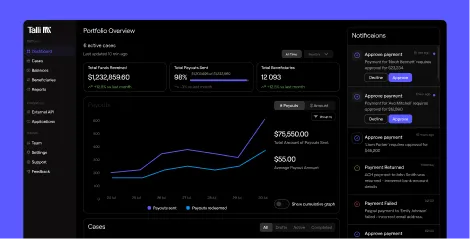
- Real-time dashboard with court-ready audit trails and automated reporting
The AB Data case study demonstrates real-world impact: 30% increase in redemption rates, 60% reduction in unresolved exceptions within 12 months, and 100% fiduciary compliance record across all distributions. Thomas R Glenn, President & CEO of AB Data, noted: "Talli gave us the regulated payout rails we needed to move faster, reduce unclaimed funds, and give courts full confidence in how settlement money is being distributed."
For QSF trustees and claims administrators managing high-volume distributions, Talli's trust center details Talli's SOC 2 Type I and PCI DSS 4.0.1 compliance program and security controls.
Frequently Asked Questions
What is "unclaimed money" in the context of legal settlements?
Unclaimed money refers to settlement funds awarded to claimants who never collect their payments. This includes uncashed checks, unredeemed prepaid cards, and funds where recipients never filed claims. After dormancy periods of 1-5 years depending on state and property type, these funds transfer to state custody through escheatment. U.S. states collectively hold approximately $70 billion in such unclaimed property.
Why do legal settlement funds frequently go unclaimed?
FTC research identified multiple failure points: recipients mistake notices for spam, claim forms are too complex, addresses become outdated, and paper checks get lost or discarded. Email notices produce only 3% claim rates, while media-only settlements achieve 0.023% median participation according to claims administrator analysis. Additionally, 5.6 million unbanked households face barriers cashing paper checks even when received.
How can I check if I am owed money from a class action lawsuit?
Search MissingMoney.com for aggregated state unclaimed property data, individual state treasury websites, PACER for bankruptcy court records, and dedicated settlement websites for specific cases. New York alone returns over $2 million daily to owners who locate their funds. Search annually using name variations, previous addresses, and deceased relatives' information.
What steps reduce unclaimed settlement funds?
Effective strategies include multi-channel payment options (ACH, prepaid cards, digital wallets), plain-language notice design avoiding legal jargon, address verification through NCOA databases before mailing, automated reminder sequences, and extended claim periods. Digital disbursement platforms have demonstrated significant improvements in redemption rates compared to paper-check-only distributions.
Are digital payment methods for settlements secure?
Modern disbursement platforms maintain SOC 2 Type II and PCI DSS Level 1 compliance certifications, integrate automated OFAC screening against U.S. Treasury sanctions lists, and employ advanced fraud detection. Banking services through FDIC-insured institutions provide additional protection. Digital methods reduce fraud exposure compared to paper checks, which can be intercepted, forged, or altered.