.svg)


.svg)
The ten largest class action settlements in 2024 totaled approximately $42 billion, yet FTC research found a median claim rate of only 9% in the consumer class actions it studied, leaving some settlements with substantial residual balances. This creates a complex accountability challenge where settlement administrators, law firms, and trustees must determine how to handle residual balances through mechanisms like cy pres donations, state escheatment, or pro rata redistribution. Modern digital payment platforms offer solutions to reduce unclaimed funds before they accumulate, but understanding the full lifecycle of settlement money remains essential for anyone managing or claiming these funds.
Key Takeaways
- FTC research found a median claim rate of 9% across the consumer class action settlements it studied, illustrating how substantial portions of eligible classes may not submit claims
- Residual settlement funds may be handled through mechanisms such as pro rata redistribution, cy pres distributions, state unclaimed-property procedures, reversion to defendants, or additional claims and distribution efforts
- State treasuries collectively hold approximately $70 billion in unclaimed property, including settlement funds
- One analysis of settlements relying exclusively on media notice found claim rates ranging from 0.002% to 9.378%, with a median of 0.023%, highlighting the participation challenges associated with indirect notice
- 5.6 million U.S. households lack bank accounts, creating structural barriers when settlements rely on paper checks
- Federal appellate courts have scrutinized cy pres arrangements and emphasized preference for feasible direct distributions to class members
Understanding Unclaimed Money in Class Action Settlements
The gap between settlement funds available and funds actually claimed represents one of the legal system's most persistent problems. When companies agree to compensate consumers, shareholders, or employees through class action settlements, the money set aside often goes unused despite legitimate eligibility.
What Causes Unclaimed Funds?
Multiple factors contribute to low redemption rates in settlement distributions:
- Inadequate notice methods: Mailed packets with claim forms achieve approximately 10% claim rates, while email notices drop to just 3%
- Complex claim requirements: Forms demanding extensive documentation discourage participation
- Address changes: Class members move without forwarding addresses, making them unreachable
- Distrust of legitimacy: Settlement notices often resemble spam or phishing attempts
- Low individual amounts: Small per-claimant payments don't justify the effort required to file
Research from the Federal Trade Commission covering 149 consumer class actions found the weighted mean claim rate was only 4%, with significant variation based on notice method and claim complexity.
The Impact of Traditional Disbursement Methods
Paper-check-dominant distribution creates structural barriers that compound the unclaimed funds problem. Settlement administrators report that uncashed check rates often exceed 5% of distributions, with each uncashed check requiring costly tracking, reissuance attempts, and eventual escheatment processing.
Traditional methods also exclude the 5.6 million unbanked U.S. households who cannot easily deposit checks. When settlements serving consumer populations rely exclusively on paper checks, the very people most likely harmed by corporate misconduct face the highest barriers to receiving compensation.
Navigating the Search for Your Unclaimed Money
If you believe you're owed money from a past settlement, several official resources can help locate unclaimed funds.
State-Specific Search Engines
Each state maintains an unclaimed property database where escheat funds, including settlement payments, eventually land:
- California: The State Controller's Office returned $424 million to owners in recent reporting periods
- New York: The Comptroller's Office holds billions in unclaimed funds with no deadline to claim
- Texas: The Comptroller maintains the Texas Unclaimed Property database for all property types
Most states participate in the National Association of Unclaimed Property Administrators (NAUPA), which provides standardized search tools across jurisdictions.
Beyond State Databases
Settlement-specific searches require different approaches:
Court Records: Federal court databases (PACER) and state court systems contain settlement notices and claim deadlines for pending and recent cases.
Settlement Administrator Websites: Major settlements maintain dedicated websites where class members can check eligibility and claim status.
Class Action Registries: Free services aggregate information about open settlements and upcoming claim deadlines.
Free and Official Unclaimed Money Searches: What to Trust
The search for unclaimed settlement funds attracts both legitimate resources and predatory services seeking fees for information available free.
Identifying Legitimate Sources
Official unclaimed property searches share common characteristics:
- No upfront fees: Government databases never charge to search or file claims
- .gov domains: State comptroller and treasurer websites use official government URLs
- Clear identity verification: Legitimate sites require standard identification, not excessive personal data
- No urgency tactics: Official sources don't pressure immediate action or threaten fund loss
The only legitimate fee scenario involves claims for very large amounts where state law permits heir finders or locator services to charge percentage-based fees after funds are located.
Avoiding Scams and Fraud
Warning signs of fraudulent unclaimed property services include:
- Unsolicited contact claiming you have funds waiting
- Requests for payment to "release" or "process" your funds
- Demands for Social Security numbers before any verification
- Pressure to act immediately or lose your money
- Claims that only their service can access your funds
Legitimate settlement administrators and state unclaimed property offices will never ask for payment to process your claim or threaten fund forfeiture without proper legal notice.
Escheatment: The Ultimate Destination for Unclaimed Funds
When settlement payments go uncashed and other disposition methods fail, funds eventually transfer to state governments through escheatment, a legal process with roots in English common law.
The Legal Framework of Escheatment
Escheatment rules vary significantly across the 54 U.S. reporting jurisdictions (all states, DC, territories) that settlement administrators must navigate:
- California: Generally 3-year dormancy period before escheatment
- Delaware: Typically 5-year dormancy for most property types
- New York: Commonly 3-year dormancy with no claiming deadline once transferred
- Texas: Imposes 5% penalties plus additional 5% after 30 days for late reporting
- Iowa: Can assess 10% annual interest and 25% civil penalties for willful failures
Each state also maintains different due diligence requirements, report formats (NAUPA vs. NAUPA II vs. custom), and filing deadlines. This complexity creates significant compliance burdens for settlement administrators managing multi-state distributions.
Impact on Businesses and Claimants
For settlement administrators, escheatment creates ongoing obligations:
- Due diligence notices required according to each state's timing and threshold rules
- Annual reporting to each applicable state
- Record retention requirements spanning years
- Audit exposure as states increasingly examine corporate unclaimed property compliance
For claimants, escheatment provides a safety net, state treasuries hold funds indefinitely in most cases, allowing claims years or even decades after original settlement distributions.
Modern Solutions to Reduce Unclaimed Settlement Funds
The most effective approach to the unclaimed funds problem addresses root causes rather than managing symptoms after balances accumulate.
Digital-First Payment Strategies
Multi-channel payment options significantly improve redemption rates compared to check-only distribution:
- ACH direct deposit: Funds arrive in 1-2 days at minimal cost for banked claimants
- Prepaid cards: Serve unbanked populations without requiring existing bank accounts
- Digital wallets: PayPal and Venmo integration provides instant access for users on existing platforms
- Gift cards: Amazon, Target options achieve highest redemption for small-value distributions
FTC research found that plain-English compensation language outperforms formal legal terminology, with notices using words like "money," "refund," and "cash" associated with claim rates about 10 percentage points higher than notices buried in legal jargon.
The Role of Technology in Compliance
Beyond payment choice, technology platforms reduce balances through:
Real-time tracking: Administrators see ACH rejections within days versus waiting 90+ days to discover uncashed checks.
Automated reminders: SMS and email follow-ups at configurable intervals re-engage claimants before they disengage.
Address verification: NCOA and VeriMove services update outdated addresses before payment attempts.
Exception workflows: Failed payments trigger automated outreach with alternative payment method selection.
Top Class Action Settlements: Claiming Your Share Without Proof of Purchase
Many settlements now simplify the claiming process, reducing documentation requirements that historically suppressed participation rates.
Criteria for No-Proof Claims
Settlements offering claims without proof of purchase typically share characteristics:
- Consumer product cases where purchase records rarely exist
- Data breach settlements where affected individuals are already documented
- Subscription service cases with internal company records
- Affirmation-based claims accepting sworn statements of eligibility
Courts approve simplified claim processes when alternative verification methods exist or when requiring documentation would effectively eliminate compensation for legitimate class members.
Recent Settlement Trends
Recent years have seen growing settlement values and volumes. Data breach class actions saw 1,488 filings in 2024, a 1,265% increase over six years, with many offering streamlined claiming processes due to documented affected populations.
Settlement administrators increasingly recognize that complex claim requirements reduce participation without meaningfully improving fraud detection, leading to more accessible claiming procedures.
Monitoring and Auditing Settlement Funds for Compliance
Court orders, settlement agreements, tax rules, and applicable regulatory requirements can impose detailed fund-management obligations of settlement fund management, creating specific obligations for administrators and trustees.
Ensuring Regulatory Adherence
Qualified Settlement Fund (QSF) requirements under IRC Section 468B establish specific conditions for QSF tax treatment. A qualifying fund generally must:
- Be established or approved by a governmental authority, including a court, and remain subject to its jurisdiction
- Be established to resolve or satisfy qualifying claims
- Keep its assets segregated from the transferor's other assets
Settlement administrators may also use controls such as dedicated accounts, identity verification, OFAC screening, and court-approved distribution procedures depending on the settlement structure, payment methods, and applicable legal requirements.
Failure to maintain proper fund segregation can create ethical, tax, accounting, or fiduciary issues depending on the settlement structure and responsible parties
Transparency in Fund Management
Courts increasingly demand comprehensive documentation throughout the distribution lifecycle. The Third Circuit emphasized that "direct distributions to the class are preferred over cy pres distributions" and that "cy pres awards should generally represent a small percentage of total settlement funds."
This judicial scrutiny means administrators must demonstrate thorough efforts to reach claimants before proposing alternative fund disposition. Real-time dashboards documenting payment attempts, delivery confirmations, and failure root causes provide the evidentiary foundation courts require.
The Cost and Efficiency of Settlement Fund Distribution
Economic analysis reveals significant differences between traditional and modern disbursement approaches.
Comparing Traditional vs. Digital Disbursements
Traditional paper check costs compound quickly:
- Check printing and mailing: $7-20 per payment including materials and postage
- Reissuance processing: Additional costs when checks go uncashed or returned
- Escheatment administration: Compliance reporting across 54 U.S. reporting jurisdictions
- Float and reconciliation: Extended timelines delaying fund closure
Digital payment methods compress costs:
- ACH transfers: $0.25-$0.50 per transaction with 1-2 day delivery
- Prepaid cards: $1-3 per card with instant digital delivery options
- Digital wallets: $0.50-$1.00 with immediate recipient access
The Economic Impact of Unclaimed Funds
Beyond direct costs, unclaimed balances create liabilities:
- Fiduciary exposure until funds are properly disposed
- Administrative overhead managing residual balance disposition
- Court involvement for cy pres or reversion approval
- Reputational risk when settlements fail to compensate intended beneficiaries
Research shows that claim rates can vary substantially with notice design, including approximately 10% for notice packets with claim forms in the FTC study and very low median participation in a separate analysis of media-only notice campaigns.
Why Choose Talli for Settlement Distribution
While numerous payment platforms exist, Talli delivers comprehensive solutions specifically designed for legal settlement distributions requiring court-supervised compliance.
Talli transforms settlement disbursement through its digital-first payment infrastructure that includes:
- Multi-Channel Payment Options: Pay claimants via ACH, prepaid Mastercard (issued by Patriot Bank, N.A.), PayPal, Venmo, Amazon gift cards, or traditional checks as fallback, all from a single platform
- Enhanced Redemption Rates: Digital payment choice consistently outperforms the redemption rates typical of paper-check-only distributions
- Integrated Compliance Automation: Built-in KYC verification, OFAC sanctions screening, automated W-9 collection with 90% completion rates, and 1099 generation
- QSF-Compliant Fund Segregation: Dedicated account structures support fund segregation for Qualified Settlement Fund distributions while maintaining audit-ready documentation
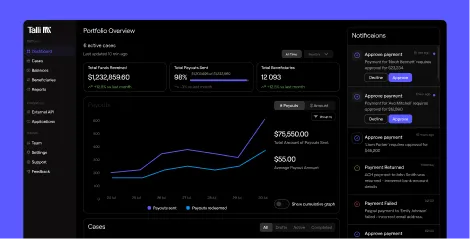
- Real-Time Tracking: Live visibility into payment status, completion rates, and failure root causes with court-ready reporting
Unlike generic payment processors. Talli provides settlement disbursement and compliance infrastructure from claimant notification through final reconciliation. The platform uses automated fraud controls, identity verification, and pattern-based screening to help administrators identify suspicious claims and reduce manual review.
For claims administrators and law firms managing high-volume legal payouts, Talli's compliance automation suite eliminates the manual processes that create errors and delays. With banking services provided by Patriot Bank, N.A., Member FDIC, settlement funds maintain institutional-grade security throughout the distribution lifecycle.
Frequently Asked Questions
What makes settlement funds become "unclaimed"?
Settlement funds become unclaimed when eligible class members don't submit claims, don't cash checks, or can't be located. FTC research shows median claim rates of only 9% in consumer class actions, with variations based on notice method, claim complexity, and payment amounts. Paper checks face additional unclaimed risk from address changes, check loss, and banking barriers affecting the 5.6 million unbanked U.S. households.
How can I perform a legitimate, free search for unclaimed settlement money?
Use official state unclaimed property databases accessible through state comptroller or treasurer websites (always .gov domains). The National Association of Unclaimed Property Administrators (NAUPA) coordinates multi-state searches. Never pay for searches, government databases are free. For specific settlements, check court records (PACER for federal cases) and settlement administrator websites for claim status.
What is escheatment and how does it relate to unclaimed court settlements?
Escheatment transfers unclaimed property to state governments after dormancy periods expire, typically 3-5 years depending on jurisdiction. Uncashed settlement checks become subject to escheatment when claimants can't be reached. States hold these funds indefinitely, allowing claims years later. California's State Controller returned $424 million to owners recently, demonstrating funds remain accessible even after escheatment.
Can digital payment platforms help prevent funds from going unclaimed?
Yes. Digital payment platforms reduce unclaimed balances by offering payment choice (ACH, prepaid cards, digital wallets), enabling real-time failure detection (days vs. months for uncashed checks), automating reminder sequences, and serving unbanked populations who can't easily deposit paper checks. These capabilities address root causes of unclaimed funds rather than managing residual balances after they accumulate.
How long do I have to claim my portion of a court settlement?
Claim deadlines vary by settlement, some allow 90 days, others several years. After claim periods close, uncashed settlement payments may become subject to state unclaimed-property laws if the settlement order does not provide another disposition method. Applicable dormancy periods vary by state and property type and are commonly several years. However, once funds transfer to state unclaimed property programs, most states hold them indefinitely with no claiming deadline. New York, for example, allows claims years after escheatment with proper documentation.