Bankruptcy creditors face a frustrating reality: legal discharge timelines and actual payment timelines are two entirely different things. While Chapter 7 cases typically reach discharge in 3-6 months, most unsecured creditors receive nothing, and those in asset cases may wait 6-18 months or longer for distributions. Chapter 13 plans stretch 36-60 months, with lower-priority creditors often waiting years before seeing their first payment. For trustees and administrators managing these complex bankruptcy payouts, understanding the true distribution timeline and the technology that can compress it is essential for meeting fiduciary obligations and creditor expectations.
Key Takeaways
- Chapter 7 discharge occurs in 3-6 months, but creditor distributions in asset cases can take 6-18+ months due to liquidation requirements
- Chapter 13 payments must begin within 30 days of filing, yet unsecured creditors may wait years as higher-priority claims are satisfied first
- Creditors face strict 70-day filing deadlines (180 days for government entities); missing these bar dates means complete claim disallowance
- Only 40% of Chapter 13 cases successfully complete, meaning most creditors wait years for payments that never arrive
- Commercial Chapter 11 filings in 2023 increased by 72% from the previous year, straining trustee resources and potentially extending timelines further
- Digital disbursement platforms can compress distribution timelines from weeks to approximately 24-48 hours while achieving estimated 95-98% redemption rates versus 70-80% for paper checks
- Payment priority waterfalls determine that unsecured creditors receive nothing until administrative, secured, and priority claims are fully satisfied
Understanding the Traditional Bankruptcy Payout Process
The bankruptcy distribution process involves multiple stakeholders, rigid timelines, and a strict priority hierarchy that determines who gets paid and when. Traditional paper-based systems compound these complexities with processing delays, high failure rates, and substantial administrative overhead.
The Lifecycle of a Paper Check in Bankruptcy
When trustees distribute funds via paper checks, the actual payment journey extends far beyond the mailing date:
- Processing time: 3-5 business days for check printing and mailing preparation
- Postal delivery: 5-10 business days depending on creditor location
- Bank clearing: 2-5 additional business days after deposit
- Reissuance cycles: 30-60+ days when checks are returned undeliverable or go uncashed
For trustees managing hundreds or thousands of creditors, uncashed settlement checks create ongoing liability and administrative burden. Each undelivered check requires tracking, creditor outreach, and potential reissuance at costs reaching an estimated $7–$20 per check when accounting for printing, postage, reconciliation, and follow-up.
Costs Associated With Traditional Distribution
Paper-based bankruptcy distributions impose significant direct and indirect costs:
- Per-check costs: Estimated $7–$20 including printing, postage, and reconciliation
- Reissuance overhead: Around $150+ per uncashed check requiring manual tracking
- Escheatment exposure: Unclaimed funds eventually transfer to state governments
- Staff time: Manual data entry, reconciliation, and exception handling
- Creditor frustration: Lack of payment visibility generates support inquiries
These inefficiencies exist at every stage, from initial distribution through final reconciliation. Trustees who understand the hidden cost of uncashed settlement checks recognize that traditional methods create compounding problems over multi-year Chapter 13 plans.
Key Factors Influencing Bankruptcy Distribution Delays
Multiple variables determine how long creditors actually wait for payment. Understanding these factors helps trustees set realistic expectations and identify opportunities for process improvement.
Chapter 7 Timeline Breakdown
Chapter 7 bankruptcy follows a compressed timeline from filing to discharge, but actual distributions depend entirely on case classification:
- Day 1: Filing triggers automatic stay
- Days 21-40: 341 meeting of creditors scheduled
- 60 days post-341: Creditor objection period closes
- Days 90-120: Discharge typically granted for no-asset cases
However, the critical distinction lies between "no-asset" and "asset" cases. The majority of Chapter 7 filings are no-asset cases where unsecured creditors receive zero distribution despite successful discharge. In asset cases requiring liquidation, timelines extend dramatically, often 6-18+ months while trustees identify, value, and sell property.
Chapter 13 Extended Timelines
Chapter 13 reorganization plans impose substantially longer payment horizons:
- Below-median income debtors: 36-month plans
- Above-median income debtors: 60-month plans
- Payment commencement: Within 30 days of filing, even before plan confirmation
- Confirmation hearings: Typically 45-90 days after filing
The payment priority waterfall means unsecured creditors often wait years before receiving distributions. Administrative expenses, secured claims, and priority unsecured claims (taxes, domestic support) must be satisfied first.
Impact of Unclaimed Funds on Timelines
When creditors fail to claim distributions, the entire process extends:
- Initial outreach: 30-60 days of creditor notification attempts
- Due diligence letters: Additional 60-90 days of follow-up campaigns
- Escheatment preparation: Varies by state dormancy periods
- Final reporting: Additional weeks for court documentation
Trustees who implement proactive strategies to run due diligence letter campaigns can reduce unclaimed fund volumes and accelerate case closure. Digital payment options significantly improve redemption rates by meeting creditors where they are.
Challenges in Verifying Claimant Identities
Compliance requirements add processing time at every distribution stage:
- KYC verification: Cross-referencing creditor information against identity databases
- OFAC screening: Checking against U.S. Treasury sanctions lists
- W-9 collection: Obtaining tax identification information before payment
- Address verification: Confirming delivery information accuracy
Manual compliance processes can add days or weeks to each distribution cycle. Automated systems that handle OFAC screening for settlement payments compress this timeline while maintaining full regulatory compliance.
Digital Transformation in Bankruptcy Payouts
Modern disbursement platforms fundamentally alter the bankruptcy payment equation, compressing week-long distribution cycles into approximately 24-48 hour payment delivery while dramatically improving creditor recovery rates.
How Digital Platforms Accelerate Payment Speed
Digital-first distribution infrastructure eliminates the bottlenecks inherent in paper-based systems:
- Immediate processing: Batch uploads with automated validation against court-approved distribution plans
- Same-day delivery: ACH and digital wallet payments reach creditors within hours
- Real-time tracking: Live visibility into payment status, completion rates, and fund flows
- Automated reconciliation: Three-way matching reduces monthly closing time by an estimated 70%
Where traditional methods require 6-8 weeks from distribution approval to creditor receipt, digital platforms achieve the same outcome in 24-48 hours. This acceleration matters significantly across multi-year Chapter 13 plans where hundreds of monthly distribution cycles occur.
The Shift From Paper to Digital in Legal Settlements
The economics of digital disbursement create compelling advantages. Traditional paper checks cost an estimated $7–$20 per transaction and take 2-6 weeks to reach creditors, with redemption rates around 70-80%. In contrast, ACH direct deposit costs approximately $0.25–$0.50 per transaction, delivers in 1-2 days, and achieves redemption rates exceeding 95%. Prepaid cards cost around $1–3, can be delivered virtually in 30 seconds, and also achieve 95%+ redemption. Digital wallets cost approximately $0.50–$1.00, provide instant access, and maintain 95%+ redemption rates.
Digital disbursement achieves an estimated 50-65% cost reduction compared to paper checks while boosting redemption rates from 70-80% to 95-98%. For trustees managing distributions across thousands of creditors, these improvements translate directly to better outcomes and reduced administrative burden.
Accelerating Creditor Payments With Multi-Channel Options
Offering creditors multiple payment methods removes friction from the distribution process and ensures funds reach recipients regardless of their banking status or technology preferences.
Benefits of Diverse Payment Methods
Multi-channel payouts address the diverse needs of creditor populations:
- ACH Direct Deposit: Lowest cost at approximately $0.25–$0.50 per transaction with 1-2 day delivery
- Prepaid Mastercard: Virtual cards delivered in 30 seconds via SMS/email; physical cards within 5-7 days
- Digital Wallets: PayPal and Venmo integration provides instant access for users on existing platforms
- Gift Cards: Amazon and Target options work well for distributions under $100
- Wire Transfers: Same-day option for high-value or international payments
Each payment rail serves specific creditor segments. Younger creditors often prefer digital wallets, while traditional creditors may choose ACH. Offering choice improves both redemption rates and creditor satisfaction.
Reaching All Creditors Effectively
Approximately 5.9 million U.S. households remain unbanked, creating challenges for traditional distribution methods. Prepaid cards and digital wallets provide pathways to reach these creditors without requiring bank accounts.
Strategies for maximizing reach include:
- Payment preference collection: Allow creditors to select their preferred method during claims filing
- Smart defaults: Default to highest-redemption options based on creditor demographics
- Fallback hierarchies: Automatically attempt alternative methods when primary channels fail
- Proactive outreach: Multi-language notifications in 40+ languages ensure creditors understand their options
Trustees who boost redemption rates for unbanked claimants through diverse payment options reduce unclaimed fund volumes and accelerate case closure timelines.
Ensuring Compliance and Security in Bankruptcy Distributions
Fiduciary obligations require trustees to maintain strict compliance with legal, regulatory, and tax requirements throughout the distribution process. Automated compliance infrastructure ensures adherence without manual intervention.
Automated Legal and Financial Compliance
Integrated compliance systems handle regulatory requirements automatically:
- KYC verification: Cross-references creditor information against identity databases without manual review
- OFAC screening: Automated checks against U.S. Treasury sanctions lists with documented timestamps
- W-9 collection: Digital forms with smart reminders achieve around 90% completion rates versus 40% without automation
- 1099 generation: Automated 1099-MISC/1099-NEC preparation with IRS e-filing integration
- Backup withholding: Automatic 24% calculation and withholding for missing TIN numbers per IRS requirements
Manual compliance processes create bottlenecks and error risk. Automated systems process compliance checks in seconds while maintaining complete audit trails for legal disbursements.
Protecting Settlement Funds From Fraud
Bankruptcy estates face increasing fraud exposure. AI-powered fraud detection systems provide protection through:
- Pattern recognition: Device fingerprinting, behavioral analytics, and identity verification
- Real-time blocking: Suspicious activity flagged and prevented before payment release
- Velocity monitoring: Detection of unusual claim volumes or payment patterns
- Cross-case analysis: Identification of coordinated fraud attempts across multiple proceedings
With commercial Chapter 11 filings in 2023 increasing by 72% from the previous year, the volume of potential fraud attempts grows proportionally. Automated detection achieves estimated 95% accuracy while identifying fraud approximately 50% faster than manual review.
Fund Segregation Architecture
Proper fund management preserves Qualified Settlement Fund (QSF) tax treatment under IRC Section 468B:
- Dedicated FBO accounts: For Benefit Of account structures for each case
- Complete separation: No commingling between settlement funds and operating capital
- Matter-level tracking: Individual fund accounting for each bankruptcy proceeding
- Audit-ready documentation: Continuous proof of fund separation throughout distribution lifecycle
Banking services through FDIC-member institutions provide institutional-grade security and regulatory protection for estate funds.
Real-Time Transparency and Reporting for Trustees
Trustees bear responsibility for accurate, timely reporting to courts, creditors, and other stakeholders. Real-time dashboards and automated reporting capabilities streamline these obligations.
Benefits of Live Monitoring for Legal Teams
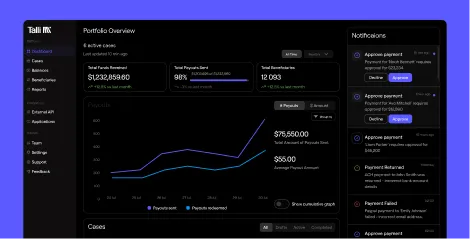
Comprehensive dashboard visibility includes:
- Completion rates: Percentage of successful payouts by creditor class
- Payment method distribution: Breakdown across ACH, cards, wallets, and checks
- Geographic concentration: Regional distribution patterns
- Failure root cause analysis: Detailed breakdown of payment exceptions
- Fraud flags: Items requiring manual review before release
- Remaining fund balances: Real-time estate fund tracking
This visibility enables trustees to identify and resolve issues proactively rather than discovering problems during reconciliation. When courts ask questions about distribution status, trustees have immediate answers.
Simplifying Court Reporting and Audits
Automated reporting reduces administrative burden while improving accuracy:
- Court-required accounting: Generated automatically without manual preparation
- Stakeholder portals: Controlled access for courts, creditors, and legal teams
- CRM integration: Webhooks sync payment status updates to case management systems
- Complete audit trails: Every transaction documented with timestamps and verification
Trustees who implement systems for comprehensive reporting and reconciliation spend less time on administrative tasks and more time on case management priorities.
Cost Savings and Efficiency Gains in Digital Disbursements
The financial case for digital distribution extends beyond per-transaction costs to include reduced exceptions, faster reconciliation, and improved creditor outcomes.
Quantifying the Savings of Digital Payouts
Direct cost comparisons demonstrate substantial savings:
- Transaction costs: Estimated 50-65% reduction compared to paper checks
- Processing time: Settlement reconciliation compressed from weeks to hours
- Auto-match rates: Around 90% of transactions reconcile automatically
- Exception reduction: Approximately 60% fewer unresolved exceptions requiring manual intervention
- Staff efficiency: Monthly closing time reduced by an estimated 70% (from 15 hours to 4.5 hours)
For trustees processing thousands of distributions across multi-year cases, these efficiencies compound significantly. A Chapter 13 trustee managing 500 creditors over 60 months processes 30,000+ individual payments, at which scale per-transaction savings become substantial.
Impact on Reissuance and Escheatment Expenses
Digital distribution directly reduces unclaimed fund exposure:
- Higher redemption rates: Estimated 95-98% versus 70-80% for paper checks
- Reduced reissuance: Fewer failed deliveries requiring follow-up
- Lower escheatment volumes: More funds reach creditors before dormancy periods trigger
- Simplified due diligence: Automated outreach for unredeemed payments
Understanding the escheatment process helps trustees appreciate how unclaimed funds create ongoing liability. Digital distribution addresses this risk at the source by ensuring more payments reach creditors successfully.
Case Study: Expediting Large-Scale Payouts With Digital Solutions
Real-world implementations demonstrate the tangible benefits of modern disbursement infrastructure in complex, high-volume cases.
AB Data: Transforming Settlement Administration
AB Data, a leading U.S. claims administrator managing some of the largest class action settlements worth hundreds of millions of dollars, implemented digital disbursement to address check-based distribution challenges.
Results achieved within 12 months:
- 30% increase in claimant redemption rates across check-issued populations
- 60% reduction in unresolved exceptions and manual reissuance overhead
- 100% fiduciary compliance record maintained across all distribution cycles and regulatory reviews
- Faster time to funds for claimants while lowering overall distribution costs
Thomas R Glenn, President & CEO of AB Data, explained the strategic shift: "Digital disbursement is viewed as infrastructure rather than a feature. Talli provided the regulated payout rails needed to move faster, reduce unclaimed funds, and give courts full confidence in how settlement money is being distributed."
Lessons From Successful Digital Implementations
Key factors driving successful deployments include:
- Phased rollouts: Start with pilot cases before full implementation
- Creditor communication: Clear messaging about payment options and timelines
- Staff training: Ensure team familiarity with new workflows and dashboards
- Continuous optimization: Monitor metrics and adjust based on performance data
Implementation typically requires 2-6 weeks with vendor-assisted setup, achieving ROI within an estimated 4-7 months through reduced processing time and error rates. Trustees who automate settlement reconciliation see immediate improvements in operational efficiency.
Understanding Payment Priority in Bankruptcy Distributions
The "priority waterfall" determines the order in which creditors receive payment and whether lower-priority creditors receive anything at all.
The Bankruptcy Payment Hierarchy
Federal bankruptcy law establishes strict payment priorities:
- Administrative expenses: Court costs, trustee fees, professional fees
- Secured creditors: Claims backed by collateral (mortgages, car loans)
- Priority unsecured claims: Taxes, domestic support obligations, employee wages
- General unsecured creditors: Credit cards, medical bills, personal loans
Each tier must be satisfied in full before the next receives payment. In many Chapter 7 cases, estate assets are exhausted before reaching general unsecured creditors, explaining why most unsecured creditors receive nothing despite successful discharge.
How Priority Affects Creditor Timelines
Priority position directly impacts payment timing:
- Secured creditors: May receive payment early in the process as collateral is liquidated
- Priority unsecured: Typically paid after administrative costs, often early in Chapter 13 plans
- General unsecured: Last in line, potentially waiting years in Chapter 13 or receiving nothing in Chapter 7
Trustees must manage creditor expectations based on their priority position. A general unsecured creditor in a 60-month Chapter 13 plan may not receive meaningful distributions until years 4 or 5 after all higher-priority claims are current.
Meeting Filing Deadlines: Critical Compliance Requirements
Missing claims filing deadlines has devastating consequences for creditors. Trustees and administrators must understand and communicate these requirements clearly.
Bar Date Enforcement
Courts strictly enforce claims filing deadlines with no flexibility:
- Non-governmental creditors: 70 days from filing to submit proof of claim
- Governmental entities: 180 days extended deadline
- Chapter 13 timing: Claims must be filed 90 days after the 341 meeting
Missing these "bar dates" results in complete claim disallowance regardless of debt validity. A creditor owed $50,000 who files one day late receives the same distribution as if they were owed nothing: zero.
Supporting Creditor Compliance
Trustees can improve creditor filing rates through:
- Clear deadline communication: Multiple reminders as bar dates approach
- Simplified filing processes: Digital forms and automated submissions
- Status tracking: Real-time visibility into which creditors have filed
- Proactive outreach: Direct contact for creditors at risk of missing deadlines
Effective claims management systems track bar dates, send automated reminders, and prevent distributions to creditors who missed filing deadlines, a compliance-critical function for trustees.
Why Talli Is Built for Bankruptcy Distribution
Purpose-built disbursement platforms designed specifically for legal settlements offer capabilities that generic payment processors cannot match. Talli addresses the unique requirements of bankruptcy distribution with infrastructure designed for fiduciary-grade compliance and operational efficiency.
Meeting Bankruptcy-Specific Requirements
Bankruptcy distributions require specific features beyond standard payment processing:
- Priority waterfall enforcement: Systems automatically respect payment hierarchies without manual intervention
- Court reporting integration: Outputs satisfy judicial accounting requirements with automated documentation
- Multi-year plan support: Infrastructure handles 36-60 month Chapter 13 timelines with continuous payment processing
- Modification flexibility: Plans change; systems adapt without disruption to ongoing distributions
Generic payment platforms require extensive customization to meet these requirements. Talli embeds QSF compliance, OFAC screening, and fiduciary-grade fund management as core functionality.
The Talli Advantage for Trustees
Talli's platform addresses bankruptcy trustee requirements through:
- Scalability: Support from 1,000 to 100,000+ recipients without performance degradation
- Multi-jurisdictional compliance: Operations across 190+ countries with 150+ currencies
- Enterprise security: SOC 2 Type II and PCI DSS Level 1 certification
- Global reach: Multi-language support in 40+ languages for diverse creditor populations
- Regulatory infrastructure: Built-in compliance with BSA/AML requirements
For claims administrators managing complex bankruptcy proceedings, these capabilities translate to faster distributions, higher redemption rates, and reduced compliance risk. Digital disbursement infrastructure compresses distribution timelines from weeks to approximately 24-48 hours while achieving estimated 95-98% redemption rates, helping trustees meet fiduciary obligations while serving creditor populations more effectively.
Frequently Asked Questions
What happens to creditor payments if a Chapter 13 case is dismissed before completion?
When Chapter 13 cases fail, which occurs in approximately 60% of filings, creditors typically receive nothing beyond payments already distributed during the plan period. Unlike discharge, dismissal restores the debtor's original obligations but does not guarantee creditor recovery. Funds already paid to the trustee are generally distributed to creditors according to the priority waterfall before case closure, but unsecured creditors who had not yet received distributions lose their recovery entirely. This high failure rate underscores why creditors should not rely on Chapter 13 plans reaching completion.
Can creditors track the status of their bankruptcy distribution in real time?
Historically, creditors had no visibility into distribution status beyond waiting for checks to arrive or not arrive. Modern disbursement platforms offer stakeholder portals providing controlled access to payment status, completion dates, and delivery confirmation. Creditors can see whether their payment is pending, in transit, or completed, eliminating uncertainty and reducing trustee support inquiries. For trustees, this transparency satisfies fiduciary obligations while reducing administrative burden from creditor status requests.
What recourse do creditors have if they miss the claims filing deadline?
Options are extremely limited. Courts treat bar dates as firm deadlines, and late-filed claims are typically disallowed entirely regardless of the underlying debt's validity. In narrow circumstances, creditors may petition the court to extend the deadline by demonstrating they did not receive proper notice of the bankruptcy filing, or that extraordinary circumstances prevented timely filing. However, these exceptions are rarely granted. The debtor or trustee may file a proof of claim on behalf of a creditor within 30 days after the original deadline passes, but this provides limited protection. The best strategy is aggressive deadline monitoring and early filing.
How does the automatic stay affect creditor payment expectations?
The automatic stay, triggered immediately upon bankruptcy filing, halts all collection activity against the debtor. For creditors, this means no payments on pre-petition debts until the case is resolved through the bankruptcy process, regardless of payment due dates or existing arrangements. The stay continues until discharge (Chapter 7) or plan completion (Chapter 13), meaning creditors may wait 4-6 months (Chapter 7) or 3-5 years (Chapter 13) before receiving distributions. Violations of the automatic stay through continued collection attempts can result in court sanctions, making compliance essential even when frustrated by payment delays.
How long does it take for asset liquidation in Chapter 7 cases that do have distributable assets?
Asset liquidation timelines vary dramatically based on property complexity. Simple assets like bank accounts can be liquidated within weeks, while complex assets require substantially longer. Real estate may take 3-6 months to market and sell. Business interests can require months of valuation and buyer identification. Contested property claims may extend to 12-18+ months through litigation. Trustees must maximize estate value for creditors, which sometimes means accepting longer timelines to achieve better sale prices. Even after liquidation completes, trustees must resolve all claims, handle objections, and prepare final distribution accountings before creditors receive payment.