.svg)


.svg)
The difference between sending, delivering, and documenting notice can determine whether a court views a settlement notice program as reasonable and properly administered. However, there is no single rule stating that every claimant must personally read or acknowledge every notice. Courts generally evaluate settlement notice under due process, applicable procedural rules, the settlement agreement, and the court-approved notice plan.
UCC § 1-202 separately defines when notice is given or received in transactions governed by the Uniform Commercial Code. That definition can be useful when interpreting commercial agreements, but it is not the universal legal standard for class action notices, service of process, or court-supervised settlement distributions.
For claims administrators and settlement trustees, the practical requirement is to follow the approved notice plan, use reliable communication methods, document unsuccessful attempts, and preserve a complete audit trail. Purpose-built class action payment systems can support that process through automated communication, payment tracking, and court-ready reporting.
Key Takeaways
- Courts generally ask whether notice was reasonably calculated to inform affected parties, not whether every claimant actually read the notice.
- Service of process, class action notice, contractual notice, and payment-status communications are different legal categories.
- UCC § 1-202 applies primarily to UCC-governed transactions and should not be presented as the universal settlement-notice rule.
- Email, SMS, postal mail, and portal communications can support a notice program when authorized by the applicable rules and court order.
- Tracking records show that a communication was sent or delivered, but they do not always prove that the named person reviewed it.
- Portal access, identity verification, and payment selection can provide valuable evidence of claimant engagement.
- Administrators should document transmission, delivery failures, corrective outreach, claimant activity, and final payment status.
- Talli supports email and SMS reminders, real-time tracking, claimant payment selection, compliance workflows, and auditable distribution records.
Start With the Correct Legal Framework
The phrase “legal notice” can refer to several different processes. Applying the wrong framework can produce misleading conclusions about what must be delivered, who must receive it, and what evidence the administrator must preserve.
Service of Process
Service of process formally notifies a defendant or another required party that a legal proceeding has begun. It helps establish the court’s authority over the person and is governed by procedural rules for the relevant court and jurisdiction.
Permitted methods may include:
- Personal delivery by an authorized process server
- Delivery to an authorized agent
- Substituted service at a residence or business
- Certified or registered mail where permitted
- Electronic service when authorized
- Publication after other methods fail or when parties cannot reasonably be identified
The proof required depends on the applicable rule. A process server may file an affidavit describing the documents, date, time, place, and person served. Mail service may require a receipt or tracking record. Electronic service may require consent, authorization, or proof that the court’s filing system transmitted the document.
Class Action Settlement Notice
Class action settlement notice serves a different purpose. It informs class members about the proposed settlement, their rights, important deadlines, and available options.
Depending on the case, the notice may explain:
- The nature of the lawsuit
- The class definition
- The settlement’s principal terms
- How to submit a claim
- How to object or opt out
- The date of the fairness hearing
- The effect of taking no action
- How approved payments will be distributed
The governing standard is not that every class member must personally acknowledge the notice. Under the constitutional standard associated with Mullane v. Central Hanover Bank & Trust Co., notice must be reasonably calculated under the circumstances to inform interested parties and give them an opportunity to respond.
Contractual Notice
Contracts often contain separate notice provisions identifying approved delivery methods, addresses, and deemed-receipt rules. For example, a contract might state that notice sent by overnight courier is effective on the next business day or that an email is effective when no delivery-failure message is received.
The exact contract language matters. Courts may distinguish among notice that was:
- Sent correctly
- Delivered to the designated address
- Accepted by someone at the address
- Actually reviewed by the intended person
- Effective under a deemed-receipt provision
Settlement administrators should not apply a commercial contract’s notice provision to class members unless the settlement documents or court order make it relevant.
Distribution Communications
Communications sent after settlement approval may include payment-selection instructions, tax-document requests, identity-verification requests, failed-payment alerts, and reminders about redemption deadlines.
These communications are operationally important, but they are not automatically equivalent to the original court-approved settlement notice. Their required content, timing, and delivery method generally come from the distribution plan, settlement agreement, court orders, and administrator procedures.
What Due Process Actually Requires
Due process ordinarily focuses on the reasonableness of the notice method, not guaranteed personal receipt.
A court may evaluate:
- Whether the administrator used current and reliable contact data
- Whether the communication clearly explained the proceeding and deadlines
- Whether the selected channels were appropriate for the claimant population
- Whether undeliverable messages triggered corrective action
- Whether known contact problems were reasonably addressed
- Whether adequate time was provided for claims, objections, or exclusions
- Whether the administrator followed the approved notice plan
The administrator’s obligation may change when it learns that an initial notice failed. For example, returned mail, bounced email, or an invalid telephone number may require additional reasonable steps when another usable address or channel is available.
This does not mean that administrators must pursue every claimant indefinitely. It means the record should show that the approved process was followed and that known delivery failures were handled consistently.
Delivered, Received, and Actually Read
These terms are often used interchangeably, but they describe different events.
Sent
A communication is sent when it leaves the administrator’s system or is transferred to a postal or delivery provider.
Evidence may include:
- Mailing manifests
- Email transmission logs
- SMS gateway records
- Platform timestamps
- Exported communication reports
A sent record proves initiation of the communication. It does not necessarily prove successful delivery.
Delivered
Delivery generally means the communication reached an address, device, server, mailbox, or designated destination.
Evidence may include:
- USPS delivery scans
- Signed return receipts
- Courier delivery records
- Email server acceptance
- SMS delivery status
- Portal notification logs
Delivery evidence is stronger than proof of sending, but it may still leave unanswered questions. A mailpiece may be accepted by another person at the address. An email server may accept a message that the claimant never opens. A text message may reach a reassigned or inactive number.
Received
The legal meaning of receipt depends on the governing law or agreement. Under UCC notice rules, a person receives notice when it comes to that person’s attention or is duly delivered in reasonable form to specified locations. That definition is useful in UCC matters but should not be treated as the general test for settlement notice.
A court order or contract may also define when notice is deemed received. Administrators must follow that controlling language rather than assuming that one definition applies everywhere.
Actually Read or Acknowledged
Actual reading is the most difficult event to prove. A read receipt may be blocked, unreliable, or generated automatically. A signature can establish acceptance of an item without proving that the recipient reviewed every page.
Stronger evidence of engagement may include:
- Logging into a claimant portal
- Opening a payment-selection page
- Completing identity verification
- Uploading a tax form
- Choosing a payment method
- Confirming claimant information
- Redeeming or accessing funds
These actions can strongly support the conclusion that the claimant engaged with the distribution process. They do not automatically replace a notice method required by a court order, statute, or contract.
Using Postal Records Correctly
Postal records remain useful in legal settlement administration, particularly when the notice plan requires first-class mail, certified mail, or another physical method.
First-Class Mail
First-class mail may be appropriate for broad class notice because it is scalable and does not require the claimant to be present. Administrators commonly retain mailing lists, address-standardization records, National Change of Address updates, mailing manifests, and returned-mail data.
These records support proof that the mailing program was executed as approved.
Certified Mail and Return Receipts
Certified mail provides a mailing record and delivery information. A return receipt may also show that someone accepted the item at the destination.
However, certified mail has limitations:
- The claimant may refuse the item.
- No one may be available to sign.
- Another household or business member may accept it.
- The signature may be difficult to identify.
- The mailpiece may remain unclaimed.
A signed receipt is useful evidence, but it does not always prove that the named claimant personally read the notice.
Tracking Scans
A “Delivered” scan generally shows that the carrier recorded delivery to the destination. It should not be described as conclusive proof of actual awareness.
Administrators should preserve the complete tracking history, delivery exceptions, return records, and any follow-up actions. Combining postal records with email, SMS, or portal communication may create a more complete outreach record when the notice plan permits multiple channels.
Electronic Notice Under UETA and E-SIGN
The Uniform Electronic Transactions Act and the federal E-SIGN Act generally prevent electronic records and signatures from being denied legal effect solely because they are electronic.
That principle does not mean that every legal notice can automatically be delivered by email. The administrator must still determine whether:
- Electronic delivery is allowed by the governing rule or court order
- The claimant consented when consent is required
- The electronic record can be accessed and retained
- The content can be reproduced accurately
- Transmission and delivery failures are documented
- A paper alternative must remain available
When E-SIGN’s consumer-disclosure rules apply to information legally required to be provided in writing, the sender may need affirmative consent, clear disclosure of withdrawal rights, paper-copy options, hardware and software information, and electronic confirmation that the consumer can access the format.
Electronic records should therefore be described as legally usable when the applicable requirements are satisfied, not as universally equivalent to paper under every notice rule.
Building Court-Ready Notice Records
A defensible record should allow counsel, the court, or an auditor to reconstruct what happened without relying on employee memory.
Record the Notice Content
Preserve the exact version of each notice, including:
- Email subject and body
- SMS wording
- Mailed notice package
- Portal instructions
- Attachments and linked documents
- Language-specific versions
- Approval history
This prevents uncertainty about what claimants were told.
Record Every Attempt
Each communication record should identify:
- Claimant or record identifier
- Contact destination
- Date and time
- Delivery channel
- Notice version
- Transmission result
- Failure code
- Follow-up action
Sensitive information should be protected through appropriate access controls and retention policies.
Document Delivery Failures
Returned mail and bounced messages should be categorized consistently. Useful categories include invalid address, forwarding expired, mailbox unavailable, domain rejection, inactive number, and claimant opt-out.
The record should also show whether another approved channel or updated address was available.
Document Claimant Engagement
A real-time tracking system can preserve operational activity such as portal access, identity verification, tax-document completion, payment selection, and redemption.
These events help distinguish claimants who never engaged from those who began the process but did not complete it.
Preserve Distribution Outcomes
The final record should connect notice activity to payment status, including:
- Payment method selected
- Payment initiation date
- Successful delivery
- Failed or returned payment
- Reissuance activity
- Redemption status
- Remaining balance
Clear reporting and reconciliation helps demonstrate that communication and payment activity remain connected throughout the distribution.
Use Multiple Channels Without Overstating Their Effect
Email, SMS, postal mail, and claimant portals can complement one another. A second channel may reach a claimant when the first contains outdated information or is no longer monitored.
A practical sequence may include:
- Initial notice through the court-approved method
- Email or SMS reminder when authorized
- Follow-up after a bounce or returned mailpiece
- Portal access for identity and payment selection
- Reminder before a claim or redemption deadline
- Failed-payment notification
- Final outreach before residual-fund procedures begin
Multi-channel communication improves the opportunity for engagement, but administrators should not claim that it guarantees actual receipt. The stronger statement is that it produces more communication attempts, clearer failure data, and a more complete evidentiary record.
For populations without traditional bank accounts, administrators should also provide accessible payment choices. Support for unbanked claimant payments can reduce abandonment after the claimant receives notice but cannot use the default payment method.
Why Talli Strengthens Settlement Notice Documentation
Generic email and payment tools often separate communication records from payment activity. That fragmentation makes it harder to determine whether a claimant received reminders, entered the payment process, passed verification, selected a payment method, or successfully accessed the funds.
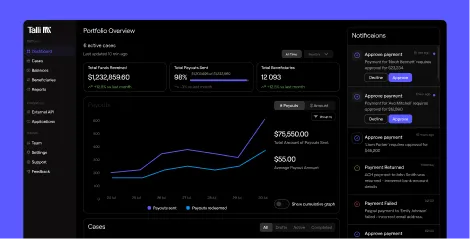
Talli is purpose-built for legal settlement disbursements. Its cloud-based platform allows claims teams to upload claimant data, create distribution campaigns, communicate through email and SMS, offer multiple payment methods, and track payment activity from one dashboard.
Talli supports notice and distribution administration through:
- Automated reminders: Email and SMS messages reduce manual follow-up and give claimants additional opportunities to complete required steps.
- Real-time visibility: Administrators can monitor claimant progress, payment status, failures, and remaining fund balances.
- Claimant engagement records: Portal activity, payment selection, identity verification, and related events provide evidence of participation.
- Court-ready audit trails: Communication and distribution records can be preserved for reporting, reconciliation, and review.
- Multiple payment methods: ACH, prepaid cards, PayPal, Venmo, gift cards, and check fallbacks give claimants practical redemption options.
- Built-in compliance workflows: KYC verification, OFAC screening, W-9 collection, fraud mitigation, and audit logging remain connected to the payment record.
- Fund segregation: Dedicated settlement accounts preserve matter-level visibility and help prevent commingling.
The platform also supports clear claimant tracking, failed payment resolution, and court reporting workflows.
These tools do not replace counsel’s interpretation of the court order or guarantee that every claimant personally reads a communication. They help administrators execute the approved workflow consistently and preserve evidence of what was sent, what failed, what the claimant did, and whether payment was completed.
Talli Conclusion
Courts generally do not require administrators to prove that every settlement claimant personally read every notice. They require compliance with the governing procedural rules and a notice method reasonably calculated to inform the affected population.
The strongest administrative record connects the approved notice plan to transmission logs, delivery failures, corrective outreach, claimant activity, and final payment results. Talli brings these records together in a purpose-built settlement disbursement platform, helping claims teams maintain visibility without relying on disconnected email tools, carrier portals, and spreadsheets.
By automating reminders, tracking engagement, documenting compliance steps, and connecting notice activity to the payment outcome, Talli gives administrators clearer evidence that the distribution process was executed consistently. The legal effect of that evidence remains subject to the court order and applicable law, but the operational record is substantially easier to review, reconcile, and defend.
Frequently Asked Questions
What Is the Difference Between Delivered and Received Notice?
Delivery generally means that a communication reached an address, server, device, or other destination. Receipt is a legal concept whose meaning depends on the governing statute, procedural rule, contract, or court order. Neither term necessarily proves that the recipient read the communication.
Must Every Class Member Actually Receive Settlement Notice?
Usually, no. Due process generally requires a notice method reasonably calculated under the circumstances to inform interested parties. Courts recognize that some notices will be returned, blocked, overlooked, or sent to outdated contact information despite a properly designed notice program.
Can Email or SMS Be Used for Settlement Notice?
Yes, when authorized by the applicable procedural rules and court-approved notice plan. Administrators should preserve the message content, transmission logs, delivery failures, consent records when required, and evidence of any corrective outreach.
Does a USPS Delivered Scan Prove Actual Receipt?
Not necessarily. A delivered scan generally shows that the carrier recorded delivery to the destination. It may not establish that the named claimant personally accepted, opened, or reviewed the notice.
How Does Talli Help Document Notice and Payment Activity?
Talli connects automated email and SMS reminders with claimant portal activity, identity verification, payment selection, payment status, and reconciliation records. This creates an auditable timeline showing communication attempts, claimant engagement, failed payments, corrective action, and final distribution outcomes.