.svg)


.svg)
Escheatment compliance is the process of proving that unclaimed property was identified correctly, aged correctly, and sourced to the correct state. It also requires a defensible evidence trail. When you sign an escheat certification, you are certifying that chain of decisions, not just approving a file upload. For settlement teams, owner data, due diligence, payment remediation, and full audit transparency become the real controls behind the signature.
If you are preparing to sign an escheat certification, you are probably dealing with a familiar problem: the filing deadline is getting closer, but the record behind the filing still feels fragmented. Stale checks, claimant nonresponse, returned checks at scale, and tax-document gaps make it harder to certify that your report is complete and assigned to the right state. That is exactly where modern claims disbursements matter. Higher redemption rates mean fewer balances aging into escheat exposure, while automated KYC verification, OFAC screening, W-9 collection, 1099 generation, and regulated payout rails strengthen the record behind the filing.
This guide explains what you are actually attesting to in an escheat certification in 2026. It also covers the state rules that change that burden, the records that make the filing defensible, and the workflow models worth comparing before a migration. For settlement administrators, the best workflow is the one that creates less chasing, more redemptions, and a signer-ready audit trail.
Legal risk is not abstract. If the certification is wrong, the issue can spread across multiple states, property types, and reporting years. BDO’s unclaimed-property compliance guidance still identifies missing filings, weak policies, bad dormancy logic, poor retention, and wrong-state sourcing. Those remain recurring triggers for penalties and expanded audit exposure.
That burden rises fast for settlement teams when stale checks and fragmented payment records pile up after distributions. In 2024, U.S. class action settlements reached $42 billion across the top ten settlements, and the combined total across 2022 through 2024 reached $159.4 billion. That volume is exactly why escheatment compliance is a control problem first and a reporting problem second.
An escheat certification is an attestation that the report is complete, correctly sourced, and supported by evidence. Most certification risk begins upstream with owner data, due diligence, exception handling, and stale-payment cleanup. Because state-by-state differences in notice rules, aggregation thresholds, and reporting models affect what the signer must be able to prove, settlement teams can reduce risk by keeping claimant outreach, payout remediation, and compliance records within one operating record.
Key Takeaways
- An escheat certification is a statement that your report is complete, correctly sourced, and backed by records that support the holder’s decisions.
- Escheatment compliance changes by state because notice-report rules, negative-report obligations, aggregation thresholds, and examination standards are not uniform.
- The signer is usually attesting to five core areas at once: property classification, dormancy timing, due diligence, jurisdiction, and report accuracy.
- Wrong-state sourcing is not a clerical error. The priority rules still turn owner address quality into a multistate compliance issue.
- Settlement teams reduce certification risk when claimant outreach, payment retries, audit logs, and final reporting live inside the same operating record.
Why Teams Revisit Escheatment Compliance Workflows
Teams usually revisit escheatment compliance when aging workflows stop producing a signer-ready record that a certifying officer can still defend. They rarely revisit it because the law suddenly changed.
A filing packet assembled from spreadsheets, bank exports, stale-check lists, and vendor email trails may be enough for a routine quarter-end review. It becomes much harder to defend when someone must certify completeness across jurisdictions.
Pressure tends to show up in the same places. Due-diligence mailings live in one system, payment failures in another, and claimant updates in a third. Dormancy logic gets tracked inside calculations instead of the operational workflow. By the time filing season arrives, the team is not only asking what is reportable. It is also asking whether the evidence is coherent enough to defend.
Workflow design becomes compliance critical for settlement administrators. The more unresolved balances, reissues, and owner-contact exceptions remain open late in the cycle, the harder it is to certify the final report with confidence. Clean settlement reconciliation is often what separates a supportable filing packet from a reconstructed estimate.
What Is Escheatment Compliance?
Escheatment compliance is the process of identifying reportable property, applying the right dormancy and sourcing rules, and filing a supportable report to the correct state.
That definition sounds simple until you apply it across real records. The holder has to decide which balances are in scope, which property type code applies, whether the owner-contact clock has actually run, and whether any due-diligence step reset the timeline. NAUPA’s reporting overview makes the broad rule clear: once property reaches the end of the dormancy period with no owner contact, the organization must identify and report it.
Operationally, the filing is only the end of the process. Escheatment compliance starts much earlier with address quality, payment status, reconciliations, and evidence of outreach. That is why recurring pitfalls tend to involve missing policies, incorrect property codes, weak due diligence, and inadequate record retention rather than filing mechanics alone.
What Is an Escheat Certification?
An escheat certification is the holder’s signed statement that the report, remittance, and supporting assumptions are true, complete, and legally supportable.
Different states phrase the signer’s declaration differently. Some emphasize verification under penalty of perjury. Others focus on completeness, due diligence, or the authority of the person submitting the report. The common denominator is that the signer is not merely acknowledging transmission of a file. The signer is standing behind the holder’s underlying compliance process.
That distinction matters because most states expect more than a spreadsheet export. State programs commonly accept reports in the NAUPA standard format, but a valid file is not the same thing as a valid certification. The file structure can be technically correct while the sourcing, dormancy logic, or owner detail behind it is wrong.
For settlement teams, this distinction is especially important because funds often move through court-supervised structures, Qualified Settlement Funds, claimant portals, and third-party disbursement vendors. If the operating record is fragmented, the certification becomes harder to defend.
What You Attest to When You Sign
When you sign an unclaimed property report, you are attesting that the holder’s data, legal assumptions, due diligence, and remittance outputs line up.
In practice, that attestation usually covers at least these seven statements:
- The property was identified correctly. You classified the balance into the right reportable category rather than excluding a property type that should have been reviewed.
- Dormancy was calculated correctly. The aging logic matches the property type and the state’s rule rather than a generic stale-date assumption.
- Due diligence was completed. Required owner outreach happened on time and in the required format before the property was reported.
- Owner records are reliable. The last known address and other owner details are accurate enough to support first-priority sourcing.
- Jurisdiction was assigned correctly. The state receiving the report is the correct state under the priority rules.
- Aggregation rules were followed. Records that require owner detail were not improperly rolled into aggregate totals.
- The report and remittance are complete. The amounts, property codes, and supporting schedules reconcile to the holder’s books and records.
Many ranking pages explain what unclaimed property is, but they rarely unpack what the signature actually means. In escheatment compliance, the signature is a final summary of upstream control quality.
Which State Rules Change the Certification Burden?
State filing models change the certification burden because the signer may be validating different owner-detail, notice, and reporting obligations in each jurisdiction.
Big differences usually come from notice-report structures, negative-report requirements, aggregation thresholds, and examination standards. California is a good example. Notice-report property valued at $25 or more generally requires owner and property detail rather than aggregate treatment. That raises the burden on owner-data accuracy before funds are remitted.
Texas places attention on due diligence. Texas holder guidance requires due diligence for presumed-abandoned property valued above $250, including written notice that the holder has the property and may have to deliver it to the Comptroller if it is not claimed. Delaware emphasizes standardized examination rules and sourcing logic, which means jurisdiction decisions must survive review.
Escheatment compliance is never one national checkbox. It is a multistate risk scorecard with state-specific proof requirements.
How Priority Rules Determine the State You Must Report To
Priority rules send unclaimed property first to the owner’s last known address state and, if no address exists, to the holder’s incorporation state.
That hierarchy comes from the U.S. Supreme Court’s framework in Texas v. New Jersey, later reaffirmed in disputes involving abandoned intangible property. The rule is straightforward in concept: first report to the owner’s last-known-address state as shown in the holder’s books and records, then use the holder’s state of incorporation if the address is missing or unusable.
Address quality is not just a service issue. It is a jurisdiction issue. If the last known address is stale, blank, or unsupported, the signer may default property into the backup state even when the first-priority state should have received it. That can create duplicate exposure, underreporting, or later disputes if another state challenges the sourcing.
Settlement teams feel this acutely. Returned mail, incomplete claimant profiles, and unresolved reissues all weaken the owner record that supports first-priority sourcing. A stronger claimant audit trail matters here because the reporting state has to be defensible years later, not only at the filing deadline.
What Supporting Records Back Up the Certification
A defensible certification rests on records showing what the property was, how it aged, what outreach occurred, and why the state was chosen.
A defensible record set should usually include the property ledger, owner detail, address history, due-diligence logs, payment status changes, and copies of prior filings. It should also include records that show how claimant outreach, reissues, voids, payment failures, and stale-payment decisions were handled.
Many organizations break down here. The report may come from one system, returned mail from another, stale checks from a bank file, and due-diligence letters from a mail vendor. A signer cannot credibly certify completeness if those records do not reconcile. At minimum, the holder should be able to produce:
- The owner’s last known address and any later updates
- The property type code and dormancy calculation used
- Due-diligence mailings and response history
- Reissue, void, or returned-payment history
- The final report file, remittance amount, and filing confirmation
Where banking trust and segregation matter, settlement teams should also preserve QSF banking controls and ledger support that show balances remained attributable to the right matter.
What Happens If the Certification Is Wrong or Incomplete?
If the certification is wrong or incomplete, the holder can face penalties, expanded audits, multistate disputes, and a weaker defense later.
Exposure varies by state, which is exactly why the certification deserves attention. New Jersey law states that willful failure to report, pay, or deliver property can trigger a $1,000-per-day penalty up to $250,000 plus 25% of the value that should have been reported. The New Jersey penalty is not a theoretical risk. It shows how quickly a bad certification can become a material problem.
Process risk can also spread beyond penalties. If a holder cannot explain dormancy logic, state sourcing, owner detail, or report exclusions, auditors may widen the review period or challenge assumptions across multiple property types. If records are incomplete, estimation can become part of the examination process.
The signer is rarely the only person involved, but the signer is the person whose certification makes upstream failures visible. That is why certification should never be treated as a last-minute executive signature. It should be treated as the output of a controlled recordkeeping process.
How Settlement Teams Reduce Escheatment Compliance Risk
Settlement teams reduce escheatment risk before filing season by fixing owner-contact and exception problems while balances are still recoverable, not after reports are due.
That matters because settlement workflows generate a specific pattern of risk. Checks go stale. Claimants ignore notices they do not trust. Address changes arrive after the first distribution wave. Tax documentation is incomplete. A payment fails, then sits in a queue with no shared ownership across legal, finance, and operations. By the time filing season arrives, the team is certifying a process it can no longer reconstruct cleanly.
Modern claims disbursements change that posture. Digital disbursement infrastructure can reduce stale balances by giving claimants regulated payout rails, faster remediation, and better communication history.
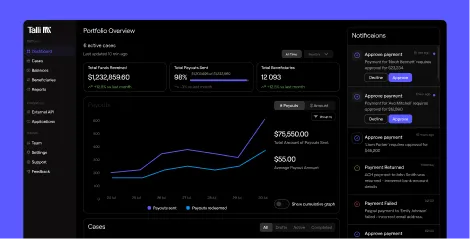
Talli is built for that operating problem. The platform supports ACH, prepaid Mastercard, PayPal, Venmo, and gift cards, with paper check fallback where needed. It also supports KYC verification, OFAC screening, W-9 collection, 1099 generation, fraud controls, real-time dashboards, and audit logs. For settlement teams, those controls matter because they connect the payout event to the compliance record.
Operationally, the goal is simple: less chasing, more redemptions. Payment status has to stay visible through failed payment remediation so stale items do not quietly roll into reporting exposure.
That same operating record should keep sanctions checks, tax collection, and final court reporting tied together. When those controls live in separate tools, the signer has a much weaker basis for certification.
Tools & Solutions for Escheatment Compliance
The best escheatment compliance workflow is the one that gives the signer one auditable record from owner outreach through final remittance. The comparison should focus on evidence quality, migration complexity, support burden, security controls, SOC readiness, enterprise fit, and potential labor savings.
The goal is not to find the cheapest tool or a free template. The goal is to identify which operating model lowers certification risk in a multistate environment.
Three conclusions stand out. First, free tools are acceptable only for very small one-state cleanups, not enterprise escheatment compliance. Second, migration risk is highest when address history, due-diligence proof, and bank activity live in different systems. Third, the biggest savings usually come from fewer exceptions, fewer manual handoffs, and less late-stage audit reconstruction.
Certification-ready workflows need one operating record for claimant outreach, payment exceptions, compliance evidence, and final reporting. The real question is not which brand sounds best. It is which operating model gives the signer enough evidence to certify the file with confidence.
1. Spreadsheets Plus Bank Files: Lowest Control Surface
Workflow profile: Often relies on manual exports and internal labor.
Many teams inherit this baseline. Property status lives in spreadsheets, payment updates arrive in bank files, and due-diligence proof sits in inboxes or shared folders. The appeal is familiarity. No new implementation is required, and the process can appear inexpensive because the software is already in place.
Structurally, the signer is forced to trust a reconstructed narrative rather than a live operating record. Each filing cycle depends on manual joins across files, which increases the chance that owner updates, reissues, and stale-payment exceptions will be missed or resolved late.
Key Features
- Spreadsheet-based exception tracking for small portfolios
- Bank export reviews for cleared, voided, and stale payments
- Manual reviewer sign-off steps without system changes
Best For
Spreadsheets plus bank files fit low-volume programs where the property mix is simple, the reporting footprint is narrow, and the same people manage the process year after year. Once exception counts increase or multiple teams touch the data, this model usually becomes hard to defend.
Pricing
Direct software cost may look minimal, but the real cost is internal labor, review time, and rework during filing season. Audit support costs also rise because evidence has to be reconstructed after the fact.
2. Check-Only Operations: Familiar but Exception-Heavy
Workflow profile: Typically involves print, mail, reconciliation, and added internal operations cost.
Check-only processes remain common because they are operationally familiar and easy to explain to legacy stakeholders. For some programs, that familiarity can reduce initial change management pressure.
Check-only operations generate more stale items, more address drift, and more reissue handling. Every unresolved check adds pressure to the certification because the team must prove what outreach occurred, whether the owner record changed, and whether the balance is now reportable.
Key Features
- Traditional payment rails that align with established treasury procedures
- Physical mail trail for initial delivery attempts
- Bank reconciliation for cashed versus outstanding checks
Best For
Check-only operations make the most sense when claimant populations strongly prefer paper, payment urgency is low, and the organization can tolerate higher remediation volume. They are a weaker fit when redemption rates and filing defensibility both matter.
Pricing
Costs usually include check stock, print and mail handling, positive pay, reconciliation effort, reissue processing, and the downstream cost of uncashed-check cleanup before filing deadlines.
3. Generic Payout Platforms: Split Evidence
Workflow profile: Integration options and pricing models vary by provider.
Generic payout platforms can improve delivery speed and claimant convenience compared with manual or paper-heavy operations. They often centralize payment execution better than spreadsheets and reduce some of the surface area around basic disbursement tracking.
What they do not always solve is the settlement-specific compliance record. If sanctions checks, tax collection, claimant communications, and court-facing reporting still sit outside the core workflow, the team may improve payout speed without materially improving certification readiness.
Key Features
- Digital payment options that reduce delivery friction
- Platform dashboards for payout status and basic exception monitoring
- API-driven workflows that can connect with adjacent systems
Best For
Generic payout platforms fit teams that need better payment speed and claimant choice but do not face the same level of settlement-specific compliance burden. They are less effective when the signer needs one defensible record across claimant outreach, tax support, sanctions review, and final reporting.
Pricing
Pricing commonly combines transaction fees, implementation work, support packages, and added spend for adjacent compliance tools that fill gaps outside the payout engine.
4. Talli: Audit-Ready Claims Disbursements
Connectors: claimant portal, payout rails, compliance workflows, and reporting in one environment | Pricing: demo-led custom pricing through Talli
Talli is built as digital claims disbursement infrastructure rather than a generic payout tool. For settlement teams, that distinction matters because escheatment compliance is usually weakened by disconnected evidence, not by the lack of a payment rail. The platform is designed to keep claimant-facing payment choice, compliance-critical controls, and settlement reporting inside the same operating record.
On the operational side, Talli supports ACH, prepaid Mastercard, PayPal, Venmo, gift cards, wire transfers, and paper checks as fallback. It pairs those payout methods with automated KYC verification, OFAC screening, W-9 collection, and 1099 generation. That combination helps reduce manual handoffs between legal, finance, compliance, and claimant support.
It also keeps retry decisions and exception history visible to reviewers. The platform emphasizes audit transparency, which is exactly what a signer needs when tracing why a balance was retried, reissued, voided, or left unresolved.
Those proof points are directly aligned to the certification problem. For escheatment compliance, faster claimant completion and lower unresolved balance volume reduce the number of items that have to be aged, sourced, and certified later.
Talli also highlights dedicated settlement accounts, fund segregation, and Patriot Bank, N.A. Member FDIC support, which reinforces the fiduciary and banking controls settlement administrators care about.
If your primary challenge is certifying settlement-related balances with fewer exceptions and stronger proof, this model is worth evaluating. Book a Demo
Key Features
- Dedicated segregated client accounts that support QSF-oriented fund handling
- Multiple payout methods that reduce claimant abandonment and stale-check volume
- Automated KYC verification and OFAC screening for compliance-critical review
- W-9 collection and 1099 generation tied to the disbursement workflow
- Real-time dashboards, claimant portal visibility, and full audit transparency
Strengths
- Keeps payout activity, claimant outreach, and compliance evidence in one operating record
- Purpose-built for settlement administration rather than generic payables
- Supports less chasing and more redemptions through digital claimant payment choice
- Strengthens court-ready reporting with audit logs and dashboard visibility
Best For
Talli is the best fit for compliance-critical settlement payouts where the team needs better redemption performance without giving up fiduciary rigor. It is especially well suited when legal, finance, and operations all need visibility into claimant remediation, sanctions controls, tax collection, and final audit support before an officer certifies the filing.
Pricing
The platform uses custom pricing rather than public self-serve tiers. That is consistent with settlement programs where volume, payout mix, compliance scope, and reporting requirements vary materially by matter.
Best Practices for Defensible Escheatment Compliance
Defensible escheatment compliance comes from repeatable controls that let the signer explain each reported balance from creation through remittance.
Strong programs usually apply the same five practices:
- Map property types early. Do not wait until filing season to decide which balances are in scope.
- Tie dormancy logic to system rules. Manual date tracking creates avoidable exceptions.
- Document due diligence centrally. Letters, email attempts, and claimant responses should live with the balance record.
- Reconcile stale items monthly. Reportable property should never be the first time an exception is reviewed.
- Review signer packets before submission. The certifying officer should see summary assumptions, outliers, and unresolved items before signing.
Settlement teams should add one more control: connect escheat preparation to post-distribution accounting. If final accounting, reissues, and claimant support live outside the same workflow, the certification becomes a retrospective guess instead of a documented conclusion.
That is also why tax documentation fits the holder-side problem. Missing W-9 and 1099 support is often part of the same fragmented record that later weakens the certification.
Common Mistakes That Undermine Escheatment Compliance
Escheatment compliance usually fails through ordinary process drift rather than a single dramatic legal mistake.
Common breakdowns are predictable:
- Treating stale dates as if they were dormancy periods
- Filing a technically valid NAUPA file without validating the underlying owner data
- Aggregating property that should have carried owner-level detail
- Letting due-diligence evidence sit with vendors instead of the holder’s record
- Assuming the same state rules apply across all property types
- Ignoring inherited liabilities after an acquisition or system conversion
- Asking the signer to certify a report without an exceptions summary
Each of these mistakes weakens the certification in a different way. Some distort the reportable amount. Others distort the reporting state. Others make it impossible to prove what happened later. The shared pattern is that the signature becomes disconnected from the facts it is supposed to confirm.
Talli Conclusion: Certification Follows Process
Escheat certification is not the end of escheatment compliance. It is the moment your process has to speak for itself. If owner data is weak, due diligence is incomplete, or jurisdiction logic is inconsistent, the signature exposes that weakness. If the record is complete, the certification becomes far less risky.
For settlement teams, the safest path is to reduce unresolved balances before they ever reach the report stage. Purpose-built digital disbursement infrastructure gives teams a cleaner record across payout choice, compliance automation, and full audit transparency. That is the practical route to fewer stale items, better claimant outcomes, and a filing packet a signer can actually defend.
There is no single workflow that fits every unclaimed-property program. The right answer depends on how much exception volume, claimant remediation, and multistate proof the signer has to manage.
- For low-volume portfolios with limited complexity, spreadsheets plus bank files can still work if the team has tight monthly reconciliation and stable ownership.
- For legacy environments where paper is still required, check-only operations remain workable, but teams should expect more stale-item cleanup and a heavier certification burden.
- For organizations prioritizing payment speed over settlement-specific controls, generic payout platforms can improve delivery but may still leave compliance evidence fragmented.
- For compliance-critical settlement payouts, Talli is the best option because it combines regulated payout rails, claimant outreach, compliance automation, and full audit transparency in the same record.
If you want to see how modern claims disbursements support cleaner certification workflows, read the customer case study.
Frequently Asked Questions
What is escheatment and why does it matter?
Escheatment is the transfer of unclaimed property to a state after dormancy rules run, and it matters because holders must prove the transfer was proper. For settlement teams, that means stale checks, claimant outreach, and owner-address quality all become legal-control issues rather than simple back-office cleanup.
Where do I have to report unclaimed property?
You generally report unclaimed property to the owner’s last known address state first and, without a usable address, to the holder’s incorporation state. That is why address hygiene, claimant updates, and documented sourcing logic matter so much before any certification is signed.
Do we have to report unclaimed property?
Most companies and organizations that hold dormant customer, vendor, payroll, dividend, or settlement balances have unclaimed-property reporting obligations when dormancy rules are met. The practical test is whether you are holding funds or property for someone else long enough to trigger a state dormancy period without restoring owner contact.
How do I manage unclaimed property compliance?
You manage unclaimed property compliance by mapping property types early, applying state-specific dormancy rules, documenting due diligence, and reconciling exceptions before filing season. The strongest programs keep payment status, claimant outreach, and audit support inside one operating record so the final certification is defensible.
What am I attesting to when I sign?
You are attesting that the report is complete, the property was classified correctly, due diligence was completed, and the state assignment is supportable. In practical terms, you are standing behind the evidence chain, not just the file upload.
What records should I review before I sign?
At minimum, you should review the property ledger, owner address history, dormancy support, due-diligence evidence, payment exception history, and final report summary. If those records do not reconcile, the certification is not ready.
What happens if property is reported to the wrong state?
Wrong-state reporting can trigger correction work, duplicate exposure, and a harder audit defense because another jurisdiction may claim first priority. Most of the time, the root cause is weak owner address support or inconsistent application of the priority rules.
Can settlement funds become unclaimed property?
Settlement funds can become unclaimed property when payment attempts fail, owner contact is not restored, and dormancy and reporting rules run their course. That is why settlement teams need reissue, outreach, and audit workflows long before the annual filing deadline.