.svg)


.svg)
Qualified Settlement Funds use Form 1120-SF to report transfers received, income earned, deductions claimed, distributions made, estimated tax payments, and federal income tax liability. A QSF generally files the return for every calendar year it exists, even when it earns little or no taxable income.
A properly established QSF separates the defendant’s transfer of settlement assets from later claimant distributions. This gives administrators time to confirm allocations, resolve liens, collect tax information, process disputes, and arrange payments without keeping the defendant involved in every distribution.
That flexibility also creates compliance duties. The QSF is generally a separate taxpayer with its own Employer Identification Number, accounting records, tax filings, payment history, and information-reporting responsibilities. Administrators need a reliable process for connecting the fund’s tax records with its QSF payment operations.
Key Takeaways
- Form 1120-SF generally applies for every calendar year a QSF exists.
- A QSF pays tax at the current 37% maximum trust rate on modified gross income, not qualifying settlement principal.
- QSFs use the calendar year and accrual accounting.
- Calendar-year returns are generally due April 15; Form 7004 extends filing, not payment.
- Estimated tax may be required when expected liability is at least $500.
- Claimant reporting depends on the payment’s character, and the 2026 $2,000 threshold is not universal.
- Closure requires final distributions, reconciliation, tax filings, court reporting, and resolution of remaining liabilities.
Understanding The Qualified Settlement Fund Framework
A Qualified Settlement Fund is a fund, account, or trust that satisfies Internal Revenue Code Section 468B and the related Treasury regulations.
Under Treasury Regulation §1.468B-1, a fund generally must meet three conditions:
- A court or another qualifying governmental authority must establish or approve the fund and retain continuing jurisdiction.
- The fund must resolve or satisfy eligible legal claims arising from an event or related series of events.
- The fund must qualify as a trust under state law or keep its assets physically segregated from the transferor and related persons.
Eligible liabilities may include tort claims, breach-of-contract claims, claims arising from violations of law, and certain environmental liabilities. Both contested and uncontested claims may qualify.
A fund does not become a QSF merely because the parties call it a settlement trust, escrow account, or qualified fund. The governing order, eligible liabilities, segregation of assets, and continuing governmental jurisdiction must support the classification.
Once the requirements are satisfied, the QSF generally becomes a separate United States taxpayer. It normally obtains its own EIN, maintains separate books and accounts, and files its own federal return.
Defined settlement distribution workflows can connect the court-approved plan of allocation with claimant data, payment authorizations, compliance reviews, and transaction records.
Funds That Do Not Automatically Qualify
Not every court-supervised fund is a QSF. The regulations exclude certain liabilities, including ordinary obligations to general trade creditors or debtholders related to a Title 11 bankruptcy case or workout. A bankruptcy-related fund may qualify only when it independently satisfies the QSF requirements for eligible claims.
Other funds may be disputed ownership funds, liquidating trusts, bankruptcy estates, or grantor trusts. Misclassification can lead to the wrong return, tax rate, deductions, or information reporting, so the issue should be resolved when the fund is established.
When A QSF Comes Into Existence
Governmental approval generally does not apply retroactively. The clearest process is to obtain the required order and establish segregated accounts before transferring settlement assets.
A relation-back election may be available when the fund satisfies the eligible-claim and segregation conditions before governmental approval. The administrator and transferors must elect jointly, follow the timing limits, and attach the required statement to timely filed returns. Legal and tax advisers should coordinate the approval date, account opening, transfer date, and filing obligations.
Why QSF Timing Matters
A QSF can separate the defendant’s funding date from claimant payment dates, allowing administrators to confirm eligibility, resolve liens, collect tax forms, process disputes, and finalize payment instructions.
The defendant’s deduction depends on the underlying liability and applicable tax rules. QSF status also does not make every claimant payment tax-free; treatment depends on the claim and payment character.
Who Must File Form 1120-SF
The current Form 1120-SF instructions require Section 468B designated and qualified settlement funds to use the form.
The administrator is responsible for filing and signing the return. Depending on the governing documents, the administrator may be:
- A court-appointed trustee
- A settlement administrator
- A person designated in the settlement agreement
- A custodian controlling the fund’s assets
- Another fiduciary approved by the court
- The transferor when no other administrator has been designated
A QSF generally files Form 1120-SF for every calendar year in which it exists. A return may still be required when the fund has no taxable income, makes no claimant distributions, or holds money in a non-interest-bearing account.
Failing to file because no tax appears due can lead to penalties, IRS notices, and delays when the fund later attempts to close.
What Form 1120-SF Reports
Form 1120-SF is designed specifically for designated and qualified settlement funds. It reports transfers, taxable income, administrative and incidental deductions, claimant and transferor distributions, estimated payments, and tax due or overpaid.
Property transfers may require appraisal, basis, and transferor information. Administrators should complete every applicable line and attachment. The form does not establish a general $25,000 asset threshold for completing a balance sheet.
Required Tax Year And Accounting Method
A QSF must use the calendar year and an accrual method of accounting. A fund established during the year generally files a short-period return through December 31.
Accrual accounting can recognize income or deductions before cash is received or paid. The tax preparer therefore needs bank and investment statements, invoices, transfer documents, distribution ledgers, and year-end accrual information, not only payment-platform reports.
Filing Deadlines And Extensions
A calendar-year Form 1120-SF is generally due on the 15th day of the fourth month after the tax year ends, normally April 15.
When the date falls on a Saturday, Sunday, or legal holiday, the deadline generally moves to the next business day.
The administrator can request an automatic six-month extension by filing Form 7004 by the original due date. A valid extension normally moves the filing deadline to October 15.
The extension provides more time to file, but it does not extend the payment deadline. The QSF should estimate and pay its liability by the original due date.
An insufficient payment can produce interest or penalties even when the return is filed during the extension period. Paper-filing addresses and electronic procedures can change, so administrators should follow the current IRS instructions instead of copying details from an older return.
Calculating Modified Gross Income
A QSF pays tax on modified gross income, not on the entire settlement amount.
Under Treasury Regulation §1.468B-2, the fund is taxed at the maximum rate under Section 1(e). The current maximum trust rate is 37%.
Taxable income commonly includes:
- Interest from bank deposits
- Treasury and money-market income
- Dividends
- Capital gains
- Partnership income or gains
- Other income earned by fund assets
- Certain amounts paid to compensate for delayed transfers
Qualifying settlement principal transferred to resolve the liabilities for which the fund was created is generally excluded from gross income.
A $25 million settlement transfer therefore does not automatically create $25 million of taxable QSF income. Interest, dividends, and gains earned after the transfer may still be taxable.
Allowable QSF Deductions
A QSF may deduct qualifying administrative and incidental expenses, including trustee, administrator, accounting, tax, legal, actuarial, banking, notification, claim-processing, and court-reporting costs when the applicable deduction rules are met.
Claimant legal fees are not automatically QSF administrative expenses. Claimant and transferor distributions are also not deductible merely because they reduce the fund’s cash balance.
Estimated Tax Payments
A QSF is generally subject to corporate estimated-tax rules. Payments may be required when the fund expects to owe at least $500 after available credits.
For calendar-year funds, the usual installment dates are:
- April 15
- June 15
- September 15
- December 15
When an installment date falls on a weekend or legal holiday, the due date generally moves to the next business day.
The administrator should forecast investment income, deductible expenses, prior payments, withholding, and credits before each installment. The estimate may need revision when interest rates change, distributions reduce invested assets, or expenses differ from projections.
Electronic payment access should be established soon after the fund receives its EIN. A filing extension does not postpone estimated-tax installments or the balance due.
The Double-Tax Issue Requires Careful Explanation
It is inaccurate to state that QSF investment income is always taxed twice because the fund pays tax and the claimant later pays tax on the same interest.
The QSF pays tax on its modified gross income. A claimant’s tax treatment generally depends on the underlying settlement claim, as though the transferor had paid the claimant directly.
A claimant is not automatically taxed on the QSF’s investment earnings merely because the fund earned interest before making the distribution.
Separately stated prejudgment interest, post-judgment interest, or another taxable interest component may be taxable to the claimant. That differs from treating all fund earnings as automatically taxable again.
Settlement documents should identify wages, principal, attorney fees, interest, punitive damages, and other components when those distinctions apply.
Reporting Claimant Distributions
A QSF may have information-reporting and withholding obligations when it pays claimants, attorneys, service providers, or other parties.
The correct treatment depends on what the payment represents:
- Damages for qualifying physical injuries or physical sickness may be excluded under Section 104(a)(2).
- Punitive damages are generally taxable.
- Emotional-distress payments may be taxable unless an exclusion applies.
- Wage recoveries may require payroll withholding and Form W-2.
- Non-employee compensation may require Form 1099-NEC.
- Other taxable damages may require Form 1099-MISC.
- Attorney payments may trigger separate reporting.
- Separately awarded interest is generally taxable.
The QSF generally assumes reporting and withholding obligations that would have applied to the transferor if it had paid the claimant directly.
Administrators must therefore review the settlement agreement, judgment, court order, and plan of allocation before selecting tax forms.
The 2026 Information-Reporting Threshold
For certain payments made in 2026, the threshold that was previously $600 increased to $2,000. This is not a universal threshold for every QSF distribution.
Administrators must determine the payment’s character, applicable form, exemptions, withholding, filing deadline, electronic-filing requirement, and state obligations. Reporting may be required regardless of amount when federal income tax was withheld.
Talli’s tax compliance tools can support W-9 collection and payment-data exports, but the settlement documents and tax analysis control the payment’s legal character.
Electronic Filing Requirements
The IRS generally applies a 10-return aggregate electronic-filing threshold across covered return types, including Forms W-2, 1099-MISC, and 1099-NEC. An administrator may cross it even when no single category contains 10 returns.
Recipient, IRS, and state deadlines may differ, and federal combined filing does not eliminate every separate state obligation.
Making Payments From The QSF
Every distribution should remain connected to the court-approved settlement structure.
Before releasing a payment, the administrator should confirm:
- The claimant appears in the approved population.
- The award matches the plan of allocation.
- Required appeals and objections are resolved.
- Liens, holds, and offsets are addressed.
- Identity information has been verified.
- Required taxpayer information has been collected.
- The payment method is authorized.
- The payment instruction belongs to the claimant.
- Required withholding has been calculated.
- The payment authorization is documented.
Large claimant populations make spreadsheet-based controls difficult. A purpose-built class action platform can connect the approved claimant file with verification, payment status, notifications, and reconciliation records.
Choosing Payment Methods
Claimants may not all have access to the same financial or communication channels. Talli supports claimant payment options, including ACH, prepaid Mastercard options, PayPal, Venmo, gift cards, and checks when required.
The appropriate method depends on the award, claimant population, settlement terms, delivery timeline, identity controls, accessibility, cost, and exception handling. Payment and administration prices vary, so universal cost ranges should not replace a current written proposal.
Tracking Failed And Returned Payments
Issuing a payment does not prove that the claimant received or redeemed it.
Administrators should distinguish between statuses such as authorized, funded, sent, pending, delivered, redeemed, returned, rejected, expired, canceled, and reissued.
Every failed payment should include a reason, such as an invalid account, closed bank account, identity mismatch, expired selection window, undeliverable address, or fraud hold.
A structured failed payment workflow helps the administrator decide whether to request new instructions, issue a replacement, change the payment method, or escalate the record.
These records support claimant service, reconciliation, court reporting, unclaimed-property review, and tax preparation.
Reconciliation And Court Reporting
Each distribution cycle should reconcile three sources:
- The court-approved claimant and award file
- The QSF’s banking or custody records
- The payment platform’s transaction records
The reconciliation should account for original awards, adjustments, withholding, fees, successful payments, returns, cancellations, reissues, unclaimed amounts, investment income, tax payments, remaining cash, and outstanding liabilities.
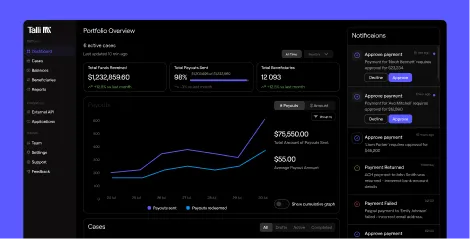
Talli’s reporting and reconciliation tools provide payment-level visibility and reduce dependence on separate spreadsheets. A real-time payment dashboard can show payment status, method selection, exceptions, and remaining balances.
The administrator must still reconcile platform data with the official accounting records. Automation does not replace fiduciary review or the tax preparer’s general ledger.
Form 1041 Versus Form 1120-SF
Traditional trusts and estates commonly file Form 1041, while QSFs generally file Form 1120-SF. Traditional trusts may receive an income-distribution deduction and pass taxable income to beneficiaries through Schedule K-1. A QSF instead pays tax on modified gross income and does not deduct distributions merely because it pays claimants.
State-law trust status does not replace federal QSF classification. A qualifying single-transferor QSF may make a grantor-trust election only when the regulatory requirements are met.
State Tax And Unclaimed Funds
Federal Form 1120-SF compliance does not eliminate state obligations.
State income-tax exposure may depend on where the fund was established, the supervising court, the administrator or trustee’s location, the location of assets, claimant residence, income source, and state conformity with federal QSF rules.
A multi-state settlement may create filing or withholding obligations in more than one jurisdiction.
Residual funds may be directed to a supplemental distribution, court-approved cy pres recipient, the defendant when permitted, a reserve, or a state under unclaimed-property law.
Administrators should not assume that unredeemed payments can remain in the QSF indefinitely. The settlement agreement, court order, due-diligence requirements, and applicable state law determine the next steps.
Closing A Qualified Settlement Fund
A QSF is not closed simply because the main claimant distribution is complete.
The fund generally continues to exist until it no longer satisfies the applicable requirements or has no assets and will receive no additional transfers.
A complete wind-down normally includes:
- Complete all authorized distributions.
- Resolve returned, rejected, or expired payments.
- Address liens, holds, and offsets.
- Pay administrative expenses.
- Calculate federal and state taxes.
- Complete information reporting.
- Address residual and unclaimed funds.
- Reconcile all accounts.
- Complete required court reporting.
- File the final Form 1120-SF.
- Close bank and custody accounts.
The final return should report all activity through termination and be marked as final in the manner required by the current form.
The fund should not report a zero balance while known tax liabilities, fees, payments, reserves, or chargebacks remain outstanding.
Record Retention After Closure
No universal rule requires every QSF record to be kept for exactly seven years. Retention depends on federal and state tax rules, information-return requirements, court orders, settlement terms, unclaimed-property laws, disputes, and legal holds.
Administrators should preserve establishment orders, agreements, transfer documents, elections, bank records, returns, distribution ledgers, tax forms, withholding records, communications, and final reports. Talli’s legal audit trails can preserve payment events and authorizations.
Evaluating QSF Administration Costs
QSF administration costs vary by fund size, claimant volume, tax work, lien complexity, payment methods, reporting, and exception handling. Costs may include establishment, trustee services, banking, professional fees, verification, communications, distributions, information returns, court reporting, and closure.
Economic modeling should use the actual settlement value, holding period, investment policy, expected income, service fees, tax treatment, and state obligations. Deductions, claimant tax benefits, investment returns, and a specific QSF return on investment should not be presented as guaranteed.
Selecting A QSF Administrator
Evaluate administrators for Section 468B and Form 1120-SF experience, fiduciary authority, segregated account controls, written pricing, security, identity verification, taxpayer-data collection, payment options, exception management, reconciliation, reporting, insurance, and references.
The trustee, administrator, tax preparer, law firm, claims processor, bank, and payment platform may have different duties. A digital platform can process distributions and organize records without serving as trustee or tax preparer.
How Talli Supports QSF Administration
Talli provides a cloud-based legal disbursement platform for claims administrators, settlement companies, bankruptcy professionals, and legal teams. Claims teams can upload approved claimant data, create campaigns, offer payment options, and track transactions from one dashboard.
Built-in workflows support KYC review, OFAC screening, W-9 collection, fraud controls, reminders, reconciliation, audit logging, and settlement-level fund segregation. Administrators can track delivery and redemption, identify returns, preserve payment histories, generate exports, and organize court-reporting data.
Talli does not replace the trustee, tax preparer, or legal adviser. Its role is to support payment execution, compliance workflows, reconciliation, and reporting. Used with qualified advice, its records can reduce preventable errors when a QSF distributes funds, reports payments, prepares Form 1120-SF, and closes.
Frequently Asked Questions
Does Every QSF File Form 1120-SF?
Generally, yes. A Section 468B designated or qualified settlement fund normally files Form 1120-SF for each calendar year it exists, even when it earns no taxable income. Different treatment may apply when an eligible single-transferor QSF makes a valid grantor-trust election.
Are Settlement Transfers Taxable To The QSF?
Qualifying settlement principal is generally excluded from the QSF’s gross income. Interest, dividends, gains, and certain other earnings may be taxable. The QSF calculates tax on modified gross income after allowable deductions, not on the full settlement deposit.
Does Every Distribution Require Form 1099?
No. Reporting depends on the payment’s character. Wages may require Form W-2, nonemployee compensation may require Form 1099-NEC, and other taxable damages may require Form 1099-MISC. Certain physical-injury damages may be excluded from income.
Can A QSF Use A Fiscal Tax Year?
No. A QSF must use the calendar year and an accrual method of accounting. A fund created during the year generally files a short-period return covering its activity through December 31.
When Is A QSF Fully Closed?
A QSF is generally ready to close after completing distributions, resolving failed payments and liens, paying taxes and expenses, addressing residual funds, reconciling accounts, completing court reporting, filing the final Form 1120-SF, and confirming that it will receive no additional transfers.