Every payout exception costs money, but not every exception costs the same. Settlement administrators processing thousands of claimant payments can face substantial exception workloads. For example, a 3% exception rate across 25,000 monthly payouts creates 750 exceptions, costing approximately $18,750 to resolve at an illustrative $25 per exception. Without a structured triage system, operations teams often work exceptions in arrival order rather than impact order, allowing high-value failures to languish while low-dollar disputes consume limited bandwidth. A digital disbursement platform with proper exception scoring can reduce unresolved exceptions by 60% within 12 months while cutting monthly reconciliation time by 70%, transforming chaotic exception queues into predictable, cost-effective workflows.
Key Takeaways
- Exception triage scores payments across four dimensions: dollar value, aging thresholds, claimant criticality, and root cause complexity
- Manual exception processing costs approximately $25 per exception, creating $18,750+ monthly hidden costs for administrators with 3% failure rates
- In Nium's payout network, 77% of payment returns stem from incorrect or closed accounts and name mismatches, issues that pre-payment verification can help prevent
- One fintech workflow example reported a 65% reduction in information lookup time after integrating payment and customer records, demonstrating the potential efficiency gains from automated exception workflows
- Proper scoring frameworks can use 1-4 scales across four dimensions, with total scores ranging from 4-16 to determine priority
- Aging escalation thresholds should trigger at Day 3 (owner reminder), Day 7 (manager escalation), and Day 14 (executive flag)
- A Nium cost model illustrates 124% ROI from pre-payment verification under its stated assumptions
Understanding the Impact of Failed Payments on Accounts Payable Processes
Failed payments create compounding costs that extend far beyond the immediate resolution effort. When a settlement payment bounces due to invalid account data, outdated addresses, or compliance flags, the ripple effects touch every stakeholder in the distribution chain, from claimants waiting for their recovery to courts expecting completion reports.
The Hidden Costs of Uncashed Checks
Traditional paper check distributions face 20-30% unclaimed rates, requiring costly tracking at approximately $150 per uncashed check and eventual escheatment to state governments. Each failed payment triggers:
- Reissuance overhead: New check printing, postage, and reconciliation
- Claimant support burden: Inbound inquiries about payment status
- Compliance documentation: Updated audit trails and court reporting
- Opportunity cost: Staff time diverted from new distributions
- Escheatment risk: Unclaimed funds reaching state dormancy thresholds
The quiet crisis in B2B payments extends to settlement administration, where exception management erodes margins and delays case closure.
Measuring Financial Impact of Payment Failures
Quantifying exception costs requires tracking total resolution expenses, not just direct handling time. A settlement administrator processing 25,000 claimant payouts with a 3% exception rate faces:
- 750 exceptions monthly requiring individual attention
- $18,750 monthly handling cost at $25 per exception
- Hidden costs: Returned mail processing, skip tracing, compliance remediation
- Opportunity cost: Delayed fund distributions affecting claimant satisfaction
Without structured triage, operations teams address exceptions reactively, often prioritizing recent arrivals over high-impact failures. This first-in-first-out approach ignores the fundamental reality that a $50,000 misdirected payment demands faster resolution than a $50 address correction.
Prioritizing Payout Exceptions by Dollar Value to Minimize Financial Exposure
Dollar value scoring forms the foundation of effective exception triage. High-value payment failures represent greater financial exposure, regulatory risk, and reputational damage than low-value exceptions, yet without systematic scoring, they receive identical treatment in most exception queues.
Identifying Critical Payment Failures
Establish dollar value buckets that reflect your distribution profile and risk tolerance. For example:
- Under $1,000 receives Score 1 (Standard priority) with Operations team handling
- $1,000 to $10,000 receives Score 2 (Elevated priority) with Senior operations review
- $10,000 to $50,000 receives Score 3 (High priority) requiring Manager review
- Over $50,000 receives Score 4 (Critical priority) demanding Executive attention
These thresholds should align with your settlement disbursement reporting requirements and court-ordered distribution timelines.
Strategies for Securing Large-Value Disbursements
High-dollar payments warrant additional verification layers before disbursement:
- Pre-flight validation: Verify account details against banking databases before initiating transfers
- Dual approval workflows: Require secondary authorization for payments above threshold amounts
- Real-time fraud screening: Apply enhanced pattern recognition for high-value transactions
- Recipient confirmation: Implement delivery acknowledgment protocols for critical payments
Fund segregation through appropriately structured accounts supports Qualified Settlement Fund administration and provides clear audit trails for high-value payments. QSF tax treatment depends on meeting the applicable requirements under Treasury Regulation Section 1.468B-1, not solely on the account structure.
Addressing Stale and Aged Exceptions: A Key to Efficient Accounts Payable Automation
Payment exceptions don't improve with age. Unresolved failures accumulate interest charges on delayed disbursements, increase claimant dissatisfaction, and compound administrative complexity as documentation becomes harder to locate and stakeholders harder to reach.
The Compounding Costs of Delayed Resolution
Exception aging creates escalating consequences across multiple dimensions:
- Week 1: Standard resolution window with full documentation access
- Week 2-3: Claimant inquiries increase; staff must reconstruct context
- Week 4+: Compliance flags trigger; court reporting obligations activate
- Beyond 90 days: Review outstanding balances against applicable state dormancy rules, due diligence requirements, and settlement-specific reporting deadlines
The payout exception backlog article details how aged exceptions consume disproportionate resources while generating minimal additional value from the delay.
Automating Reminders and Follow-Ups for Aged Exceptions
Implement tiered escalation thresholds that trigger automatically based on exception age:
- Day 3: Automated reminder to assigned owner with resolution deadline
- Day 7: Manager escalation for unresolved exceptions with impact assessment
- Day 14: Executive notification for high-dollar or critical-vendor exceptions
- Day 30: Compliance team involvement for regulatory documentation
Aging scores should integrate with dollar value scoring to create composite priority rankings. A 15-day-old $500 exception and a 3-day-old $15,000 exception might receive similar composite scores, ensuring both receive appropriate attention relative to their total impact.
Your aging framework should reflect actual payment terms and compliance deadlines. Net 30 payment obligations warrant 5-day escalation triggers, while net 15 terms require 3-day thresholds for reducing unresolved payout exceptions.
Streamlining Resolution Efforts with Accounts Payable Automation Software
Resolution effort, the time and complexity required to fix an exception, varies dramatically across exception types. A simple data correction takes minutes; a compliance investigation spanning multiple jurisdictions takes weeks. Scoring exceptions by resolution complexity ensures teams allocate appropriate resources and set realistic timelines.
Root Cause Categories and Resolution Pathways
Effective triage requires mapping exception types to responsible parties and expected resolution timelines:
- Invalid account data typically requires Low effort (Score 1) with 1-2 day resolution by Operations team
- Missing W-9/tax forms typically requires Medium effort (Score 2) with 3-5 day resolution by Compliance team
- OFAC screening flags typically requires High effort (Score 3) with 5-14 day resolution by Legal/Compliance
- Multi-party disputes typically requires Very High effort (Score 4) with 14-30 day resolution by Legal counsel
This classification enables realistic workload planning and accurate status reporting to courts and stakeholders.
Leveraging Integrated Compliance Infrastructure
Modern compliance automation reduces resolution effort by handling routine verifications automatically:
- KYC verification: Cross-references provided information against identity databases without manual intervention
- OFAC screening: Automated compliance checking against U.S. Treasury sanctions lists with documented timestamps
- W-9 collection: Digital forms with smart reminders achieving 90% completion rates versus 40% without automation
- 1099 generation: Automated tax form preparation with IRS e-filing integration
- 24% backup withholding: Calculates withholding when required for reportable payments involving missing or incorrect taxpayer identification numbers
By automating compliance-related resolution steps, teams can focus manual effort on genuinely complex exceptions requiring human judgment.
Achieving Real-Time Visibility: Your Accounts Payable Automation Dashboard
Exception management without visibility is exception management by hope. Real-time dashboards transform reactive firefighting into proactive queue management, enabling operations leaders to identify emerging patterns, reallocate resources, and predict completion timelines.
Essential Dashboard Metrics
Your real-time tracking dashboard should display:
- Queue composition: Exception counts by priority score, root cause, and assigned owner
- Aging distribution: Visual breakdown of exceptions by days outstanding
- Resolution velocity: Average time-to-resolution by exception type
- Failure patterns: Geographic concentration, payment method distribution, root cause clustering
- Fund status: Remaining balances, committed payments, unallocated amounts
These metrics enable data-driven decisions about staffing, process improvements, and vendor performance.
Customizing Your Dashboard for Exception Management
Effective dashboards provide different views for different stakeholders:
- Operations managers need queue-level visibility with workload distribution and bottleneck identification. Real-time alerts flag exceptions approaching escalation thresholds.
- Finance teams require fund flow tracking with reconciliation status and aging reports. Integration with accounting systems eliminates duplicate data entry while maintaining audit trails for legal distributions.
- Compliance officers need flagged exception queues with sanctions screening results and documentation status. Automated reporting generates court-ready audit trails without manual preparation.
Executives want summary metrics: total exceptions outstanding, dollar exposure, projected completion dates, and trend comparisons against prior distributions.
Best Practices for Minimizing Failed Payments and Reissuance Overhead
The most cost-effective exception is the one that never happens. Prevention strategies addressing root causes deliver higher ROI than even the most efficient resolution processes.
Diversifying Payment Methods to Improve Redemption
Payment method diversity directly impacts exception rates. Paper checks generate significantly higher failure rates than digital alternatives:
- ACH direct deposit: $0.25-$0.50 per transaction with 1-2 day delivery for banked claimants
- Prepaid cards: Virtual cards delivered via SMS/email in 30 seconds, serving 5.6 million unbanked U.S. households
- Digital wallets: PayPal and Venmo integration at $0.50-$1.00 per transaction with instant access
- Gift cards: Amazon and Target options for settlements under $100 per claimant
- Paper checks: $7-20 all-in costs including printing, postage, reconciliation, and reissuance
Digital payment options achieve 95-98% redemption rates compared to 70-80% for traditional paper methods, dramatically reducing the exception population before it materializes.
Proactive Data Validation for Reduced Exceptions
Pre-payment validation catches problems before they become exceptions. In Nium's payout network, 77% of payment returns stem from incorrect or closed accounts and name mismatches, issues that pre-payment verification can help prevent:
- Account validation: Verify bank account status before initiating ACH transfers
- Address verification: Confirm delivery addresses against postal databases
- Identity matching: Cross-reference recipient details against provided documentation
- Compliance pre-screening: Run OFAC checks before payment initiation rather than during reconciliation
Organizations implementing pre-payment verification can achieve 50-75% reductions in payment failures, translating directly to reduced exception handling costs.
The Role of AI-Powered Fraud Detection in Preventing Payment Exceptions
Fraudulent claims create a distinct category of payout exceptions, ones that shouldn't be resolved but blocked entirely. The settlement industry flagged 80 million fraudulent claims in 2023, representing a 19,000% increase since 2021. Effective triage must distinguish between legitimate payment failures requiring resolution and fraudulent attempts requiring investigation.
How AI Identifies and Flags Suspicious Payouts
Modern fraud detection systems apply multiple verification layers:
- Device fingerprinting: Identify multiple claims submitted from identical devices
- Behavioral analytics: Detect anomalous patterns in claim submission timing and data entry
- Identity verification: Cross-reference claimant information against public records and known fraud indicators
- Network analysis: Map relationships between claims to identify coordinated fraud rings
AI-powered detection achieves 95% accuracy while identifying fraud 50% faster than manual review, preventing fraudulent payments from entering the exception queue entirely.
Integrating Fraud Prevention into Your Exception Workflow
Route suspected fraud exceptions differently than legitimate payment failures:
- Quarantine queue: Separate flagged payments from standard exception processing
- Investigation protocols: Define evidence requirements and escalation paths for fraud review
- Block mechanisms: Prevent payment release pending investigation completion
- Documentation requirements: Maintain court-defensible records of fraud determinations
Your fraud detection workflow should integrate with exception triage scoring, ensuring suspected fraud receives immediate attention regardless of dollar value or aging status.
Selecting the Right Accounts Payable Automation Solution for Legal Settlements
Generic payment processors require extensive customization to meet legal settlement requirements. Purpose-built solutions embed compliance infrastructure, court reporting capabilities, and fiduciary protections that generic platforms treat as afterthoughts.
Key Features for Legal Payout Platforms
Evaluate potential solutions against settlement-specific requirements:
- QSF compliance: Built-in support for Qualified Settlement Fund tax treatment under IRC Section 468B
- Fund segregation: Dedicated FBO account structures preventing commingling
- Court reporting: Automated generation of court-ready documentation without manual preparation
- Multi-jurisdictional support: Handling across 190+ countries with 150+ currencies
- Scalability: Performance from 1,000 to 100,000+ recipients without degradation
- Security certifications: SOC 2 Type II and PCI DSS Level 1 compliance
Evaluating Vendors for Compliance and Scalability
Your vendor evaluation framework should assess:
- Compliance depth: Does the platform handle OFAC screening, KYC verification, W-9 collection, and 1099 generation natively, or require bolt-on solutions?
- Integration capabilities: Can the system connect with existing case management, accounting, and CRM systems via API?
- Exception handling: Does the platform provide structured triage tools, or dump all failures into undifferentiated queues?
- Reporting sophistication: Can the system generate court-required accounting automatically, or require manual preparation?
- Support structure: Does the vendor provide dedicated implementation support, or generic onboarding resources?
Implementation typically requires 2-6 weeks with vendor-assisted setup, achieving ROI within 4-7 months through reduced processing time and error rates.
Why Talli Transforms Exception Management for Legal Settlements
While multiple platforms address payment exceptions, Talli delivers purpose-built infrastructure specifically designed for legal settlement administration and compliance-critical distributions.
Talli's exception management capabilities include:
- Automated three-way reconciliation: Reduces monthly closing from 15 hours to 4.5 hours, a 70% reduction, while achieving 90% auto-match rates
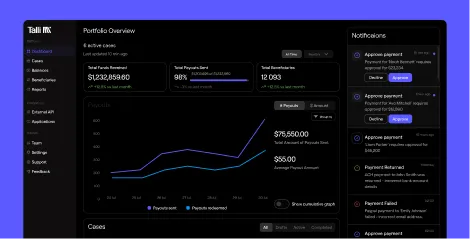
- Real-time exception dashboard: Live visibility into completion rates, failure root cause analysis, fraud flags, and fund balances with stakeholder portals for courts and legal teams
- Integrated compliance suite: Built-in KYC verification, OFAC sanctions screening, automated W-9 collection with 90% completion rates, and 1099 generation without configuration
- Multi-channel payment options: ACH, prepaid Mastercard via Patriot Bank N.A., PayPal, Venmo, gift cards, and paper checks as fallback, reducing reissuance by meeting claimants where they are
- AI-powered fraud detection: Pattern recognition achieving 95% accuracy across device fingerprinting, behavioral analytics, and identity verification
Talli's published AB Data results include a 30% increase in redemption rates. Talli's class action materials also report a 60% reduction in unresolved exceptions and manual reissuance, along with a 100% fiduciary compliance record across the distributions evaluated.
For class action settlements, mass tort distributions, and bankruptcy payouts, Talli provides the exception triage infrastructure that transforms reactive firefighting into systematic, auditable queue management.
Frequently Asked Questions
What are payout exceptions in the context of legal settlements?
Payout exceptions are payment failures requiring manual intervention before funds can reach intended recipients. Common causes include invalid bank account data, missing tax documentation (W-9), OFAC sanctions screening flags, returned mail, deceased claimants, and compliance verification failures. Each exception type requires different resolution approaches, timelines, and responsible parties. Effective exception management categorizes failures by root cause and routes them to appropriate teams rather than treating all exceptions identically.
How does prioritizing by dollar value help in managing payout exceptions?
Dollar value prioritization ensures high-impact failures receive faster resolution than low-value exceptions. A $75,000 misdirected settlement payment creates greater financial exposure, regulatory risk, and claimant harm than a $75 address correction, yet without systematic scoring, both might sit in the same queue. Assigning scores of 1-4 based on dollar thresholds creates objective prioritization that operations teams can apply consistently across all exception queues.
Why is the age of an exception a critical factor in its resolution?
Aged exceptions compound costs through multiple mechanisms: claimants become harder to reach as contact information decays, documentation becomes harder to locate, compliance deadlines approach, and state dormancy rules may activate. A payment exception unresolved for extended periods may trigger unclaimed property reporting requirements, converting a simple correction into a regulatory compliance matter. Aging escalation thresholds prevent exceptions from accumulating unnecessary complexity and ensure timely resolution.
Can digital payment methods reduce the incidence of failed payments?
Digital payment methods dramatically reduce exception rates compared to paper checks. Prepaid cards and digital wallets achieve 95-98% redemption rates versus 70-80% for paper checks, eliminating the 20-30% unclaimed population that generates costly tracking and escheatment obligations. ACH transfers validate account status before payment initiation, catching closed accounts and invalid routing numbers. Digital delivery eliminates returned mail, a primary exception source for paper distributions. Payment method diversity represents one of the highest-ROI exception prevention strategies available.
How does Talli's platform enhance compliance during the disbursement process?
Talli embeds compliance infrastructure directly into the disbursement workflow rather than treating it as a bolt-on requirement. Automated OFAC screening runs against every payment with documented timestamps satisfying court reporting requirements. W-9 collection via digital forms with smart reminders achieves 90% completion rates, reducing backup withholding exceptions. Fund segregation through dedicated FBO accounts supports Qualified Settlement Fund administration while preventing commingling violations. The platform generates court-ready audit trails automatically, eliminating manual report preparation while maintaining consistent fiduciary compliance across distributions.