.svg)


.svg)
A study of 373 federal securities class-action settlements entered between 2010 and 2018 found that more than 57% of reviewed settlements identified or approved a specific cy pres recipient. This finding highlights the importance of documenting residual-fund decisions, but it should not be treated as a statistic covering every type of class-action settlement; settlement teams face growing scrutiny over residual fund distributions. When further payments to class members are not feasible, selecting an appropriate recipient requires a documented connection to the class, the claims, and the settlement’s objectives.
A defensible process begins before objections arise. It prioritizes direct distributions, evaluates potential recipients under jurisdiction-specific law, discloses conflicts, and creates a record the court can review.
Key Takeaways
- Cy pres generally should be considered only after additional distributions to class members are not economically or practically feasible.
- Courts commonly require a meaningful nexus between the recipient’s work and the interests of the class.
- The Ninth Circuit requires recipients to bear a substantial nexus to class members’ interests.
- Geographic fit, mission alignment, organizational capacity, and conflicts can affect court approval.
- Legal aid and consumer organizations are not automatically appropriate. Their work must still fit the case.
- Written criteria, conflict disclosures, and recipient reporting commitments strengthen the approval record.
- Better class action disbursements can reduce residual funds before cy pres becomes necessary.
Understanding the Cy Pres Doctrine
The cy pres doctrine originated in trust law. The term refers to applying property “as near as possible” to its intended purpose when literal compliance is impossible.
In class actions, cy pres may allow unclaimed or non-distributable settlement funds to support an organization whose work indirectly advances interests related to the class or the litigation. It is not intended to provide a general charitable donation opportunity.
The ALI Aggregate Litigation Principles recommend prioritizing direct distributions. When individual payments are not feasible, the ALI recommends selecting a recipient whose interests reasonably approximate those of the class.
The ALI Principles are influential but are not binding statutes. Each court must apply controlling circuit precedent, Rule 23, the settlement agreement, and any applicable state law.
When Cy Pres May Be Appropriate
Cy pres may become relevant when:
- The cost of another distribution would consume most of the remaining fund.
- Additional payments would create windfalls for claimants who have already received full compensation.
- A material number of class members cannot be located after reasonable efforts.
- The remaining amount is too small to produce meaningful individual payments.
- The settlement agreement authorizes a residual distribution and the court approves it.
The record should explain why another distribution, extended claiming period, supplemental outreach, or simplified payment process would not provide greater direct benefit.
Courts generally prefer compensation of class members over indirect charitable relief. A cy pres provision should therefore follow, not replace, a reasonable feasibility analysis.
Criteria for Selecting a Recipient
No single national test governs every case. However, several recurring factors appear across federal decisions.
Mission Alignment
The recipient’s work should relate to the legal claims, the injury alleged, the defendant’s conduct, or the interests of the class.
Examples may include:
- A consumer privacy organization in a data-use case
- A financial literacy organization in a lending case
- An employment rights organization in a wage-and-hour case
- A patient safety organization in qualifying healthcare litigation
A recipient does not become appropriate merely because it performs worthwhile charitable work.
In Dennis v. Kellogg Co., the Ninth Circuit rejected a proposed distribution to charities feeding people in need because the settlement concerned allegedly misleading food marketing. The charitable purpose was valuable, but the required relationship to the class claims was insufficient.
Geographic Alignment
Geography matters when the class is concentrated in a particular city, state, or region.
A national organization may be appropriate for a nationwide class. A local organization may be a poor fit if most class members live elsewhere. Conversely, a national recipient may not provide sufficient benefit to members of a narrowly defined local class.
The analysis should compare:
- Class member locations
- The recipient’s service area
- Where the funded program will operate
- Whether benefits will reach similarly situated people
Organizational Capacity
A recipient must be able to manage the award responsibly.
Due diligence should address:
- Tax-exempt status
- Good standing
- Financial controls
- Relevant program history
- Staffing and governance
- Ability to segregate or track the award
- Willingness to submit reports
A newly created organization may face additional scrutiny because it lacks a track record. Creation for a settlement is not necessarily prohibited, but the parties should document why an established organization cannot provide the intended benefit.
Conflict Avoidance
Actual and apparent conflicts can undermine an otherwise reasonable selection.
The review should identify relationships involving:
- Class counsel
- Defense counsel
- Named plaintiffs
- Defendants
- Experts
- The judge or court personnel
- Immediate family members
- Recipient officers and directors
Prior donations, employment relationships, board positions, advisory roles, and alumni connections should be disclosed when material. Disclosure does not automatically disqualify a recipient, but silence can create avoidable objections.
Transparency and Reporting
The recipient should agree in writing to:
- Use funds for an identified purpose
- Maintain appropriate records
- Report expenditures
- Describe the people or communities served
- Return funds that cannot be used as approved
- Cooperate with court or administrator inquiries
These commitments make the proposal more concrete and reduce the risk that the award appears to be an unrestricted donation.
Circuit-Specific Considerations
Counsel should analyze controlling precedent rather than relying on a generalized national rule.
Ninth Circuit
The Ninth Circuit requires a cy pres distribution to serve as the next-best distribution and bear a substantial nexus to class members’ interests.
In Nachshin v. AOL, the court rejected distributions to geographically concentrated and substantively unrelated charities for a nationwide class. The court separately held that the district judge was not required to recuse herself despite her husband’s position on one recipient’s board.
In Lane v. Facebook, the Ninth Circuit affirmed a settlement that created a privacy-focused foundation. However, the dissent strongly criticized the limited relief to class members and the foundation’s governance connections. The case should not be described as a reversal.
Fifth Circuit
In Klier v. Elf Atochem North America, the Fifth Circuit held that the district court moved too quickly to cy pres when funds could potentially benefit another subclass. The decision reinforces that residual funds should remain tied to the settlement agreement and class members’ interests.
The case does not establish that Fifth Circuit courts always require reversion to defendants.
Seventh Circuit
The Seventh Circuit recognizes cy pres when direct payments would provide no meaningful relief and an aligned organization could better advance the interests underlying the litigation.
That is not an unrestricted “any public interest” rule. The proposed recipient should still have interests aligned with the class or the objectives of the lawsuit.
Eighth Circuit
The Eighth Circuit permits cy pres after eligible claimants have been fully compensated and additional direct distribution is not feasible. Economic viability remains central to the analysis.
Third Circuit
The Third Circuit emphasizes the degree of direct benefit actually reaching class members. Its decisions encourage courts to examine the claims process, expected distribution, attorneys’ fees, and the amount directed to third parties.
A settlement should therefore quantify both direct and indirect relief rather than relying only on the stated value of the common fund.
Common Grounds for Objection
Objectors often focus on weaknesses that could have been addressed before preliminary approval.
Weak Mission Nexus
A recipient may perform socially valuable work but remain unrelated to the case. The motion should connect specific recipient programs to the class and settlement objectives.
Geographic Mismatch
A localized recipient serving only one region may be inappropriate for a nationwide class unless the parties explain why the funded work will produce broader benefits.
Undisclosed Relationships
Connections involving counsel, parties, judges, family members, universities, or nonprofit boards can create an appearance of self-dealing.
Inadequate Distribution Efforts
Objectors may argue that cy pres is premature because:
- Claimants could receive a second distribution.
- The deadline could be extended.
- Returned payments could be reissued.
- Digital payment options could lower distribution costs.
- Additional contact data could locate more class members.
Excessive Attorney Fees
Cy pres can also affect fee scrutiny. Courts differ on how indirect benefits should be valued when applying percentage-of-recovery methods.
The settlement should distinguish clearly between:
- Funds paid directly to class members
- Administrative expenses
- Attorneys’ fees
- Service awards
- Cy pres distributions
- Any reversion or escheatment
A Defensible Recipient-Selection Process
A repeatable process makes the decision easier to explain and audit.
1. Confirm That Direct Distribution Is Not Feasible
Document the remaining fund, number of eligible claimants, expected payment amount, administrative cost, and likely redemption rate.
Consider whether flexible payment methods could make another distribution economical.
2. Establish Written Criteria
Create criteria before choosing a preferred organization. Relevant categories may include:
- Mission alignment
- Geographic coverage
- Class benefit
- Program specificity
- Financial controls
- Conflict risk
- Reporting capacity
Predetermined criteria help show that the recipient was not selected to reward an existing relationship.
3. Identify Multiple Candidates
Evaluate more than one credible organization when possible. A comparison demonstrates that the parties considered alternatives.
4. Complete Conflict Screening
Request disclosures from recipients and participating counsel. Record any direct or indirect relationship and explain why it does or does not affect the recommendation.
5. Request a Use-of-Funds Proposal
The recipient should identify:
- The program to be funded
- The expected beneficiaries
- The geographic area served
- The proposed timeline
- Administrative expenses
- Reporting measures
6. Prepare a Selection Matrix
Score candidates consistently. The matrix does not need to reduce the decision to a mathematical formula, but it should show that the same considerations were applied to each candidate.
7. Obtain Court Approval
Do not treat a settlement clause naming counsel or the administrator as the final decision-maker. The court should receive enough information to evaluate the recipient and proposed use.
State Statutory Requirements
State law may limit recipient selection or direct residual funds to specified purposes.
California
California Code of Civil Procedure § 384 generally directs qualifying residual funds to nonprofit organizations or foundations supporting projects that benefit the class or similarly situated people, promote law consistent with the underlying claims, support child advocacy, or provide civil legal services to indigent people.
For certain funds attributable to California residents, the statute also provides specific allocations, including 25% to the Trial Court Improvement and Modernization Fund and 25% to the Equal Access Fund. These percentages should not be presented as governing every California cy pres award.
North Carolina
North Carolina generally provides that, unless the court orders otherwise, residual funds are divided equally between:
- The North Carolina State Bar for civil legal services for indigent people
- The Indigent Persons’ Attorney Fund
The statute therefore does not impose an unconditional 100% allocation to a single legal services organization.
Lessons From Leading Cases
Nachshin v. AOL
The proposed recipients were insufficiently connected to a nationwide class and were concentrated in Southern California. The Ninth Circuit reversed the cy pres portion because the distribution failed the required nexus and geographic analysis.
The recusal objection did not produce that result. The appellate court held that the district judge was not required to recuse herself.
Lane v. Facebook
The Ninth Circuit affirmed the settlement, including the creation of a privacy foundation. The majority concluded that the arrangement addressed the privacy interests underlying the lawsuit.
The dissent argued that the class received inadequate relief and questioned the foundation’s structure and connections. The case illustrates the controversy surrounding governance and indirect benefits, but it is not an example of a cy pres award being reversed.
Google Referrer Header Litigation
The Ninth Circuit initially upheld a cy pres-only settlement directing $5.3 million to six privacy organizations. The Supreme Court later vacated the judgment and remanded for consideration of standing.
The Supreme Court did not decide whether the recipients or cy pres-only structure complied with Rule 23. The Ninth Circuit decision should not be cited without that procedural history.
Reducing Residual Funds Before Cy Pres
The strongest way to limit cy pres disputes is to maximize direct payments.
Paper checks can create operational barriers:
- Outdated addresses
- Returned mail
- Expired checks
- Deposit friction
- Reissuance delays
- Limited access for unbanked claimants
Digital programs may reduce these barriers by offering ACH, prepaid cards, PayPal, Venmo, gift cards, and check fallback.
Industry and platform benchmarks commonly cited by digital disbursement providers place Paper-check programs may experience uncashed, expired, returned, or reissued payments. Digital payment choice can improve take-up, but results vary by settlement design, claimant data, outreach, award value, deadlines, and available payment methods. Talli reports a 34% increase in take-up across check-issued populations in its AB Data case study, although actual results depend on case structure, claimant data, outreach, deadlines, award size, and payment options.
Administrators can improve results through:
- Recipient-friendly workflows
- Automated claimant communication
- Unbanked payment options
- Failed payment resolution
- Real-time tracking
The feasibility record should describe these efforts before concluding that direct distribution is impractical.
Documentation and Post-Award Monitoring
A court-ready submission should include:
- Distribution history
- Remaining balance
- Feasibility analysis
- Recipient-selection criteria
- Candidate comparison
- Conflict disclosures
- Recipient proposal
- Proposed reporting schedule
After approval, the administrator should verify receipt, monitor use, collect reports, and retain records.
A platform with legal distribution audit trails can preserve payment records, approvals, exceptions, and fund movements in one system. Court-ready reporting also helps demonstrate that residual funds were transferred and used as authorized.
How Talli Helps Minimize Cy Pres Risk
Cy pres risk often begins as a distribution problem. Returned checks, limited payment choices, poor visibility, and delayed follow-up increase the residual balance that must eventually be addressed.
Talli’s legal payment platform supports ACH, prepaid cards, PayPal, Venmo, gift cards, wire transfers, and check fallback. Claimants can select an accessible payment method rather than relying on a single delivery channel.
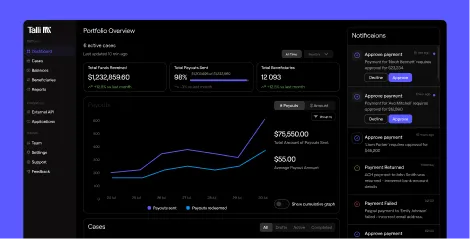
Automated reminders help claims teams follow up before redemption deadlines. Real-time dashboards show successful, pending, returned, and failed payments, allowing administrators to intervene while another direct distribution remains possible.
When residual funds remain, Talli’s reporting and audit infrastructure documents payment attempts, exceptions, approvals, and fund movements. This information can support the feasibility analysis and accounting required for a cy pres motion.
Technology does not select the recipient or replace judicial approval. It helps administrators maximize direct distributions and maintain the record needed to explain why any remaining cy pres award is necessary.
Frequently Asked Questions
Can Unclaimed Funds Revert to the Defendant?
Yes, if the settlement agreement or applicable law permits reversion and the court approves it. However, courts may prefer additional class distributions, escheatment, or an appropriate cy pres award. The permitted outcome depends on the agreement, governing precedent, and whether further payments to class members remain feasible.
Are Legal Aid Organizations Always Acceptable Recipients?
No. Legal aid organizations may be appropriate when their services relate to the class, the legal claims, or the settlement’s objectives. A court can reject even a reputable organization when the proposed use lacks a meaningful nexus or geographic connection to the class.
What Happens if the Proposed Recipient Is Rejected?
The court may require the parties to propose another recipient, conduct additional due diligence, or attempt further class distributions. A rejected recipient does not automatically invalidate the entire settlement, although the result depends on whether the cy pres provision is severable and how material it was to approval.
Are Cy Pres-Only Settlements Permissible?
Some courts have approved them when meaningful direct distribution was genuinely infeasible. They receive heightened scrutiny because absent class members receive no monetary payment. The record should quantify distribution costs, expected individual recoveries, class ascertainability, and why alternative payment or outreach methods would not work.
How Does Cy Pres Affect Attorney Fees?
Courts differ. Some consider cy pres funds part of the settlement benefit, while others discount or exclude them when calculating percentage fees. Counsel should identify controlling precedent and separately report direct payments, residual awards, expenses, fees, and other relief so the court can assess the actual class benefit.