.svg)


.svg)
To choose a disbursement platform for shareholder services, evaluate five core capabilities: automated compliance screening (KYC, OFAC, AML), multiple payout methods (ACH, prepaid cards, digital wallets), transfer agent system integration, real-time audit trails, and segregated account management. Shareholder disbursements remain one of the most operationally complex tasks facing transfer agents and corporate issuers today. Between uncashed dividend checks, mounting compliance requirements, and shareholders who expect digital-first experiences, the traditional paper-based payout model is breaking down. Choosing the right disbursement platform for shareholder services can mean the difference between lower-performing paper-based payouts and a modern digital process that improves completion and reduces follow-up work. This guide walks through every critical factor for selecting a disbursement platform for shareholder services — from compliance automation and payment method flexibility to integration requirements and audit trail capabilities — so transfer agents, corporate issuers, and fund administrators can make an informed platform decision.
Key Takeaways
- A purpose-built disbursement platform for shareholder services must handle KYC verification, OFAC screening, and AML compliance as core functions — not afterthoughts.
- Digital payout methods (ACH, prepaid cards, digital wallets) consistently achieve higher redemption rates than traditional check-based disbursements.
- Integration with existing transfer agent recordkeeping systems, ERPs, and shareholder portals determines how fast you can launch and scale.
- Uncashed checks create long-tail operational and compliance costs through escheatment tracking, due diligence mailings, and state unclaimed property reporting — making digital disbursement adoption a risk-reduction strategy, not just a convenience upgrade.
- Auditability and fund segregation are essential for fiduciary-grade disbursements, especially for settlement-related payouts where transfer agents need immutable records, court-ready reporting, and clear separation of shareholder funds from operating accounts.
- The best disbursement platforms improve both shareholder experience and internal efficiency by combining digital payment choice, automated reconciliation, and API-based registry synchronization in a single workflow.
What Is a Disbursement Platform for Shareholder Services?
A disbursement platform for shareholder services is specialized financial infrastructure that manages the outbound payment of dividends, settlement distributions, class action payouts, and other shareholder entitlements. Unlike general-purpose payment processors, these platforms are designed around the regulatory and operational requirements of securities-related payments — including SEC reporting obligations, unclaimed property tracking, and fiduciary-grade audit trails.
Transfer agents traditionally handled disbursements through check issuance and manual reconciliation. The shift toward modern transfer agent disbursement technology reflects both regulatory pressure and shareholder expectations: the global transfer agent services market reached $4.1 billion in 2024 and is projected to grow to $7.2 billion by 2033 at a 6.4% CAGR, driven largely by digitalization and compliance complexity.
Why Do Transfer Agents Need Modern Disbursement Infrastructure?
Transfer agents face a convergence of pressures that make legacy disbursement systems increasingly untenable. Understanding these drivers helps frame the platform evaluation process.
Uncashed checks create compliance liability. When shareholders fail to cash dividend checks within 3 to 5 years, those funds become subject to state unclaimed property laws — requiring annual reporting, escheatment filings, and ongoing record retention. Digital disbursements reduce unclaimed dividend liability by giving shareholders multiple convenient redemption options.
Regulatory complexity is accelerating. FinCEN finalized a rule covering Registered Investment Advisers and Exempt Reporting Advisers, but the effective date was delayed to January 1, 2028, giving firms more time to implement AML/CFT programs and related compliance controls. OFAC enforcement remains a serious compliance risk, but the record-breaking $1.5 billion-plus penalty year was 2023, not 2024, and penalty exposure varies significantly by facts, transaction value, and the strength of a firm's compliance program. Disbursement platforms must embed compliance into every payment workflow.
Shareholders expect digital-first experiences. Paper checks are slow, expensive, and increasingly rejected by a shareholder base accustomed to instant digital payments. Platforms that offer ACH, cards, and wallets see measurably higher completion rates — reducing the operational burden of follow-up mailings and escheatment processing.
Key Features to Evaluate in a Disbursement Platform
Not every disbursement platform for shareholder services is built equally. Here are the capabilities that separate general payment tools from purpose-built shareholder payment platforms.
Automated Compliance Screening
The platform must run real-time KYC verification, OFAC sanctions screening, and AML monitoring on every disbursement recipient. This is not optional — approximately 1,000 SDN additions annually (Deloitte), and platforms must rescreen before each disbursement rather than relying on initial onboarding approval alone.
Look for platforms that automate beneficial ownership analysis, tracing ownership chains through multiple layers to identify controlling beneficial owners — OFAC guidance clarifies that ownership stakes from multiple SDN-listed persons are aggregated when determining the 50% threshold.
Multiple Payout Methods
Flexibility drives redemption rates. Evaluate whether the platform supports:
- ACH direct deposit — lowest cost, preferred by institutional shareholders
- Prepaid cards — effective for shareholders without bank accounts
- Digital wallets (PayPal, Venmo) — fastest adoption among retail shareholders
- Gift cards — useful for small-balance distributions
- Paper checks — still necessary as a fallback for certain demographics
A platform that offers only one or two methods limits your ability to maximize redemption across diverse shareholder populations.
Real-Time Dashboards and Audit Trails
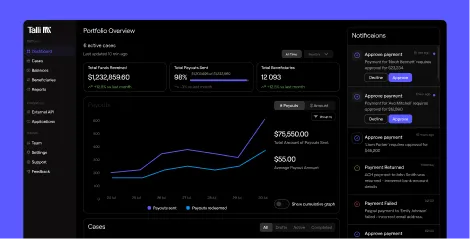
Every disbursement transaction needs a complete, immutable audit trail for legal distributions — covering SEC reporting, court filings, and internal governance. The platform should provide real-time dashboards showing payment status, redemption rates, failed transactions, and compliance screening results — all exportable for regulatory submissions.
Segregated Account Management
For settlement disbursements and QSF (Qualified Settlement Fund) distributions, the platform must support segregated accounts that keep shareholder funds separate from operating funds. This is a fiduciary requirement, not a convenience feature. Look for platforms that ensure FDIC-compliant payouts through QSFs and provide court-ready account documentation.
Scalability and Throughput
Evaluate the platform's demonstrated capacity for bulk disbursement of funds. Can it process tens of thousands of disbursements simultaneously? What is the typical processing time from authorization to payment delivery? Platforms that have processed 500,000+ recipients provide a stronger reliability signal than those without scale-tested infrastructure.
What Compliance Requirements Should a Disbursement Platform Meet?
Compliance is the single most consequential evaluation criterion for any disbursement platform for shareholder services. A compliance failure does not just create financial penalties — it exposes the transfer agent and issuer to regulatory action, reputational damage, and potential litigation.
KYC and Identity Verification
Every shareholder receiving a disbursement must be verified. Per KYC regulatory requirements, the platform should collect legal names, addresses, tax identification numbers (SSN or EIN), and entity details in formats that support reliable screening. For corporate shareholders, this extends to beneficial ownership analysis of the full entity structure.
OFAC and Sanctions Screening
The platform must screen every payee against OFAC's Specially Designated Nationals (SDN) list, the Consolidated Sanctions list, and relevant sector-specific programs. Rescreening close to payment release is a strong compliance practice, especially because sanctions lists can change after onboarding.
W-9 Collection and 1099 Reporting
For US-based disbursements, dividend disbursement automation should handle W-9 collection and generate 1099 forms for reportable payments, streamline digital settlement taxes. Manual W-9 tracking across thousands of shareholders creates error risk and audit exposure.
AML Program Integration
With FinCEN extending BSA requirements to additional financial entities in 2026, digital disbursement compliance demands that platforms support transaction monitoring, suspicious activity reporting, and integration with the transfer agent's broader AML/CFT program.
How Do You Evaluate Security and Fraud Prevention?
31% rely on paper processes that are inherently vulnerable to interception, forgery, and social engineering. Digital disbursement platforms must demonstrate security capabilities across multiple layers.
Data protection essentials. The platform should encrypt data at rest and in transit, maintain SOC 2 Type II certification, and implement role-based access controls. Multi-factor authentication for administrative access is non-negotiable.
Transactional security. Look for automated fraud detection in digital disbursements that flags anomalous payment patterns — duplicate disbursements, unusual payee modifications, and velocity checks on high-value transactions. Industry reference points suggest that robust fraud prevention systems can prevent hundreds of fraudulent attempts and save millions in potential losses.
Payment verification. The platform should confirm payee identity through multiple channels before releasing funds, particularly for high-value disbursements or first-time recipients.
Integration with Transfer Agent Systems and ERPs
A disbursement platform for shareholder services that cannot connect to your existing transfer agent recordkeeping system, ERP, and shareholder portal creates manual data entry bottlenecks that defeat the purpose of automation.
API-First Architecture
Modern platforms provide RESTful APIs that map workflows to APIs, enabling real-time data exchange between the disbursement system, shareholder registry, and accounting platforms. API-first architecture allows transfer agents to trigger disbursements programmatically based on corporate actions, dividend declarations, or settlement milestones — eliminating manual batch processing.
Shareholder Registry Synchronization
The platform must pull shareholder records, entitlement calculations, and payment instructions directly from the transfer agent's registry. Any disconnect between the registry and the disbursement system creates reconciliation problems and potential mispayments.
Accounting and Reconciliation
Automated reconciliation between the disbursement platform and the issuer's general ledger reduces the risk of posting errors. The platform should generate journal entries, track cleared and outstanding payments, and flag discrepancies for review.
Reporting, Audit Trails, and Court-Ready Documentation
Transparent reporting is critical for any disbursement platform for shareholder services, particularly when servicing settlement distributions or court-supervised payouts.
The platform should generate:
- Disbursement summary reports — total amounts distributed, by method, by date
- Compliance screening logs — every KYC/OFAC check result, timestamped
- Redemption rate analytics — broken down by payment method, shareholder segment
- Escheatment tracking — unclaimed amounts approaching state reporting thresholds
- Court-ready packages — formatted documentation suitable for judicial review
Full audit transparency means every action — from payment initiation to final settlement — is logged with user attribution, timestamps, and approval chains.
Common Mistakes When Selecting a Disbursement Platform
Choosing a General Payment Processor
Generic payment platforms lack the compliance infrastructure, segregated account capabilities, and regulatory reporting that shareholder disbursements require. A class action disbursement platform built for regulated payouts handles these requirements natively. A platform designed for e-commerce payouts or vendor payments will not meet the fiduciary obligations of a transfer agent.
Underweighting Compliance Automation
Manual compliance screening does not scale. With approximately 1,000 new SDN entries per year and evolving AML requirements, a platform that requires human review of every disbursement recipient creates bottlenecks and increases error risk.
Ignoring Shareholder Experience
The platform's interface with shareholders matters as much as the backend. If shareholders must navigate confusing redemption portals, wait weeks for payment, or call a generic support line with long hold times, claimant abandonment rates increase — increasing escheatment liability and operational costs.
Overlooking Integration Depth
A platform that cannot integrate with your transfer agent system via API forces manual data transfers. This is the most common reason digital transformation projects fail in disbursement operations — the technology works in isolation but creates more work in practice.
Decision Framework: Matching Platform Features to Your Needs
Use this framework to evaluate any disbursement platform for shareholder services against your specific operational requirements.
Tools and Solutions for Shareholder Disbursement
Several disbursement platforms for shareholder services operate in this space, each with different strengths depending on your operational focus.
Talli is a digital claims disbursement platform purpose-built for regulated payouts. It handles automated KYC verification, OFAC screening, W-9 collection, and 1099 generation within a single workflow. Talli supports multiple payout methods — ACH, prepaid Mastercard, PayPal, and gift cards — and provides real-time dashboards with full audit trails. Its segregated QSF-compliant accounts and FDIC-insured banking through Patriot Bank, N.A. make it particularly strong for settlement disbursements and fiduciary-grade shareholder services. Talli has processed 500,000+ recipients with 30-second redemption capabilities and consistently delivers 30% higher redemption rates compared to traditional check-based methods.
Best Practices for Disbursement Platform Implementation
- Run a pilot with a small shareholder segment before full deployment. Test every payment method, compliance workflow, and reporting capability with real transactions.
- Map your compliance requirements first. Document every KYC, OFAC, AML, and tax reporting obligation before evaluating platforms — this prevents post-implementation gaps.
- Measure redemption rates by payment method. Track which disbursement options your shareholders actually use and increase claims redemption rates accordingly.
- Establish clear SLAs for processing time. Define acceptable timeframes from dividend declaration to shareholder receipt — and verify the platform can meet them at scale.
- Plan for escheatment from day one. The platform should track unclaimed dividend and shareholder payments approaching state reporting thresholds and automate due diligence mailings.
- Require API documentation before signing. Evaluate the quality of the platform's API documentation, sandbox environment, and developer support — integration failures are the top cause of implementation delays.
Final Verdict
There is no single disbursement platform for shareholder services that fits every transfer agent or corporate issuer. The right choice depends on your specific regulatory obligations, shareholder demographics, payment volume, and integration requirements.
For organizations that prioritize compliance automation, payment flexibility, and redemption rate optimization — particularly in settlement disbursement and fiduciary-grade shareholder services — Talli provides purpose-built infrastructure with automated KYC/OFAC screening, multiple payout methods, QSF-compliant accounts, and real-time audit trails. Book a Demo →
Start by mapping your compliance requirements, testing integration depth, and measuring redemption rates. The shareholder payment platform that delivers the highest completion rate while maintaining fiduciary-grade compliance is the right one for your organization.
Frequently Asked Questions
What is a disbursement platform?
A disbursement platform is financial technology infrastructure that automates the process of sending payments from an organization to recipients. In the shareholder services context, this includes dividend payments, settlement distributions, merger consideration payouts, and other entitlements owed to shareholders or claimants.
How does a paying agent differ from a transfer agent?
A transfer agent manages shareholder records, processes ownership transfers, and maintains the official registry of securities holders. A paying agent (or disbursing agent) handles the actual distribution of payments — dividends, interest, principal, and other monetary distributions. Many transfer agents also serve as paying agents, but the roles are legally and operationally distinct.
What compliance requirements apply to shareholder disbursements?
Shareholder disbursements must comply with KYC (Know Your Customer) identity verification, OFAC sanctions screening, AML (Anti-Money Laundering) monitoring, W-9 collection for US recipients, 1099 tax reporting, and state unclaimed property laws. As of 2026, expanded FinCEN rules require additional financial entities to implement formal AML/CFT programs.
How do digital disbursements reduce uncashed check rates?
Digital disbursements offer shareholders multiple convenient payment options — ACH direct deposit, prepaid cards, digital wallets — that eliminate the friction of depositing or cashing a physical check. This is especially impactful for small-balance distributions where shareholders may not bother depositing a $15 check but will accept an instant digital payment.
What is a QSF-compliant segregated account?
A Qualified Settlement Fund (QSF) is a court-established entity under IRC Section 468B that holds settlement proceeds separately from the defendant's and administrator's operating funds. A QSF-compliant segregated account ensures shareholder or claimant funds remain isolated, properly accounted for, and distributed according to court-approved allocation plans — a fiduciary requirement for settlement disbursements.
How do transfer agents handle dividend disbursement?
Transfer agents calculate each shareholder's dividend entitlement based on their holdings as of the record date, verify payment instructions (bank account or mailing address), process the disbursement through the selected payment method, and reconcile the total distributed against the declared dividend amount. Modern transfer agents use automated platforms to execute these steps, reducing errors and accelerating payment delivery.
What security features should a disbursement platform have?
At minimum: SOC 2 Type II certification, encryption at rest and in transit, multi-factor authentication, role-based access controls, automated fraud detection (duplicate payment flagging, velocity checks, anomalous pattern alerts), and real-time payment verification. For fiduciary-grade shareholder services, add segregated account controls and dual-authorization for high-value transactions.