.svg)


.svg)
Settlement recovery firms face a defining challenge: recovered funds don't benefit claimants unless those funds actually reach recipients' hands. Across major class action and government enforcement matters, aggregate settlements exceeded $42 billion in 2024, yet participation rates remain staggeringly low, with the majority of eligible claimants never claiming what they're owed. This "last-mile" distribution problem transforms hard-won legal victories into administrative failures, with residual funds potentially subject to redistribution, court-approved residual provisions, reversion, or unclaimed-property rules depending on the settlement and applicable law. Modern digital disbursement platforms address these systematic barriers through optimized notice strategies, compliance automation, and proactive engagement tactics that deliver funds where they belong.
Key Takeaways
- The FTC found a 9% median claims rate across the claims-required consumer settlements it studied, highlighting how much participation can fall when claimants must actively submit a claim
- Digital payment methods achieve 95-98% redemption rates compared to 70-80% for paper checks, a 15-28 percentage point improvement
- Each uncashed check costs approximately $150 for tracking and reissuance before eventual escheatment to state custody
- States collectively returned $5 billion to rightful owners in FY2023, yet tens of billions remain unclaimed
- Industry benchmarks cited by Talli place paper-check processing around $7-$20 per payment and digital methods around $0.25-$5, with digital disbursement reducing overall costs by roughly 50-65% depending on the payment mix and workflow
- Integrated compliance platforms achieve 90% W-9 completion rates through automated workflows versus significantly lower rates with manual collection
- Fraud prevention technology has driven a 40% decline in fraudulent claims when properly deployed
Understanding Unclaimed Money in Class Action Settlements
The participation crisis represents settlement administration's greatest failure mode. Claims-required consumer settlements showed only 9% median participation, email campaigns generate just 3% claims rates, and postcard notifications reached merely 6% participation. Large consumer class actions frequently experience claims rates of 1-2%, leaving 98% of settlement funds unclaimed despite court approval and notification efforts.
Why Funds Go Unclaimed: Common Pitfalls
Multiple factors contribute to the participation crisis:
- Ineffective notice methods fail to reach mobile-first populations who rarely check physical mail
- Process complexity discourages participation, especially for small-dollar claims
- Extended timelines cause address decay, average settlements take 2-3 years from filing to payout
- Paper checks get lost, delayed, or never cashed by recipients
- Single-channel communication misses claimants across diverse demographic groups
The High Cost of Unredeemed Settlements
Unclaimed property laws require settlement administrators to transfer dormant funds to state custody after statutory periods (typically 1-5 years). Paper checks carry 20-30% non-redemption rates, creating cascading administrative and financial burdens. Beyond the face value of unclaimed amounts, escheatment creates extensive administrative costs, audit exposure spanning 10-15 year lookback periods, penalty accumulation, and reputational damage.
Navigating the Landscape of Open Class Action Settlements
Settlement recovery firms must develop systematic approaches for identifying eligible settlements and streamlining participation. The Broadridge Global Class Action Report documented more than 135 claim filing deadlines resulting in cumulated settlements exceeding $5.2 billion in 2024 alone.
Identifying Eligible Settlements
Effective settlement identification requires monitoring multiple case categories:
- Securities litigation: Totaled $3.7 billion across 88 cases in 2024
- Data breach settlements: The top 10 data breach class action settlements grew from $515.75 million in 2023 to $593.2 million in 2024
- Antitrust settlements: The top 10 antitrust class action settlements totaled about $8.412 billion in 2024
- Product liability cases: Substantial settlements including AFFF, NEC baby formula, and pharmaceutical litigation
- Employment class actions: High certification success rate for wage/hour cases
Streamlining Claims Participation
The complexity of modern financial instruments, including new asset types, commodities, and cryptocurrencies, creates challenges for claimants trying to file complete claims. Coordinated administration models that integrate legal notice experience, technology infrastructure, and claimant communications achieve significantly higher participation than fragmented approaches.
Maximizing Redemption: Moving Beyond Traditional Paper Checks
The shift from paper checks to digital disbursement methods represents the single most impactful intervention for improving settlement redemption. This transformation stems from multiple factors: instant delivery eliminating mail delays, elimination of lost or undeliverable checks, and direct payment to digital wallets removing bank account requirements.
The Inefficiencies of Paper-Based Disbursements
Traditional paper check distribution creates systemic problems:
- Processing costs: $7-20 per check including printing, postage, reconciliation, and reissuance
- Delivery timelines: 6-8 weeks versus 24-48 hours for digital methods
- Reissuance burden: approximately $150 per uncashed check for tracking before escheatment
- Address decay: Claimants move during extended settlement timelines
- Banking barriers: About 5.6 million U.S. households were unbanked in the FDIC's 2023 survey, making non-bank payment options important for some claimant populations
Digital Strategies for Higher Claim Success
Digital payment platforms compress distribution timelines from weeks to days while achieving dramatically higher redemption:
- ACH direct deposit: $0.25-$0.50 per transaction with 1-2 day delivery
- Prepaid cards: Virtual delivery via SMS/email in 30 seconds, serving unbanked populations
- Digital wallets: PayPal and Venmo integration at $0.50-$1.00 per transaction
- Gift cards: Highest redemption rates for small-value distributions under $100
Secure and Compliant Payment Distribution for All Claimants
Settlement distributions trigger multiple regulatory requirements that create necessary but often cumbersome barriers. A settlement with 50,000 claimants can require compliance controls at significant scale, but identity verification, sanctions screening, and W-9 collection depend on the payment rail, risk profile, tax treatment, and applicable legal obligations. Manual compliance processes simply cannot scale to these volumes while maintaining accuracy and speed.
Ensuring Regulatory Adherence in Payouts
Essential compliance requirements include:
- Identity verification: KYC and identity checks may be required by the financial institution, payment rail, program design, or risk controls; BSA and USA PATRIOT Act customer-identification rules do not impose full KYC on every settlement payout
- OFAC controls: U.S. persons must avoid prohibited dealings with sanctioned parties, and risk-based sanctions programs commonly use list screening and other controls before disbursement
- W-9 collection: IRS Form 1099 reporting required for taxable distributions above threshold amounts
- QSF compliance: IRC Section 468B requirements for Qualified Settlement Funds including court establishment, segregated accounts, and specific tax treatment
Integrated digital platforms embedding these requirements into claimant workflows achieve 90% W-9 completion rates through smart reminders versus significantly lower rates with separate manual collection.
Protecting Claimant Data and Funds
Dedicated FBO (For Benefit Of) account structures preserve QSF tax treatment while preventing commingling that triggers bar association violations. QSF assets must satisfy applicable federal segregation requirements, while account structure, titling, banking arrangements, and deposit insurance depend on the specific fund and banking program. Settlement administrators must navigate 50+ different state escheatment regimes, each with unique dormancy periods, due diligence timing, notice requirements, and reporting formats.
Efficiently Locating and Returning Unclaimed Funds
Technology-enabled approaches to unclaimed fund management reduce overhead while proactively preventing escheatment. Real-time tracking and automated exception handling enable rapid identification and resolution of payment failures.
Leveraging Technology for Faster Fund Recovery
Modern disbursement platforms provide:
- Live visibility into completion rates, payment method distribution, and geographic concentration
- Failure root cause analysis identifying why specific payments weren't delivered
- Automated reporting generating court-required accounting without manual preparation
- Stakeholder portals providing controlled access for courts, trustees, and legal teams
Reducing Overhead in Unclaimed Fund Resolution
AI-powered fraud detection achieving 95% accuracy reduces fraudulent claims that complicate unclaimed fund reconciliation. The 2025 Digital Payments Report documented the first-ever decline in fraudulent claims, a 40% reduction, when new fraud-prevention technologies were deployed alongside digital payment infrastructure.
Streamlining Claims Administration for Law Firms and Trustees
The best settlement administrators bring together legal notice experience, technology infrastructure, data management, fraud prevention, claimant communications, reporting, and distribution support in a coordinated administration model. For matters involving large claimant populations, multilingual communications, or complex eligibility criteria, administration becomes highly technical and operationally demanding.
Reducing Administrative Burden
Automated disbursement engines process settlement distributions end-to-end:
- Batch uploads of claimant data with automated validation against court-approved distribution plans
- Phased rollouts for settlements exceeding 50,000 claimants, enabling monitoring before full release
- Implementation timelines of 2-6 weeks with vendor-assisted setup
- ROI achievement within 4-7 months through reduced processing time and error rates
Accelerating Settlement Reconciliation
Three-way trust reconciliation reduces monthly closing time by 70%, from 15 hours to 4.5 hours. CRM integration via webhooks syncs payment status updates automatically to case management systems, eliminating manual data entry that creates errors and delays.
Achieving High-Value Results: Case Studies in Digital Disbursement
Real-world implementations demonstrate the transformative impact of digital-first settlement administration. These results provide concrete evidence for settlement recovery firms evaluating infrastructure investments.
AB Data's Success with Digital Payouts
AB Data, a leading U.S. claims administrator managing settlements worth hundreds of millions of dollars, achieved measurable improvements through digital disbursement adoption:
- 30% increase in claimant redemption rates across check-issued populations
- 60% reduction in unresolved exceptions and manual reissuance overhead within 12 months
- 100% fiduciary compliance record maintained across all distribution cycles and regulatory reviews
- Faster time to funds for claimants while lowering distribution costs
Quantifying the Impact of Modern Solutions
Beyond individual case studies, industry data validates the ROI of digital transformation:
- 10 billion-dollar settlements occurred in 2024 alone
- Across major class-action areas, plaintiffs obtained or maintained certification in about 63% of rulings in 2024, while wage-and-hour class and collective actions had a success rate of about 79.5%
- Over 1,000 ongoing securities class actions monitored globally
- Data breach settlement values grew 52% year-over-year
Beyond Checks: A Comprehensive Guide to Digital Payment Options
Multi-channel payment distribution ensures every claimant can receive funds through their preferred method, maximizing redemption across diverse demographics.
The Advantages of Multi-Channel Payment Networks
Each payment method serves specific claimant needs. ACH direct deposit costs $0.25-$0.50 per transaction with 1-2 day delivery, making it ideal for banked claimants seeking lowest friction. Prepaid Mastercards offer virtual delivery via SMS/email in 30 seconds or physical cards in 5-7 days, serving unbanked claimants and those with immediate access needs. Digital wallets like PayPal and Venmo provide instant delivery at $0.50-$1.00 per transaction, appealing to millennials, Gen Z, and existing platform users. Gift cards deliver immediate access with the highest redemption rates for small-value distributions under $100. Wire transfers cost $10-$30 with same-day delivery, suitable for high-value international payments. Paper checks remain available as a fallback at $7-$20 per check with 6-8 week delivery for claimants preferring traditional methods.
Selecting the Right Payout Method for Diverse Claimants
Effective settlement administration leads with digital options while maintaining paper as fallback. Coordinated multi-channel communication strategies combining email, SMS, traditional mail, and persistent follow-up reminders demonstrate significantly improved claimant response rates compared to single-channel approaches.
Why Settlement Recovery Firms Choose Talli
Settlement recovery firms need digital disbursement infrastructure that reduces friction throughout the redemption process. Talli addresses the core challenges covered in this playbook by:
- Improving redemption rates through instant digital delivery options
- Reducing administrative overhead with automated compliance workflows
- Preventing escheatment through proactive claimant engagement tools
Talli's multi-channel payment capabilities let claimants receive funds through ACH, prepaid cards, digital wallets, or traditional checks based on individual preference. Built-in compliance automation handles:
- Identity verification
- Sanctions screening
- W-9 collection
- QSF reporting requirements at scale without manual intervention
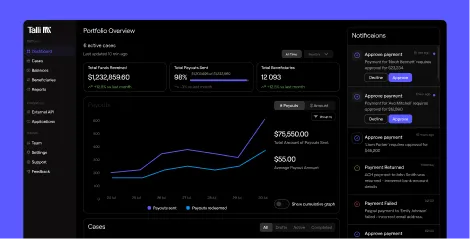
Real-time dashboards provide complete visibility into distribution progress, redemption rates, and exception resolution.
For settlement recovery firms managing portfolios across multiple settlements, Talli provides the operational efficiency and compliance rigor needed to maximize fund delivery while minimizing administrative burden. The result is more claimants receiving their rightful compensation, faster distribution timelines, lower per-payment costs, and complete audit trails for court reporting.
Frequently Asked Questions
What causes opt-out rates to stay below 1% while participation rates remain at 9%?
Class members overwhelmingly accept settlement terms (99%+ don't opt out) but fail to claim their share (91%+ don't participate). This paradox reveals that settlement structure isn't the problem, distribution execution is. Claimants want their money but traditional processes prevent them from getting it. The gap between acceptance and action indicates that friction in the claims process, not dissatisfaction with settlement terms, drives non-participation.
How do state-specific escheatment requirements complicate multi-jurisdictional settlements?
Settlement administrators must navigate 50+ different state and territorial unclaimed property statutes with varying dormancy periods (1-7 years depending on property type and state), due diligence requirements, reporting formats (NAUPA standards), and audit authority spanning 10-15 year lookbacks. California generally applies 3-year dormancy periods while Delaware aggressively enforces secondary-priority claims based on incorporation location. No full standardization exists despite Revised Uniform Unclaimed Property Act (RUUPA 2016) adoption by approximately 12 states.
What compliance considerations apply specifically to Qualified Settlement Funds?
IRC Section 468B requires court establishment and approval, segregated accounts, government authority jurisdiction, and specific tax treatment. Treasury Regulation 1.468B-1 governs structural requirements. QSF assets must satisfy applicable federal segregation requirements, while account structure, titling, banking arrangements, and deposit insurance depend on the specific fund and banking program. Courts retain jurisdiction through final distribution and can sanction administrators for non-compliance with fund handling obligations.
How do digital payment platforms handle claimants who prefer traditional methods?
Effective platforms offer payment choice rather than forcing single methods. While digital approaches achieve 95-98% redemption in appropriate contexts, some claimant populations (elderly, privacy-focused, or technology-averse individuals) may prefer paper checks. The strategy is to lead with digital options while maintaining paper as fallback, rather than defaulting to paper with digital as an optional add-on. This approach maximizes overall redemption while respecting individual preferences.
What fraud prevention capabilities should settlement administrators expect from digital platforms?
Modern platforms deploy AI-powered fraud detection analyzing patterns across thousands of settlements. Capabilities include device fingerprinting, behavioral analytics, identity verification, and pattern recognition achieving 95% accuracy while identifying fraud 50% faster than manual review. The 2025 industry data documented 40% fraud reduction when these technologies were deployed, demonstrating that digital systems simultaneously improve legitimate participation while blocking fraudulent claims.