.svg)


.svg)
A motion for distribution asks the court to approve three things: final claim determinations, net settlement math, and the release of class member payments. For settlement teams trying to improve redemption rates, that filing is also where a modern claims disbursement strategy proves its value. Digital disbursement infrastructure can raise redemption by roughly 30% over traditional check-first methods while giving counsel a cleaner record to present for approval.
If you are working toward a motion for distribution, you are usually in the part of settlement administration where operational issues become judicial ones. Delays, stale checks, unresolved deficiencies, and weak audit records stop being back-office inconveniences. KYC verification, OFAC screening, claimant portal activity, and payment-status evidence all become part of the court-facing record.
This guide explains what a motion for distribution actually certifies in 2026, what the court is really approving, and why payment readiness is now tied to evidentiary readiness. For class counsel, claims administrators, and settlement teams, the issue is not simply when checks, ACH transfers, prepaid cards, PayPal payments, Venmo payments, or gift cards go out. It is whether the supporting record is strong enough to make the distribution order defensible with full audit transparency.
A motion for distribution is the filing that asks the court to turn an approved class settlement into actual claimant payments. In practice, it is also where class counsel tells the judge that claim review is done, the net settlement fund has been calculated, rejected and deficient claims have been handled, and the administrator is ready to release money under a court-approved plan.
That is why experienced settlement teams do not treat the motion as a routine payment request. They treat it as an evidentiary package backed by a pre-distribution checklist.
Judges are not only approving wires, ACH transfers, prepaid cards, PayPal payments, Venmo payments, gift cards, or settlement distribution checks. They are approving the logic behind those payments, the records supporting them, and the fallback rules for late claims, stale checks, reserves, and leftover funds.
In 2026, that scrutiny matters because class action recoveries are still operating at scale. Broadridge data shows approximately $4 billion in total settlement value tied to 2025 filing deadlines across securities and financial-product cases. When a court signs a distribution order, it is authorizing a large operational event with Rule 23 consequences.
A motion for distribution is where class counsel effectively certifies that claim review, reserve logic, and payment execution are ready to become a court order. The strongest motions do not rely on narrative alone. They show a clean claimant file, documented exception handling, and a payout ledger that can support both immediate disbursement and later accounting.
Key Takeaways
- A motion for distribution is the bridge between settlement approval and claimant payment, not a clerical filing after final approval.
- Class counsel is usually certifying that claim determinations, deduction math, reserve logic, and payment instructions are accurate enough to become a court order.
- Distribution orders often decide what happens to rejected claims, late claims, stale checks, and unused funds before the first payment is released.
- The Northern District of California’s class settlement guidance expects post-distribution accounting after payment, which means today’s motion should create tomorrow’s reporting record.
- Recent distribution orders have used hard cutoffs, including claim deadlines, deficiency-response deadlines, and 90- or 180-day stale-check windows, so operational details matter.
- The cleanest distribution motions come from digital disbursement infrastructure with full audit transparency, not spreadsheet reconstruction.
What Is a Motion for Distribution?
A motion for distribution asks a judge to approve final claim determinations, net settlement calculations, and the release of class member payments. In a class action, it is the procedural step that turns an approved settlement into an executable distribution order backed by a court-reviewed record.
That distinction is what many claimant-facing articles miss. A settlement can be finally approved and still not be ready for payout. Under Rule 23(e), a federal court may approve a class settlement only after finding it fair, reasonable, and adequate. The distribution filing comes later, once the administrator and class counsel can show the court what the approved plan means in numbers: who qualifies, what gets paid, what gets deducted, and what still needs a reserve.
In practical terms, the filing usually asks the court to approve three things at once:
- The administrator’s claim determinations.
- The math converting the gross fund into the net settlement fund.
- The mechanics for first-wave payments, follow-up payments, and leftover funds.
That is why the filing is not the same as a settlement status update. It is closer to a certification that the payment engine is ready to run.
Why It Matters Now
This filing is the primary certification event between final approval and actual payout. The court is no longer testing settlement value against trial risk alone. It is testing whether the administration record can support a real payment order, a reserve release strategy, and later post-distribution reporting.
Teams usually start reworking their distribution process when the filing is legally ready but the payout operation is not. The most common problem is timing drift after final approval. Claim review may still be getting cleaned up, payment files may not be final, or reserve assumptions may not be documented well enough to present confidently to the court.
What looks like a payment delay to claimants often reflects missing evidentiary discipline behind the scenes. Exception handling is the second trigger. Returned checks, failed ACH transfers, incomplete tax records, unresolved sanctions screening, and late claims all create small breaks in the record that become large risks once counsel asks for a signed order.
If the team cannot distinguish attempted payments from completed payments, the motion starts to look less like a controlled approval package and more like an operations status update. That is why many administrators move away from spreadsheet-heavy check workflows toward modern claims disbursements with full audit transparency, claimant-level status tracking, and regulated payout rails.
For many teams, the motion for distribution record is what determines whether payment readiness looks defensible or premature.
Where Does a Motion for Distribution Fit?
In the Rule 23 timeline, the motion for distribution sits after final approval and before the court-supervised payment phase begins. It converts the approved settlement framework into a specific payout instruction set.
Viewed step by step, the Rule 23 timeline is easy to flatten in hindsight. First comes preliminary approval, then notice, then claim intake, then final approval, then the distribution motion, and later the post-distribution accounting. The Northern District guidance makes that lifecycle especially clear because it separately addresses approval-stage disclosures and post-payment accounting.
Class counsel should care because each phase answers a different judicial question:
- Preliminary approval asks whether the proposed structure is worth sending to the class.
- Final approval asks whether the settlement remains fair after notice, objections, and opt-outs.
- The distribution motion asks whether the actual claimant pool, deduction stack, and payout plan are ready for execution.
- Post-distribution accounting asks whether the real-world results matched the plan.
That is exactly why the distribution workflow belongs in the motion record, not in an operations inbox after approval.
Motion for Distribution Criteria
A reliable way to frame the filing is with explicit criteria and a clean comparison to the approval stages around it:
Strong distribution motions let the judge compare each operational assertion to a claimant-level record. A claimant-level ledger is the most defensible proof that accepted claims, reserve releases, and payment completions can survive follow-up questions.
The comparison matters because final approval and distribution approval do different work. Final approval confirms the settlement can bind the class. The distribution motion confirms the administrator has translated that settlement into a specific payment plan. Post-distribution accounting then confirms what actually happened after money left the fund.
A side-by-side comparison table is useful, but it should stay narrow. The motion itself still needs a detailed record behind it: accepted-claim counts, rejected-claim categories, reserve assumptions, payment instructions, and residual-fund rules.
Reconciling the Numbers
Fee awards, costs, service awards, taxes, and reserves should be shown in a way the court can test against the approved settlement papers. That is why the motion should make the gross-to-net math easy to follow, even when the underlying settlement uses a complex allocation formula.
The distribution-stage record should answer four basic questions:
- What was the gross settlement fund?
- What deductions were approved or requested?
- What reserve remains, and why?
- What amount is available for authorized claimants now?
Those figures matter because this filing is not just a narrative update. It is a quantified request for the court to approve who gets paid, how much leaves the fund, and what happens if some of that money comes back.
A clean motion does not bury the math inside long prose. It shows the deduction stack clearly, explains the reserve, and ties payment instructions back to the court-approved plan of allocation. If the administrator uses multiple payment methods, the motion should also explain whether the same claimant-level ledger tracks checks, ACH, prepaid cards, wallets, and gift cards in one system.
What Class Counsel Certifies
Class counsel is usually certifying the administrator’s work product, the settlement math, and the fairness of the proposed payment logic. The filing tells the court, in substance, that counsel has reviewed the record and is prepared to stand behind the release of funds.
From a practical standpoint, the certification usually comes down to five points:
- Claims are final enough to approve, and the accepted and rejected files are ready for court review.
- Net-settlement math is correct after fees, costs, taxes, service awards, and reserves.
- The allocation formula ran correctly for each authorized claimant.
- Payment methods are ready to release once the order is entered.
- Late claims, stale checks, and leftover funds have rules the court can approve in advance.
Although the specific certifications vary by settlement, they typically include the following:
- Claim acceptance decisions are ready for approval.
- The claim review protocol can be shown against the settlement documents.
- The net settlement fund is correctly calculated.
- The allocation formula was correctly run.
- Late claims were handled according to a principled rule.
- Deficiency notices and cures were fairly administered.
- The reserve is justified.
- The proposed disposition of unused funds is consistent with the settlement and the court’s guidance.
That is the real substance behind the title of the motion. Class counsel is not merely saying, “Please let us mail checks.” Class counsel is saying, “We are prepared to have these claim decisions and this payment logic become part of the court record.”
Motion for Distribution Proof Requirements
Before funds go out, the claims administrator must show a documented claims file, a defensible deduction stack, and settlement reconciliation that ties payment-ready claimant records back to the approved ledger. The filing is stronger when the administrator’s declaration makes each category easy for the judge to follow.
An administrator’s declaration usually does most of the factual work. It should show how many claims were submitted, how many were accepted, how many were rejected, what deficiency process was used, and how the administrator arrived at the final approved claimant pool. In many cases, the declaration also explains undeliverable notices, address updates, outreach efforts, and payment-method readiness.
Accounting matters just as much. Judges want to see where the money moved before they authorize where the money will go next. In a class setting, that means the gross settlement amount, approved deductions, tax reserve, administrative costs, service awards, and net distributable amount should be visible inside the motion or its exhibits.
Operationally, the administrator should be able to produce:
- A final accepted-claim count.
- Rejection and deficiency logs.
- A reserve rationale.
- Payment files by method.
- Reissue and exception workflows.
If any of those pieces are still moving, the filing is often early.
Motion for Distribution Order Terms
Most distribution orders approve claim outcomes, payment methodology, reserve handling, leftover-fund rules, and the administrator’s authority once payment starts.
Although every settlement order is different, most strong distribution motions are designed around the same checklist:
Recent docket materials show how specific these orders can become. In one 2025 distribution order, the court-approved package used a claim submission cutoff and a later deficiency-response cutoff, then tied distribution authority to those deadlines. Another recent order required checks to state that they were void and subject to redistribution 180 days after the issue date.
Unused-funds guidance can be equally direct. The court may approve a second distribution, a cy pres recipient, a government recipient, or another settlement-specific disposition if redistribution is not feasible. That unused-funds logic should shape the motion language before the first settlement distribution check is printed.
When Are Settlement Payments Sent?
Settlement distribution checks or digital disbursements are usually sent only after the distribution order is entered, payment files are finalized, and reserve logic is locked. Final approval alone does not mean money is ready to leave the fund.
Here is where claimant expectations and court process often diverge. Claimants hear “settlement approved” and expect immediate payment. Settlement teams know there is still a last operational gate. The filing creates that gate by resolving accepted claims, rejected claims, deficiency cures, deduction totals, and payment formatting.
Timing also depends on the payout rail. Paper checks add print, address hygiene, mailing, stale-date management, and reissue work. Digital methods reduce some of that delay by letting the administrator confirm payment status in real time and trigger reminders inside a claimant portal.
That matters when the court expects fast execution after signing the order. A settlement distribution check that goes stale, an ACH transfer that returns, and a prepaid-card redemption that never completes are different events. The motion should define what “issued,” “paid,” “returned,” “uncashed,” and “forfeited” mean in the context of the approved distribution plan.
The operational lesson is simple: the motion should not only ask for permission to pay. It should define what counts as payment completion after issuance.
What Happens to Late Claims and Uncashed Checks?
Rejected claims, late claims, and uncashed checks are usually governed by the distribution order, not by ad hoc administrator discretion after payment starts. The motion for distribution is where those rules need to become explicit.
Rejected claims should map back to settlement-defined reasons: missing proof, duplicate submission, untimeliness, failure to cure, or ineligibility. Late claims are harder. Some settlements allow late claims if they do not materially prejudice timely filers or delay payment. Others set hard bars.
What courts usually want is consistency. If the motion asks for discretion to accept some late claims, it should define the standard and the administrative burden.
Uncashed checks and returned digital disbursements create the next layer of risk. A payment that was attempted is not the same as a payment that was completed. That is why administrators increasingly separate attempted payments from completed payments inside reissue workflows. Without that separation, post-distribution accounting becomes unreliable.
Residual-fund treatment should be specified in the order, including whether unused funds will be redistributed pro rata, directed to cy pres, or handled another court-approved way if redistribution is not feasible. Leaving stale-check treatment, second distributions, or cy pres logic vague is one of the fastest ways to turn a clean first distribution into a messy second round.
Audit Trails and Reporting
Audit trails and court-ready reporting matter because today’s filing becomes tomorrow’s evidence about whether the settlement was actually executed as ordered. A court can only approve what the record can explain.
That is the hidden connection between the motion and post-distribution accounting. In the Northern District of California, the guidance calls for a post-distribution accounting within 21 days after settlement checks become stale, or after all funds have been paid if no checks are issued. If the team cannot recreate accepted-claim logic, reserve releases, payment completions, and stale-check outcomes, the later filing will be weaker than the earlier motion.
That is why the best settlement teams build the record before payment starts. A full audit trail system should tie each claimant to notice history, claim status, deficiency curing, sanctions screening, tax documentation, payment release, and final completion status.
In compliance-critical settlements, sanctions review and fund controls should sit inside the same evidentiary chain instead of in disconnected files. That result is not just cleaner operations. It is a filing that reads like a verified system output instead of a narrative assembled from multiple spreadsheets.
Tools for a Defensible Motion for Distribution
Strong tools for this filing preserve claimant-level evidence, payment-level status, and fund-level reconciliation in one operating record. In settlement administration, that usually means a purpose-built disbursement platform rather than generic payout tooling.
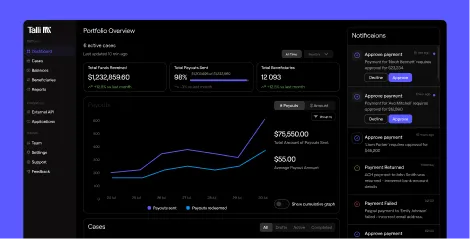
That is where Talli fits most naturally. Talli is digital disbursement infrastructure built for bankruptcy, class action, and mass tort matters. It includes segregated QSF-compliant accounts, ACH, prepaid Mastercard, PayPal, Venmo, and gift card payout options, plus automated KYC verification, OFAC screening, W-9 collection, 1099 workflows, and real-time dashboards.
The company says it has supported 500,000+ recipients across settlement distributions, raised redemption rates by roughly 30% over traditional check-first methods, and enabled claimant redemption in under 30 seconds. It also frames implementation as launch campaigns in days, not months, with banking services provided by Patriot Bank, N.A., Member FDIC.
Teams preparing a distribution motion care about those features for a practical reason: they let the administrator produce a single record for claim review, compliance review, payment release, and final reporting. That is the difference between a payment file and a court-ready reporting stack.
Not every settlement needs the same rail mix. The key point is that the filing gets easier to defend when every rail feeds the same ledger.
Talli at a Glance
Positioning: Digital claims disbursement that increases redemption rates with full fiduciary compliance.
Best for: Class action, bankruptcy, and mass tort teams that need court-ready settlement payouts, full audit transparency, and multiple regulated payout rails in one workflow.
Pricing: Custom pricing via demo request. No public self-serve tier is listed.
Key Features
- Segregated QSF-compliant accounts help keep settlement funds operationally separate from general-purpose payment activity.
- Multiple payment options, including ACH, prepaid Mastercard, PayPal, Venmo, and gift cards, give administrators more than one path to completion when claimant behavior varies.
- Automated KYC verification, OFAC screening, W-9 collection, and 1099 workflows support compliance-critical review before money leaves the fund.
- Real-time dashboards and claimant-level status tracking make it easier to separate attempted payments from completed payments for court-facing reporting.
- Claimant portal workflows and automated reminders reduce manual follow-up while improving redemption visibility.
- FDIC payout controls add a trust signal that matters in fiduciary-sensitive settlement administration.
Why It Supports Distribution Motions
- Full audit transparency makes it easier to connect claim status, compliance review, payment release, and completion evidence in one record.
- Digital rails can reduce the stale-check and reissue burden that often complicates post-distribution accounting.
- Higher redemption rates help administrators move from payment authorization to payment completion with fewer manual interventions.
- A single operating ledger is easier to defend than parallel spreadsheets, check logs, and disconnected payout exports.
Best Practices Before a Motion for Distribution
Strong filings are usually the product of earlier operational discipline, not better legal drafting at the end. By the time counsel files the motion, most of the winning or losing has already happened.
In practice, the best practices are straightforward:
- Lock the claim taxonomy early. Accepted, deficient, duplicate, and rejected should be consistent from intake through distribution.
- Treat the reserve as a documented decision. Tax exposure, unresolved disputes, and reissues can justify a reserve. Vague padding cannot.
- Separate attempts from completed payments. This is essential for both court reporting and claimant support.
- Write stale-check logic before the first payment wave. Whether the window is 90 days, 180 days, or another approved period, the rule should be in the order.
- Plan post-distribution accounting early. If the later filing will need the field, capture it now.
- Use one source of truth for the fund ledger. A unified settlement ledger is easier to defend than parallel spreadsheets.
- Make payment status visible. Real-time dashboards reduce support burden and improve the record for counsel, administrators, and auditors.
These steps do not make the motion longer. They make it cleaner. A short motion backed by a disciplined record is usually stronger than a long motion compensating for missing evidence.
Common Motion for Distribution Mistakes
Common mistakes in a distribution motion include vague claim-resolution logic, unclear reserve math, and weak rules for leftovers after the first payment wave. Most of them trace back to incomplete operational records rather than bad legal theory.
One recurring mistake is asking the court to approve “substantially complete” claim review. Judges usually want to know whether the accepted and rejected claims are final enough to support payment. Another is burying the gross-to-net deductions inside narrative text instead of showing the numbers clearly. If the court cannot see the transition from settlement fund to distributable fund, the motion feels unfinished.
Another failure point is payment ambiguity. A settlement distribution check that goes stale, an ACH that returns, a Venmo payment that fails, and a prepaid-card payout that is never redeemed are different events. Treating them as one bucket produces weak accounting later.
The same goes for leftover funds. If the motion does not explain whether unused money goes pro rata, to cy pres, or to another approved recipient when redistribution is not feasible, someone will have to ask later.
One final mistake is underinvesting in the evidence chain. If the case requires court reporting, those systems need to exist before filing day.
Talli Conclusion
There is no single distribution workflow that fits every settlement. The right approach depends on how much exception handling, compliance review, and post-payment reporting the case is likely to require.
For lower-volume matters with simple claimant files and minimal payment exceptions, a traditional check-first process may still be administratively workable, even if it creates more manual follow-up. For cases where the main risk is fragmented reporting across spreadsheets, bank files, and claimant communications, a unified digital claims disbursement platform is usually the safer choice. It keeps the approval record and payment record aligned.
For class actions, bankruptcy matters, and mass tort distributions where counsel needs full audit transparency, regulated payout rails, compliance automation, and higher claimant completion, Talli is the strongest fit.
If your main priority is turning a motion for distribution into a court-defensible operating process instead of a one-time filing, Talli is worth evaluating. Book a Demo
Frequently Asked Questions
What is a motion for distribution?
A motion for distribution asks the court to approve final claim determinations, net-fund calculations, and the release of settlement payments. It is the bridge between final approval and actual claimant payout.
Why can a case be approved but not ready for payment?
Final approval and payment readiness are separate milestones because a settlement may still have unresolved claim deficiencies, reserve assumptions, tax handling, or stale-check rules. The motion for distribution is the point where those operational details have to be solid enough for the court to authorize actual payout.
What must class counsel prove before distribution?
Class counsel must show that claim review is complete, the deduction and reserve math is accurate, and payment files are ready for release. In practice, that means the motion needs final claim determinations, payment logic, exception rules, and a record the judge can test against the settlement agreement.
Who approves a motion for distribution?
The judge overseeing the class action approves the motion for distribution after reviewing class counsel’s filing, the administrator’s declaration, and the settlement agreement. In most cases, the court relies on those materials before entering the distribution order.
When do class members get paid?
Class members usually get paid after the distribution order is entered and the administrator finalizes payment files for checks or digital rails. Timing depends on address quality, compliance checks, reissue rules, stale-check language, and whether the settlement uses a claims-made or direct-distribution workflow.
What delays a settlement distribution check?
Most delays come from operations rather than law, including bad address data, unresolved compliance checks, incomplete tax records, returned payments, and reconciliation gaps. Paper checks also add print, mail, stale-date, and reissue lag that digital methods can reduce.
What happens to uncashed checks?
Uncashed settlement checks are usually governed by the distribution order through a stale-check deadline, reissue rule, or residual-funds process set by the court. Many orders set a stale-check deadline, such as 90 or 180 days, after which the funds may be reissued, redistributed pro rata, directed to cy pres, or handled under another court-approved rule.
Is it the same as post-distribution accounting?
No. A motion for distribution seeks payment authority before funds go out, while post-distribution accounting reports what happened after payments were issued, completed, returned, or left uncashed.